

Open innovation in Portugal: get the corporate mandate first
Planning open innovation in Portugal? Learn how to line up a corporate sponsor, agree on a paid pilot budget, and decide what comes after the test.

Your corporate contact likes the idea and says, “Send me something I can share internally.” Does what you send explain why your company should run the program, or just why the program sounds worth running? There is a meaningful difference. An innovation program can sound attractive in a meeting, yet remain impossible for the corporate sponsor to advance. The business unit has not agreed to participate. There is no budget for a test. Nobody has identified who will make the decision afterward. And the company proposing the initiative has not explained why it is the right organization to deliver it.
For founders and emerging innovation operators, the first challenge is not recruiting startups or designing an open call. It is securing a mandate that connects the corporate's business problem to a credible delivery team, resources and a decision.
Portugal offers several useful examples of how these relationships can be structured, from scouting and matchmaking to formal program co-management and paid pilots. They are not all the same commercial model, and that distinction matters when developing your own offer.
Are you selling a solution or operating an innovation program?
The Garwood Center at UC Berkeley describes open innovation through the exchange of knowledge and technology across organizational boundaries. For a founder, that broad concept can translate into two very different propositions.
A startup selling its own technology needs a customer with a relevant problem and a way to validate the solution. An innovation operator, on the other hand, needs to establish why the corporate should delegate part of the challenge definition, scouting, selection or coordination process to it.
| Proposition | What the corporate is buying | Evidence to bring |
|---|---|---|
| Bilateral pilot | A test of your own technology | Product maturity, relevant tests, delivery capability |
| Scouting and matchmaking | Access to and evaluation of potential solutions | Search methodology, sector knowledge, relevant network |
| Program co-management | Coordination of a defined innovation process | Governance, delivery team, track record and reporting |
If you intend both to run the selection process and compete for its pilot budget, declare that dual role. Agree in advance who evaluates participants and how conflicts are handled. Otherwise, your commercial proposition risks undermining the legitimacy of the program itself.
Make your company easy to introduce
The corporate sponsor is not necessarily the person who will approve your proposal. They may need to send it to a business-unit director, procurement team or technical colleague who has never met you.
Start with the information that this second audience needs: what category of company you are, whom you serve, what you deliver, your closest relevant proof point and who is accountable for delivery.
A systematic review of new-venture branding connects brand building with legitimacy, consistent communication and stakeholder interactions. That is a useful lens for understanding why the same company should be recognizable across its website, capability statement and proposal. It is not evidence that visual polish alone wins corporate contracts.
A Portuguese study of B2B construction-services purchasing offers a useful counterweight: brand reputation mattered, but functional criteria generally ranked higher, with variation across purchasing situations. This is evidence from a particular sector, not a study of startup procurement. Nevertheless, it raises the right question: does your brand make relevant capabilities easier to evaluate, or simply make the company look established?
Consider a fictional operator positioning statement:
Before: We are a leading innovation platform transforming retail.
After: We help retail operations teams find and test tools for one workflow at a time. For this proposal, we will source and screen vendors; your store operations lead selects the pilot. Our proposal identifies the closest relevant project and its delivery lead.
The second version makes the category, customer, scope and authority legible. If the company has never delivered a comparable project, it should show a sample methodology or explicitly attribute relevant experience to its team members' previous roles. Borrowed experience should not become a fictional company track record.
How to get a corporate mandate for open innovation in Portugal
Before building a program, identify three corporate roles: the sponsor who champions it, the business owner whose workflow needs improvement, and the person authorized to approve funding or initiate procurement. The same person may fulfill more than one role, but do not assume this.
Nesta's guidance on working with startups emphasizes sponsorship, budget authority and starting small. Applied to a proposed innovation program, this suggests a practical sequence:
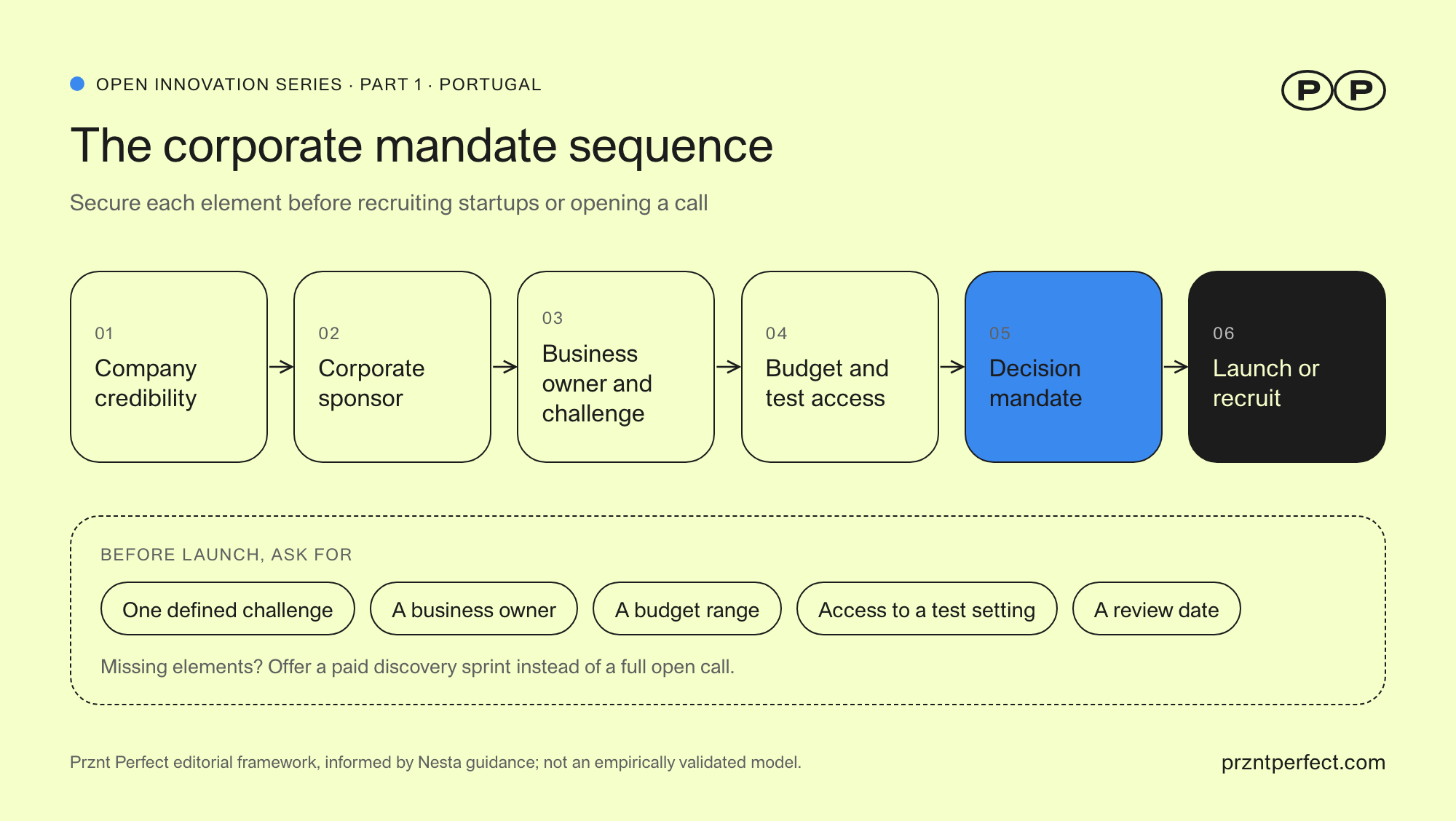
Figure 1. Proposed mandate sequence. Prznt Perfect editorial framework, informed by Nesta guidance; not an empirically validated model.
Ask for a single defined challenge, a business owner, a budget range, access to an appropriate test setting and a date for reviewing the result. Separate the fee for operating the program from the money available to participants for implementation or testing.
If those elements are missing, offer a paid discovery sprint instead of a full open call. The output can be a prioritized problem, verified operational constraints, a draft selection method and an approval-ready pilot brief. The corporate can then approve or stop before either side invests in recruitment.
What Portuguese programs illustrate
Dealflow.eu: the value of sourcing and matchmaking
Dealflow.eu describes actively scouting against corporate challenges alongside its matchmaking platform. Its June 2026 announcement also describes Corporate Innovation Days involving companies including Galp, P&G and ABB.
For a prospective operator, this illustrates a specific service proposition: identify relevant technologies and facilitate connections. It does not establish that the operator runs Galp's own program, nor that an introduction becomes a funded pilot. If matchmaking is your offer, define the evaluation and handoff deliverables rather than claiming ownership of downstream commercial outcomes.
Vodafone Portugal and Beta-i: co-management with formal responsibilities
The Vodafone Business open innovation program terms name both Vodafone and Beta-i as managers, describe a pilot-development phase and require a service agreement before execution.
This is a more formal arrangement than an introduction. It shows why a program proposal needs to explain responsibilities, selection and contracting, not just the recruiting funnel. Beta-i is the established operator in this example, not a participating startup. The terms do not establish completed pilots or follow-on purchases.
Protechting and SANDORA: a paid pilot as a milestone
The Protechting terms identify Fábrica de Startups as powering the program. In a testimonial published by Protechting, SANDORA's founder reports that its relationship with Fidelidade resulted in a paid pilot.
That is a meaningful commercial milestone: according to the founder, the relationship moved beyond exposure into funded work. It is not evidence that every participant receives a paid pilot or that SANDORA achieved a wider rollout.
Galp and Jungle: a separate example of a later decision
In its 2024 announcement, Jungle said Galp chose to expand its power-forecasting service across its renewables portfolio following a successful backtest at one site.
This illustrates the type of decision a test may support. The announcement is supplier-reported, not independent confirmation of full deployment. It should not be attributed to Dealflow.eu or treated as a continuation of any of the preceding cases.
| Case | Documented relationship | What remains unestablished |
|---|---|---|
| Dealflow.eu | Scouting and corporate matchmaking | Pilot or purchase resulting from an introduction |
| Vodafone / Beta-i | Program co-management and contracting structure | Completed pilots or purchases |
| Protechting / SANDORA | Founder-reported paid pilot with Fidelidade | Wider rollout or universal participant payment |
| Galp / Jungle | Supplier-reported expansion decision | Independently verified full deployment |
The two-page proposal your sponsor can forward
Build two pages around different decisions. The first establishes the company as a credible delivery partner. The second defines what the sponsor is being asked to approve.
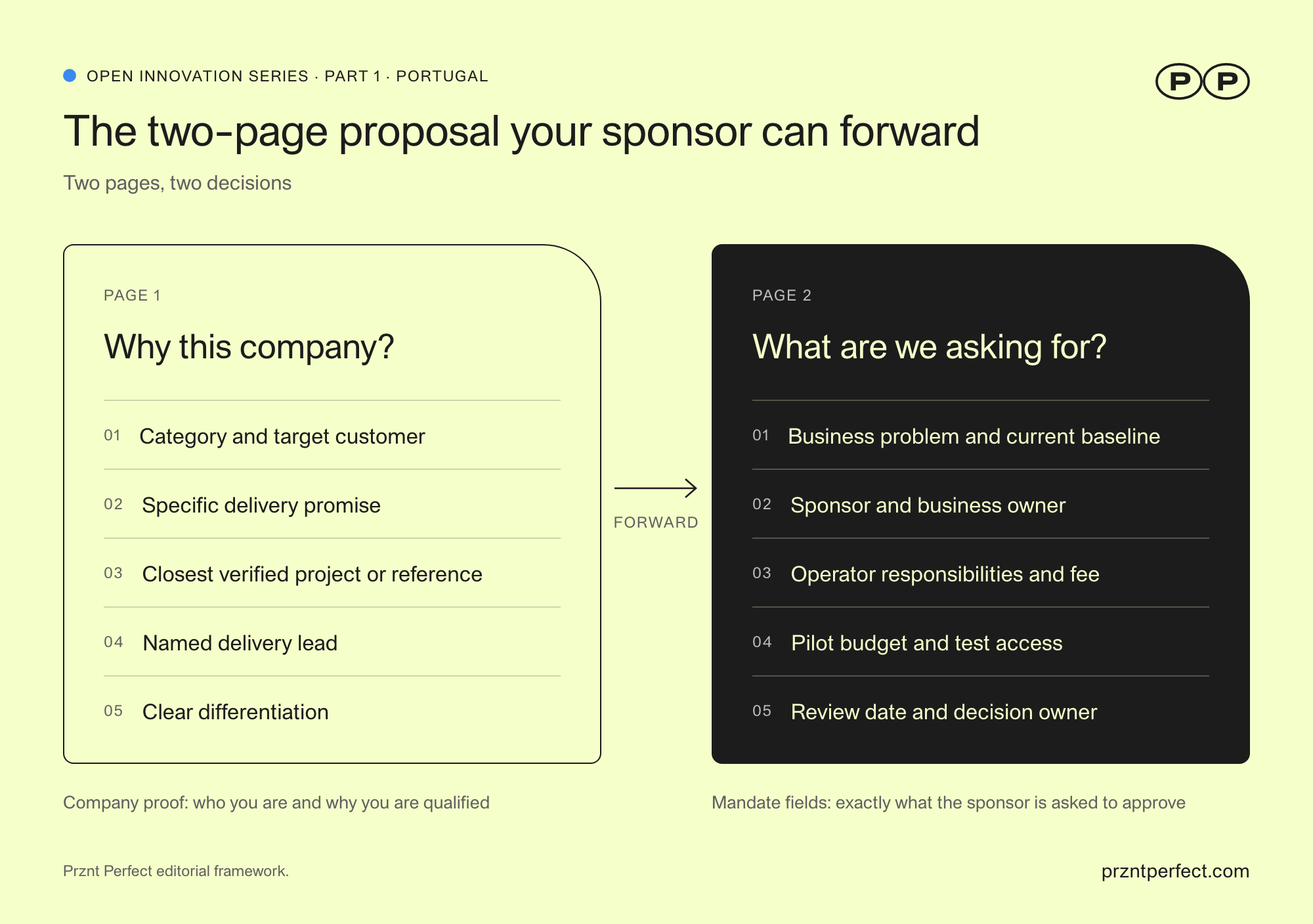
Figure 2. Sponsor-forwardable pitch: company proof on page 1, five mandate fields on page 2. Prznt Perfect editorial framework.
The test for this material is simple: could someone who missed your meeting explain what your company does, why it is qualified and exactly what approval you need? If not, the problem may be positioning and information architecture, not a lack of slides.
Where brand strategy meets corporate innovation
At Prznt Perfect, we approach positioning, brand identity and presentation design as parts of the same communication system. Our quantum security branding case illustrates how an identity that no longer reflected a company's maturity could be updated and extended across presentation and other touchpoints. It is an example of design work, not evidence of corporate adoption or participation in a Portuguese program.
For an innovation operator, the equivalent challenge is to make the company recognizable and its offer understandable as the proposal circulates through the corporate. The sponsor's decision should be supported by a credible company profile, a coherent proposal and clearly attributed evidence. The actual mandate, budget and authority must come from the corporate.
Sharpen your corporate pitch. Talk to Prznt Perfect about positioning and building the brand and presentation system behind your innovation proposal.
Next in the series: Open innovation in Spain: From challenge to paid pilot. For multi-partner programs, see Open innovation in the Netherlands: From pilot to buyer.