

Deep-tech commercialization: from prototype to a paid pilot
A practical guide to deep-tech commercialization, from technical validation and federal R&D funding to customer discovery, paid pilots and procurement.

A laboratory breakthrough is not a commercial product. Neither is a successful fundraising round, a research grant or a signed letter of intent. Each can be a meaningful milestone, but each answers a different question. Deep-tech commercialization is the process of turning research-intensive technology into a solution that a customer can evaluate, purchase and deploy. The difficulty is that technical, operational and commercial uncertainties often develop on different timelines. A technically mature component can still lack a credible manufacturing process or a buyer with an approved budget.
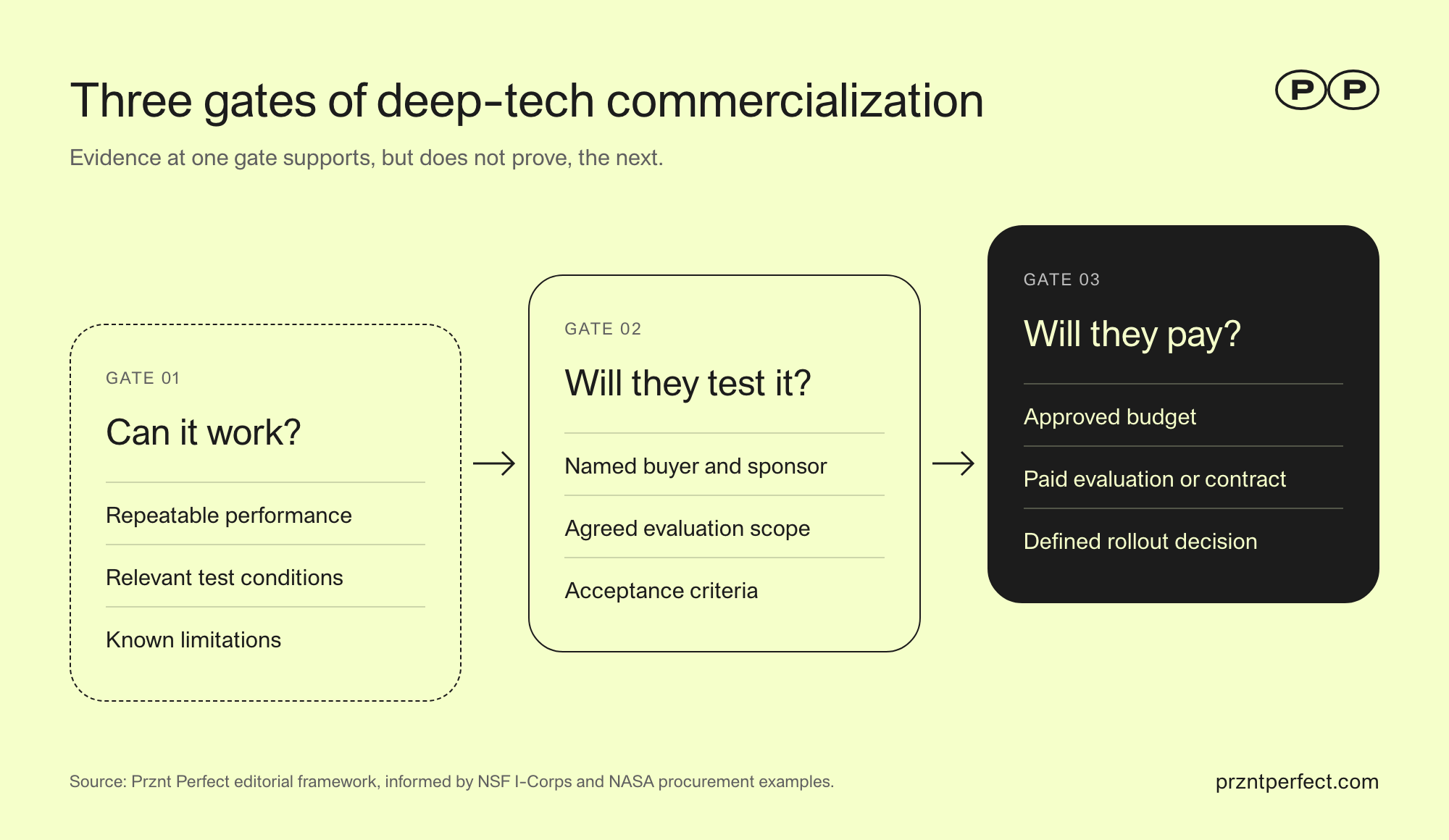
For founders, the path becomes more manageable when three questions are treated separately: Can it work? Will a specific buyer test it? Will that buyer pay to deploy it?
Technical readiness is not commercial readiness
Technology readiness levels describe technical maturation, but they do not, by themselves, establish the market, procurement pathway, pricing, unit economics or manufacturing repeatability of a product. Even a promising prototype can have an uncertain commercial path.
One useful way to think about maturity is to track several dimensions of evidence in parallel. This is a Prznt Perfect editorial framework, not a standardized readiness scale or an empirical predictor of funding success.
| Dimension | Early evidence | Stronger evidence | Risk remaining |
|---|---|---|---|
| Technical performance | Laboratory observation | Repeatable benchmark under relevant conditions | Reliability at deployment |
| Customer need | Interviews and stated interest | Named buyer, documented problem and evaluation request | Willingness to pay |
| Manufacturing or delivery | Single prototype | Repeatable process and validated suppliers | Yield, capacity and cost at scale |
| Procurement | Informal sponsor | Budget owner, scope and purchasing pathway | Contract approval |
| Economics | Modeled savings | Measured customer economics in pilot | Repeatable margins |
| Organizational readiness | Research team | Complementary commercial and technical owners | Ability to deliver repeatedly |
The distinction matters because the next investment should address the binding constraint. If performance is promising but manufacturing yield is unknown, customer interviews cannot solve that engineering problem. If a product works but the economic buyer has no budget, another benchmark may not create a sale.
The commercialization staircase
The following lifecycle describes the evidence founders need to develop, not a universal chronology of financing rounds. A team may revisit a stage when a new application or buyer changes the requirements.
| Stage | Evidence to establish | Useful artifact | Decision maker |
|---|---|---|---|
| Research to venture | Repeatable result, usable IP, plausible application | Non-confidential technical overview | TTO, cofounders, early investors |
| Discovery | Named user, problem, buyer and competing alternatives | Customer discovery log, application map | Technical sponsor, founder |
| Prototype to pilot | Relevant test data, agreed scope, acceptance criteria | Pilot brief and evaluation plan | Technical evaluator and buyer |
| Pilot to contract | Results, economics, operational integration and buying pathway | Pilot report, business case, proposal | Budget owner and procurement |
| First sales to growth | Repeatable demand, margins, delivery capacity | Commercial metrics, investor deck, board reporting | Customers, growth investors, board |
Gate one: can it work?
A prototype should answer a clearly defined technical question. What performance baseline does the company use? Does the test environment approximate real operating conditions? Is the result reproducible, and what are the limitations? An impressive percentage improvement without a baseline or comparison method is difficult for a potential technical partner to evaluate.
For semiconductor and photonics teams, this stage may involve material characteristics, thermal performance, process integration, yield or packaging. For enterprise cybersecurity, it may involve detection coverage, false positives, deployment architecture and workload impact. The relevant evidence depends on the intended application.
Gate two: will a specific buyer test it?
Positive feedback from interviews is useful, but it is not a pilot agreement. The NSF I-Corps program uses customer discovery to investigate assumptions about customers and markets. A company should identify not just a potential user but the stakeholder who owns the operational problem, the evaluator and the person with the authority and budget to fund an evaluation.
A pilot should have an explicit hypothesis: under specified conditions, the technology will meet a threshold that matters to the buyer. Without agreed success criteria, the startup may complete a technically interesting project without knowing whether the result qualifies it for procurement.
Gate three: will the buyer pay to deploy it?
A paid pilot is stronger evidence of willingness to fund an evaluation than an unpaid proof of concept. It is still not equivalent to recurring revenue, a production rollout or product-market fit. The scope, acceptance criteria and commercial terms of the pilot determine what it actually proves. The founder should know which decision follows a successful test and who owns it.
Case study: HEXAspec and the semiconductor commercialization path
HEXAspec is a Rice University spinout developing packaging materials for semiconductors. Its story demonstrates how research teams can combine commercial discovery and non-dilutive R&D funding without conflating those mechanisms with sales.
According to Southwest I-Corps' case study, the company used customer discovery to examine assumptions about its technology and industry applications. The federal SBIR award record lists a 2026 NSF Fast-Track award of $1,554,959 for development of advanced hexagonal boron nitride composite semiconductor packaging.
The distinction is essential: this amount is an R&D award, not a venture financing round or a purchase by a semiconductor customer. Industry validation and manufacturing scale-up were described as next steps in the I-Corps account. The sources do not establish a named paying customer or production deployment.
| Milestone | What it indicates | What it does not demonstrate |
|---|---|---|
| University research and spinout | A technical foundation and venture formation | Manufacturing scale or demand |
| I-Corps discovery | Structured investigation of industry assumptions | Signed pilot agreement |
| $1.55m SBIR Fast-Track award | Competitive public funding for R&D | Customer revenue or equity raised |
| Industry validation and scale-up plans | Next areas of work | Completed validation or volume production |
The commercial question following a research award is not how to present the award as traction. It is how to use the funded development to obtain evidence that a target buyer can evaluate.
Finding the right infrastructure for the next technical milestone
One of the benefits of a geographically distributed innovation economy is that a company can access specialist capabilities without necessarily building all of them internally. But facilities are only useful if their processes match the design, the access terms are workable and the results can be transferred to subsequent development or manufacturing.
| Next milestone | U.S. example | Questions to resolve |
|---|---|---|
| Silicon photonics prototype | AIM Photonics multi-project wafer services, through Albany NanoTech, with test and packaging capabilities described in Rochester | Process compatibility, submission rules, lead time, pricing, packaging and iteration |
| Heterogeneous integration and advanced packaging | Texas Institute for Electronics, Austin | Which tools are operational, who can book access, process transfer to production |
| Research-intensive prototyping | DOE Lab-Embedded Entrepreneurship Program | Fellowship eligibility, access terms, lab expertise and IP arrangements |
| Manufacturing development | Manufacturing USA | Appropriate institute, partnership terms, technical fit and production pathways |
| Paid industrial pilot | Target buyer, informed by I-Corps customer discovery | Decision owner, budget, test protocol, acceptance and decision date |
Facility plans are not equivalent to currently bookable capacity. Contact operators before committing to dates or budgets. A prototype service also does not prove a process can be replicated at industrial volumes.
A complementary example: memQ
Quantum connectivity company memQ illustrates another combination of mechanisms. The Department of Energy's commercialization account describes Energy I-Corps participation, prototype development with Argonne's LEEP node and a $2.5 million private pre-seed round. The example shows that discovery, lab infrastructure and private financing can be complementary. It does not establish that the public programs caused the investment or that a customer paid for deployment.
How public development funding can connect to procurement
A federal research award and a public-sector sale are different transactions. The government can serve both as a sponsor of development and as a customer, but the programs, contractual obligations and acceptance mechanisms differ.
NASA's Commercial Orbital Transportation Services (COTS) program offers an instructive historical example. NASA used development and demonstration agreements and separate Commercial Resupply Services contracts to purchase cargo transportation missions. See the NASA Inspector General report and NASA's program account.
The point is not that a federal R&D award automatically converts into a contract. Rather, development and procurement can form connected but separate mechanisms. A startup pursuing a public-sector customer must understand who can purchase the solution and how the purchasing process works, not simply identify an agency that supports its technology area.
| Financing mechanism | Primary purpose | Evidence it provides |
|---|---|---|
| R&D award | Finance eligible development | Award selection; subsequent results require verification |
| Equity financing | Fund company growth and risk-taking | Investor commitment, not customer demand |
| Unpaid evaluation | Test performance or application | Evaluation activity; no payment established |
| Paid pilot | Fund a scoped evaluation | Customer commitment to that evaluation |
| Production contract | Purchase defined product or service | Contractual commitment, subject to terms and delivery |
| Recurring deployment | Continued use and purchase | Stronger evidence of repeatability, subject to margins and retention |
Structure a pilot around the decision that follows
A pilot should be designed backwards from the buyer's decision. Imagine a hypothetical thermal material company selling to a packaging manufacturer. Its technical team wants to demonstrate performance in a relevant operating environment. The buyer wants to understand compatibility, costs and integration risks. These interests overlap, but they are not identical.
Before beginning work, the company should seek agreement on the following pilot charter. The example is illustrative and not based on disclosed client information.
| Pilot charter field | Questions to answer |
|---|---|
| Problem | What operating constraint is expensive or limiting today? |
| Ownership | Who experiences the problem, evaluates the result and approves the budget? |
| Scope | Which process, samples, sites or configurations are included? |
| Baseline | Which current solution will be used for comparison? |
| Acceptance | Which measured thresholds qualify as success? |
| Responsibilities | Who provides materials, equipment, data and labor? |
| Economics | How is the pilot priced; how will rollout economics be evaluated? |
| Risk | What safety, confidentiality, quality, security or regulatory requirements apply? |
| Decision date | Who reviews the results and when? |
| Next step | Does acceptance trigger a purchase review, another test or a rollout decision? |
A useful pilot does not necessarily end in a sale. A negative result can identify an unsuitable application before more resources are committed. An inconclusive result, by contrast, may be costly if the test was not designed to support a decision.
Communicating evidence to three different audiences
Prznt Perfect works at an interface that is particularly important in deep tech: translating the evidence produced by engineering and commercial teams into a format that helps someone else make a decision. The goal is not to change the facts for each audience. It is to change the relevance, hierarchy and framing of the same facts.
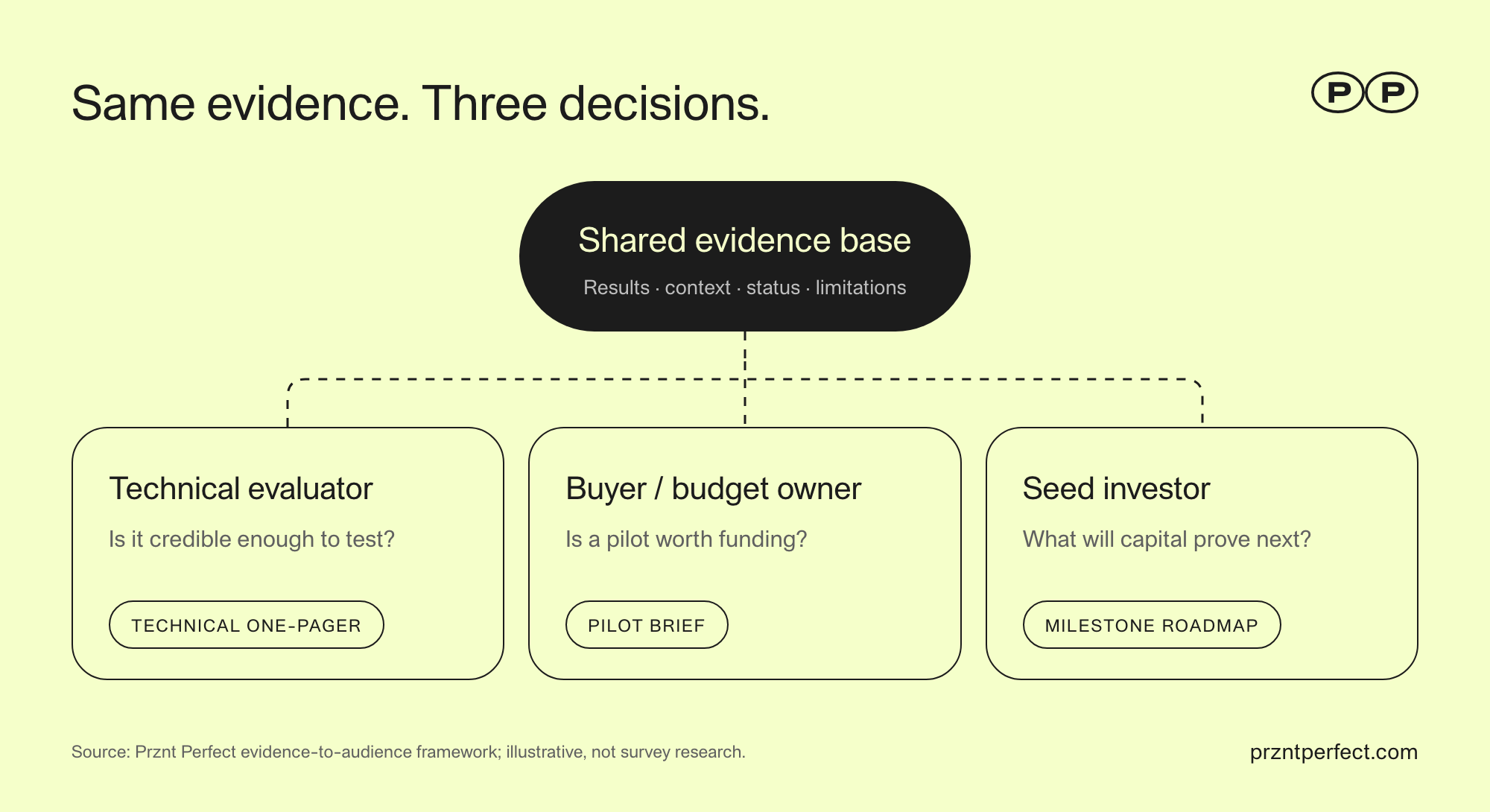
Consider a hypothetical packaging material. Assume a laboratory experiment reports a 15% reduction in thermal resistance relative to a named incumbent material under one set of test conditions. The figure is invented solely to explain the method; no actual client or company result is implied.
A technical evaluator
Decision: Is this result credible enough to test in our environment?
Lead with the comparison, measurement method, sample conditions and limitations. Show the result as a labeled benchmark, not as a universal performance claim. If the experiment does not prove reliability after repeated thermal cycling, say so explicitly. A technical one-pager could be structured around the observed result, protocol, integration requirements and proposed next test.
A buyer or budget owner
Decision: Is a pilot worth funding, and what would justify a subsequent deployment?
Lead with the operational constraint and its economic relevance. Explain what the pilot will test, what participants must provide and how success will be judged. Translate thermal performance into a potential business benefit only as a hypothesis unless the connection has been validated. A 15% thermal resistance improvement is not automatically a 15% cost or energy saving.
A seed investor
Decision: What risk has already been reduced and what will the next financing milestone establish?
Place the laboratory finding in a roadmap, the backbone of a credible startup fundraising deck, that distinguishes measured results, customer discovery status and manufacturing uncertainties. Show how funding supports the next validation step and what outcome would increase the company's commercial options. Do not describe prospective buyers as contracted customers, or projected sales as actual revenue.
| Audience | Primary question | Suggested artifact | Avoid |
|---|---|---|---|
| Technical evaluator | Does it merit another test? | Benchmark card, technical one-pager | Unsupported generalization |
| Buyer | Is the evaluation worth paying for? | Pilot charter, business case | Unverified savings claims |
| Investor | What does the next capital unlock? | Milestone roadmap, investor deck | Treating pipeline as revenue |
Original Prznt Perfect framework and hypothetical example; not survey evidence or a verified customer case.
One evidence registry, multiple narratives
As the company matures, it becomes difficult to keep sales materials, pitch decks and technical briefs synchronized. A shared evidence registry can record each claim, source, date, testing context, validation status, owner and permitted audience. Teams can then adapt an investor presentation or buyer document without changing the underlying assertions.
| Claim identifier | Evidence | Status | Permitted wording |
|---|---|---|---|
| T-01 | Hypothetical lab benchmark | Measured in specified lab conditions | “15% lower thermal resistance in the specified test” |
| C-01 | Hypothetical interview feedback | Discovery, not contract | “Interviewees identified thermal constraints” |
| M-01 | Hypothetical scale-up target | Planned | “Next milestone: test repeatability at pilot scale” |
This approach is also useful when building AI-pluggable brand systems: teams can scale content production while keeping claims traceable and preventing a model or a human author from turning a target into an achieved result.
What to do next
Before raising the next round, opening a new office or building another prototype, identify the uncertainty that most limits the company's progress. Is it technical performance, a suitable application, customer economics, production repeatability or the procurement process? Which piece of evidence would change a decision? Which partner can help generate it?
The answer may point to a laboratory, a specialized innovation hub, a research award, an industrial design partner or a particular investor. Our companion guide, The U.S. startup ecosystem in 2026, maps these mechanisms and regions.
A compelling pitch cannot substitute for evidence. But evidence can also fail to move a decision when the relevant context is missing. Building a clear, consistent representation of what the technology has demonstrated and what remains to be proven is part of the commercialization journey.
See how we approached this for a semiconductor startup, or talk to Prznt Perfect about your next investor or customer presentation.