


The U.S. startup ecosystem in 2026: hubs, capital and scale
Explore U.S. startup hubs, venture funding and federal programs, and learn how deep-tech founders move from research to customers and scale.
The United States has the world's highest-ranked startup ecosystem, but it is not one homogeneous market. A semiconductor company looking for a packaging partner, a cybersecurity startup pursuing a first federal customer, and a fintech team selling to banks face fundamentally different location decisions. The useful question is not which city ranks highest. It is where the company can obtain the next piece of evidence that changes its prospects.
This guide maps the institutions, capital, infrastructure and customers that make up the American innovation economy, with particular attention to companies commercializing complex B2B technology.
The scale of the ecosystem, and what the numbers conceal
The U.S. startup ecosystem is the network of entrepreneurs, researchers, investors, technical facilities, talent, customers and institutions that enables new ventures to form and grow. High-growth startups are only one part of that network: the Census Bureau's business formation statistics describe a broader population of business applications and formations, not a count of technology startups.
According to StartupBlink's 2026 index, the United States ranks first globally, with 226 cities in the global top 1,000. That geographical breadth matters. A founder does not need to live in Silicon Valley to participate in the American startup economy, although access to specific investors and buyers may justify a presence there.
The funding picture is more concentrated than the national headline suggests. The Q3 2026 PitchBook–NVCA Venture Monitor reports $515.8 billion of U.S. venture deal value from January through September 2026, with AI accounting for 82.7%. That percentage changes the interpretation: record aggregate investment does not establish that a non-AI seed company has an easier fundraising environment.

| Indicator | Period | Value | Interpretation |
|---|---|---|---|
| U.S. venture deal value | Jan–Sep 2026 | $515.8bn | Transactions, not startup revenue |
| Estimated venture deals | Jan–Sep 2026 | 14,199 | Deals, not unique companies |
| Venture deal value | Q3 2026 | $98.4bn | Quarterly activity |
| Estimated venture deals | Q3 2026 | 5,012 | Quarterly transaction count |
| AI share of deal value | Jan–Sep 2026 | 82.7% | Capital concentrated by category |
| Deals of $100m+ | Q3 2026 | ~5% of count; ~75% of value | A small number of transactions drives total dollars |
| VC fund capital raised | Jan–Sep 2026 | $108.5bn | Commitments to investment funds, not startup investment |
Source: PitchBook–NVCA Venture Monitor, Q3 2026, pp. 9, 11; NVCA quarterly summary. Figures are dated estimates where applicable.
Geography tells a similar story. The Bay Area and New York together account for 52.9% of deal value but 34.2% of deal count in the report's geographic breakdown (p. 14). Capital concentration and the distribution of transactions are related but not identical. The two regions are important, yet most deals by count are outside them.
Sector-specific conditions matter just as much. MassBio's 2026 Industry Snapshot reports $3.45 billion of venture financing for Massachusetts-headquartered biopharma companies in the first half of 2026, up 25% year over year. Its average seed round, however, declined from $7.65 million to $4.65 million. A recovery in total funding can coexist with tighter financing at entry stages.
For a founder, the practical implication is simple: benchmark against companies at a comparable stage, in a comparable sector, raising money for a comparable risk. National deal totals are context, not a fundraising forecast.
The eight layers of the American startup ecosystem
A startup ecosystem is better understood by function than by a list of logos. Universities can generate intellectual property and talent; corporations can invest, provide test environments and buy products. The same organization may therefore operate across several layers.
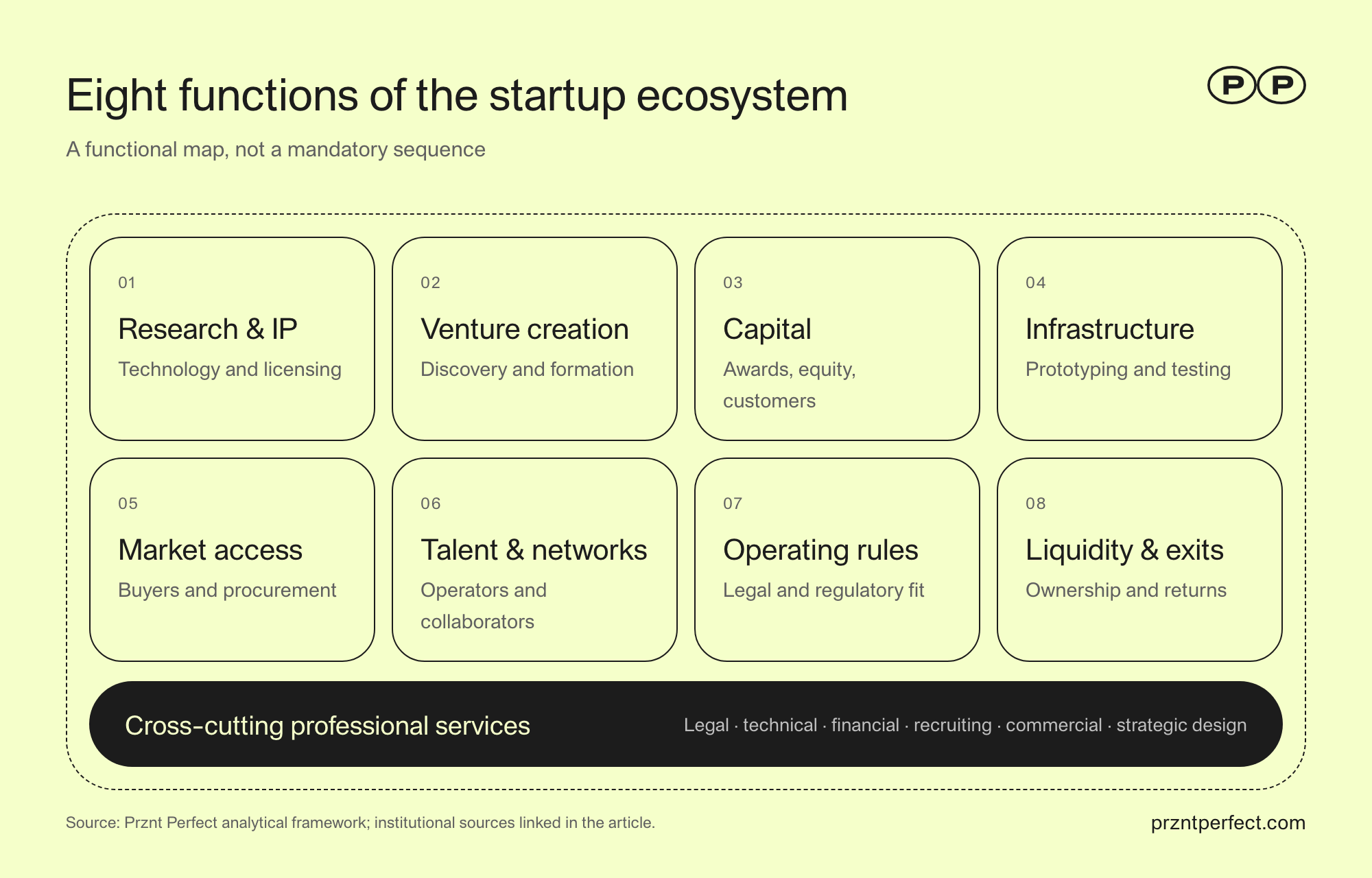
| Layer | Representative organizations and mechanisms | Founder's decision |
|---|---|---|
| Research and IP | MIT Technology Licensing Office, NSF research statistics | What is defensible and can we secure rights to use it? |
| Venture creation | NSF I-Corps, Y Combinator, Techstars | Who needs the product and why would they adopt it? |
| Capital | Angels, VC, corporate investors, SBIR/STTR | Which kind of financing matches the risk? |
| Technical infrastructure | DOE LEEP, NAIRR, Manufacturing USA | Where can we prototype, test and prove repeatability? |
| Market access and procurement | Design partners, enterprise customers, SBA federal contracting guide | Who can authorize and fund deployment? |
| Talent and networks | Universities, WTIA, EDA Tech Hubs | Which operators and collaborators do we need? |
| Regulation and operating rules | SEC exempt offerings, USCIS entrepreneur rule, sector regulators | What legal and regulatory conditions apply? |
| Liquidity and exits | Acquisitions, IPOs, secondary transactions | What routes to liquidity are plausible? |
Prznt Perfect analytical framework, based on the linked institutional sources; not an official government taxonomy.
Research and technology transfer
America's research base is substantial. The NSF's FY 2024 higher education R&D survey recorded $117.7 billion of expenditures, 8.1% above FY 2023. This measures research activity, not investable startup capital or the commercial value of spinouts.
The transition from laboratory to company requires more than a patent. Founders must assess the scope of intellectual property, licensing terms, ownership of new inventions and freedom to operate. The MIT TLO startup directory illustrates the variety of companies using university IP. A technology transfer office can be a critical first interface, but the license itself does not establish a market.
Venture formation and validation
University teams often enter commercialization programs before they have a mature product. NSF I-Corps focuses on customer discovery: testing assumptions about applications, users, buying processes and adoption. Y Combinator and Techstars offer different acceleration and investment models. Participation in an accelerator is neither a universal requirement nor an endorsement of product-market fit.
Capital as a tool for removing risk
Equity capital makes sense when a company can use it to achieve milestones that increase enterprise value. Research awards can make sense when the immediate task is still experimental development. Customer funding can make sense when there is a defined buyer need and a deliverable worth purchasing. These instruments are not interchangeable; our guide to deep-tech startup funding compares them in more detail.
Technical infrastructure
A software team can often run experiments using broadly accessible cloud services. A photonics company may need a wafer fabrication process, packaging equipment, specialist metrology and an experienced operator. For research-intensive businesses, access to infrastructure may determine the feasible development schedule and capital requirements. Check actual availability, intellectual property terms, process compatibility and pricing before putting a facility partnership into a financing plan.
Markets and procurement
The ecosystem includes people who buy, not only people who invest. Customers can provide requirement specifications, access to operating environments, validation data and revenue. Government agencies can also buy products and services, but a research award or demonstration agreement is not necessarily a procurement contract. We examine this distinction in our companion guide to deep-tech commercialization.
Which U.S. startup hubs matter for which industries?
StartupBlink's 2026 U.S. ranking lists, in order: San Francisco Bay, New York, Los Angeles Area, Boston Area, Austin, Seattle, Chicago, Washington DC Area, Miami Area and San Diego. Startup Genome's separate 2026 ranking places Silicon Valley and New York first and second globally, Seattle tenth and Austin eighteenth. The rankings use different methodologies; they should not be merged into a single league table.
For founders, the decision is more granular. A smaller regional ecosystem may provide unusually relevant equipment or buyers.
| Region | Sector fit to investigate | What to look for locally |
|---|---|---|
| San Francisco Bay Area | AI, software, venture-backed infrastructure | Specialist investors, AI operators, enterprise design partners; YC Bay Area AI directory |
| New York City | Fintech, enterprise software | Financial institutions, regulated-industry buyers and experienced commercial teams; NYCEDC technology economy, growth industries |
| Boston–Cambridge | Biopharma, university spinouts | Licensing expertise, specialized talent, laboratories and life-sciences investors; MIT TLO, MassBio |
| Austin | Semiconductors, hardware | Device and packaging expertise, engineering talent, research collaborations; UT Austin microchip research, Texas Institute for Electronics |
| Seattle | Cloud, AI, enterprise software | Infrastructure engineers, enterprise operators and mentoring; Startup Genome Seattle, WTIA |
| Pittsburgh | Robotics, industrial automation | Applied robotics research, industrial partners and testing environments; Carnegie Mellon robotics, Robotics Factory |
| North Carolina Research Triangle | Life sciences, biomanufacturing | Research and manufacturing partners, specialist facilities and talent; Research Triangle Regional Partnership |
| Albany, New York | Semiconductor process development, photonics | Shared fabrication and metrology infrastructure; NY CREATES, EUV Accelerator, AIM Photonics |
This is a qualitative shortlist, not an exclusive classification. Boston is not only biotech, and New York is not only fintech. A cybersecurity company selling to financial institutions might benefit from New York while a company pursuing federal procurement may prioritize Washington-area buyers. The buyer and the use case should drive that choice.
One company, multiple geographies
Headquarters, engineering, technical validation, sales and fundraising do not have to occur in the same ZIP code. A hypothetical silicon photonics venture might maintain its R&D team near its university, use a specialized fabrication service in Albany, investigate packaging access in Rochester, and meet prospective investors in the Bay Area. The point is to optimize for the milestone rather than the prestige of a location.
A practical way to compare hubs is to score each candidate against the following criteria. The weights are illustrative and should be adjusted to the next milestone, not interpreted as empirical rankings.
| Selection criterion | Illustrative weight: technical validation | Illustrative weight: commercial pilot |
|---|---|---|
| Access to target customers | 20% | 45% |
| Suitable technical infrastructure | 45% | 15% |
| Experienced talent and collaborators | 25% | 20% |
| Relevant stage-specific investors | 10% | 20% |
Score each region from 1 to 5 using verified evidence. Multiply by the chosen weights, but treat indispensable conditions such as facility access or regulatory requirements as hard gates: a high weighted score cannot compensate for an unavailable essential capability.
Public programs and the commercialization gap
Federal support can finance specific forms of uncertainty that private investors or customers are not yet willing to carry. It is not one unified startup grant program.
| Mechanism | What it can provide | What it does not establish |
|---|---|---|
| NSF I-Corps Teams | Structured customer discovery for eligible research teams | Signed customers or revenue |
| SBIR/STTR, NSF solicitation | Competitive research and development funding for eligible businesses | Equity investment, commercial contracts or eligibility for every applicant |
| DOE Lab-Embedded Entrepreneurship Program | Lab access and technical support for selected fellows | Unlimited access or qualification for production |
| National AI Research Resource | Research-oriented AI resources | Automatic commercial cloud credits |
| Manufacturing USA | Specialized manufacturing networks and collaboration | Guaranteed production capacity |
| EDA Regional Tech Hubs | Regional innovation ecosystem development | A direct grant to every startup in a designated region |
SBIR/STTR were reauthorized in April 2026 under Public Law 119-83; see the legislative text. Check current solicitations, ownership conditions and application windows before relying on any award in a financial plan.
Consider memQ, a quantum connectivity startup emerging from Argonne research. The Department of Energy's account describes participation in Energy I-Corps, prototyping through Argonne's LEEP node and a subsequent $2.5 million private pre-seed round. The example shows how discovery, infrastructure and private financing can complement one another. It does not show that the company acquired paying customers through those programs or that any one program caused the funding outcome.
International founders: choose a market before choosing a legal structure
The U.S. can provide access to customers, capital and infrastructure, but entering it does not require solving every question simultaneously. Separate four decisions:
| Decision | Question |
|---|---|
| Commercial presence | Where are the buyers and what local presence do they require? |
| Incorporation and tax | Which structure supports contracts, IP ownership, employment and financing? |
| Immigration | What authorization is required for the founders' intended activities? |
| Federal eligibility | Does the company satisfy the particular program's ownership, location and other criteria? |
A U.S. corporation does not automatically confer immigration status or qualify for federal funding. The USCIS International Entrepreneur Rule concerns discretionary parole, not an automatic visa. Equity offerings also require consideration of SEC registration and exemptions. This is a decision framework, not legal or tax advice.
For European startups, a relevant comparison comes from the ECB's 2026 analysis of EU and U.S. venture capital, which finds the funding gap grows at later stages in its 2019–2024 data. That supports investigating U.S. financing and customers as a company scales; it does not suggest every European startup should relocate or that EU and American headline totals from different years are directly comparable.
Where specialist partners fit
Legal advisors, technical specialists, commercial advisors, financial professionals, recruiters and design teams cut across the ecosystem's layers. They are not an additional mandatory stage.
At Prznt Perfect, we focus on the interface between complex technology and the people who must make decisions about it. An investor may need evidence of risk reduction and capital efficiency; an industrial buyer may need a clear evaluation protocol and adoption economics. Presenting the same technical discovery in the same way to both is rarely effective, which is why a deep-tech presentation needs a different structure from a generic startup deck.
A shared evidence base can support distinct artifacts: a non-confidential technical one-pager, a pilot brief, a sales deck, an investor presentation, a data room or board reporting. The numbers and underlying claims must remain consistent, even when the narrative and visual hierarchy change.
For a detailed framework, see our companion article, Deep-tech commercialization: from prototype to a paid pilot. Explore our semiconductor startup case study and AI-pluggable brand systems article for related design perspectives.
Conclusion
The value of the U.S. ecosystem is not simply its size. It lies in the diversity of mechanisms available to address different kinds of uncertainty. Define what your company must prove next, find the institution or partner that can help establish that proof, and choose the location and financing model accordingly. The best ecosystem for the company is the one that moves its next consequential decision forward.