


Open innovation in Spain: turn a challenge into a paid pilot
Planning open innovation in Spain? Learn how to scope a paid corporate pilot, agree on site access, and choose the evidence needed for a buying decision.

An innovation lead likes your pitch. The plant manager asks who will show up on day one, what you have done before, and what could disrupt the line. Does your pitch get more convincing when the questions get more specific? For a startup entering an industrial environment, these are not peripheral questions. They determine whether an attractive innovation theme can become a project somebody can price, staff and approve.
For the operator pitching a corporate innovation program, the challenge is different but connected: can the program reliably translate broad business priorities into testable opportunities for credible suppliers?
Examples from Spain show how open innovation can be structured around real corporate projects and paid proofs of concept. They do not establish that Spain has a single national approach; they illustrate mechanisms founders and venture builders can learn from.
Start with a workflow, not a sector theme
“Improve manufacturing sustainability” might work as the title of an innovation call. It does not tell a startup which problem to solve, or give a plant manager enough information to approve access.
A usable challenge identifies a process, a site, a current way of working and an observable problem. It also identifies the operational constraints that determine whether the solution can be tested safely.
For example, a fictional quality-inspection challenge might move from “use AI to improve production quality” to “evaluate whether assisted review can reduce the time spent checking flagged parts at one inspection station, without connecting the prototype to live controls.”
The revised brief is narrower, but commercially stronger. It makes it possible to define what data is needed, who supervises the test, which metrics matter and what the pilot excludes.
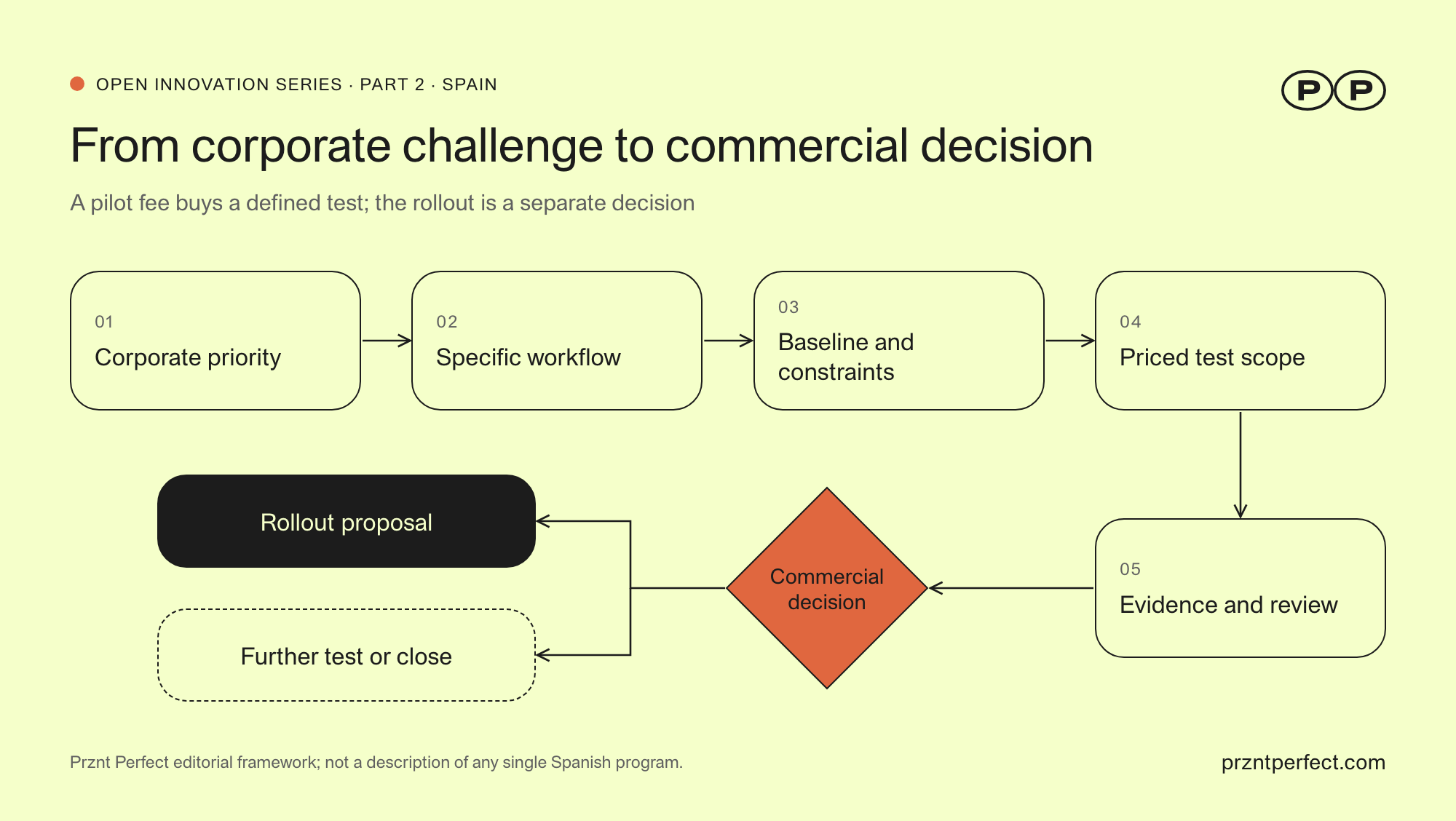
Figure 1. From challenge to decision: a proposed Prznt Perfect editorial framework, not a description of any single Spanish program.
How Spanish programs put real work behind a challenge
BIND: industrial challenges and paid projects
BIND is a public-private open innovation platform in the Basque Country. Its open innovation program describes connecting ventures to established industry clients through paid projects.
The practical insight is that the relationship is structured around work for an industrial counterpart, rather than visibility alone. An operator designing a similar offer should be able to explain how challenges are sourced, how companies are matched and how the scope of a project becomes contractable.
However, paid project participation does not establish production use or a subsequent order.
Lanzadera and Mercadona: a corporate-specific proof of concept
The Mercadona opportunity published by Lanzadera advertises a paid, equity-free proof of concept. The joint program terms provide additional context on the format.
This illustrates a different structure: a named corporate counterpart with a specific program offer. Separately, Lanzadera's corporate innovation case material identifies a Mercadona proof of concept with Voicefinder addressing in-store communications.
Do not infer the payment amount or individual contractual terms for Voicefinder from the general program offer. The cited material also does not establish a subsequent rollout.
AgroBank and Innsomnia: sector expertise in program design
CaixaBank's announcement describes AgroBank Tech Digital INNovation as jointly designed and developed by its AgroBank business line and Innsomnia for agri-food startups.
The example illustrates where an operator can add value before a pilot exists: sector-specific challenge design and program development. It does not prove a paid pilot or procurement outcome. If your proposition is program design rather than technology supply, show relevant expertise in defining challenges and coordinating the process.
BeePlanet and Mercedes-Benz: what a credible proof point looks like
The SPRI account of sustainability-related BIND projects identifies BeePlanet's work with Mercedes-Benz in the 2021 edition. pv magazine España's reporting describes a second-life battery installation at the Vitoria factory as a proof of concept.
This is the sort of evidence a company can communicate precisely: a technology category, an identifiable industrial setting, a concrete installation and a bounded stage of validation.
The distinction between this and a generic “trusted by automotive leaders” statement is substantial. A technical evaluator can ask about the configuration, conditions and evidence. A commercial buyer can ask whether the result is relevant to another site. A founder can explain the maturity of the system without implying that one installation proves readiness for fleet-wide or factory-wide deployment.
The cited records do not establish rollout across multiple factories or that the batteries originated from Mercedes-Benz vehicles. BIND is the platform, not BeePlanet's operating company.
| Case | Model | Evidence supported | Not established |
|---|---|---|---|
| BIND / BeePlanet / Mercedes-Benz | Industrial open innovation | Vitoria installation as proof of concept | Multi-factory rollout |
| Lanzadera / Mercadona / Voicefinder | Corporate-specific program | Published paid POC offer; named POC | Individual payment terms or rollout |
| AgroBank / Innsomnia | Sector-focused program design | Joint design and development | Paid pilot or purchase |
Present the company as a specialist, not a generic innovator
A capabilities page for an industrial buyer should communicate more than the size of the opportunity or the novelty of the technology. It should show how the proposed solution fits into the customer's workflow and what the supplier can actually deliver today.
An analysis of 50 initial corporate–startup meetings examined preparedness and tailored communication alongside technology fit and readiness, including visual aids within a wider set of behaviors. The research does not isolate visual design as a causal factor in closing contracts. It does support treating communication as part of preparation rather than as an afterthought.
A concrete example outside Spain is the BMW Startup Garage FAQ, which describes a working product or functional prototype suitable for integration and validation among its criteria. That is one corporate buyer's standard, not a universal prerequisite for every open innovation program.
Use a consistent company narrative across four pieces of collateral: a capability statement, a workflow diagram or demo, a technical appendix and a commercial proposal. The capability statement explains the value; the workflow diagram locates it; the appendix exposes assumptions and constraints; the proposal specifies what is being bought.
The operator and the participating startup need different evidence. A program operator demonstrates its ability to manage a process; a supplier demonstrates its ability to implement a solution. One cannot borrow the other's track record.
How to scope a paid pilot for open innovation in Spain
A useful pilot has an agreed unit of work, bounded operational risk and a decision at the end. The following scope card is a proposed working tool, not a legal agreement or engineering specification.
| Scope field | Question to resolve | Fictional inspection example |
|---|---|---|
| Site and workflow | Where is the test performed? | One flagged-parts review station |
| Baseline and target | What is compared, and what counts as improvement? | Current review time and missed-defect rate; targets agreed before testing |
| Sample and exclusions | Which data, volume and scenarios are in scope? | Agreed image sample; no live-control integration |
| Responsibilities | Who provides access, implements and supports? | Site quality lead and named startup engineer |
| Fee and payment | What work is purchased and when is it paid? | Defined test fee and milestones, to be agreed |
| Approval and decision | Who signs off and what follows? | Quality owner reviews; authorized buyer decides next step |
Add a proof strip at the top: company category, maturity stage, closest existing evidence and named delivery lead. Keep that evidence visually distinct from the results the pilot is intended to establish.
Before: Enterprise-ready AI for quality inspection.
After: Working prototype for reviewing flagged parts. The paid pilot will test one inspection station against current review time and missed-defect rate. There is no connection to live controls; a named startup engineer will support the test.
If the commercial offer depends on assumptions about staff time, data access, security review or installation, expose them before the test begins. If the operator is recruiting participants, disclose exclusions and expected capabilities before asking applicants to develop proposals.
A pilot fee and a rollout budget are different decisions
A pilot fee purchases a defined learning or validation exercise. The business case for wider adoption must also account for integration, operating costs, support and organizational change. A promising result might justify additional validation but still fail to justify deployment at the envisaged scale.
The review should have three possible outcomes: a business owner requests a commercial proposal; the team approves a follow-up test with a specified unresolved question; or the test closes. A positive technical result is not automatically a purchase decision.
Make the evidence travel from engineer to buyer
The site reviewer and the executive sponsor will look at the same pilot through different lenses. A site reviewer may need sample conditions, technical limitations and operational exceptions. The sponsor may need a concise comparison with the baseline and a view of the potential business case.
Do not change the underlying claim when changing the level of detail. Build the readout around the same proof system: claim, test method, observed result, limitations and next decision. Every benchmark needs a source and test conditions.
At Prznt Perfect, our OT cybersecurity sales-deck case illustrates designing materials for commercial and specialist readers through a consistent visual system. It is not evidence of a sale or work with the Spanish programs mentioned here.
For a technology company preparing a corporate pilot, we bring positioning, identity, technical diagrams and commercial materials into a coherent system. Engineers define the test and the corporate approves it; our role is to make the proposal and its evidence understandable to the people making those decisions.
Build your pilot pitch. Talk to Prznt Perfect about translating technical capability into decision-ready corporate communications.
Read Part 1: Get the corporate mandate before launching a program, and Part 3: From pilot to buyer for multi-partner commercial handoffs.