


Open innovation in the Netherlands: who hosts, who buys?
Planning open innovation in the Netherlands? Learn how to map program partners, agree on test-site access, and identify who can buy after the pilot.

Your deck has three partner logos. Take them off for a moment. Is it still clear what your company does, what it has delivered, and who would buy from it if the pilot works? For a startup navigating a multi-partner innovation ecosystem, an impressive set of affiliations can open doors. But the organization that introduces you may not be the organization that hosts your test. The host may not have procurement authority. An investor may fund the company but have no reason to purchase its product.
This is not a problem with collaboration. It is a problem with treating different kinds of collaboration as interchangeable.
Examples from the Netherlands, including the Port of Rotterdam, Shell's New Energy Challenge and Eindhoven's venture-building ecosystem, provide several useful models for understanding the distinction. The practical objective is to establish what each partner contributes, what it can decide and where the company must go next.
Who does what in open innovation in the Netherlands?
Before evaluating a program, separate four roles. A host provides access to a site, asset, dataset or operational workflow. An operator recruits, matches participants and coordinates the process. A technical or investment partner brings expertise, technology or funding. A corporate buyer has authority to initiate the next commercial step.
One organization can occupy several of these roles. That does not mean every relationship with that organization includes every role.
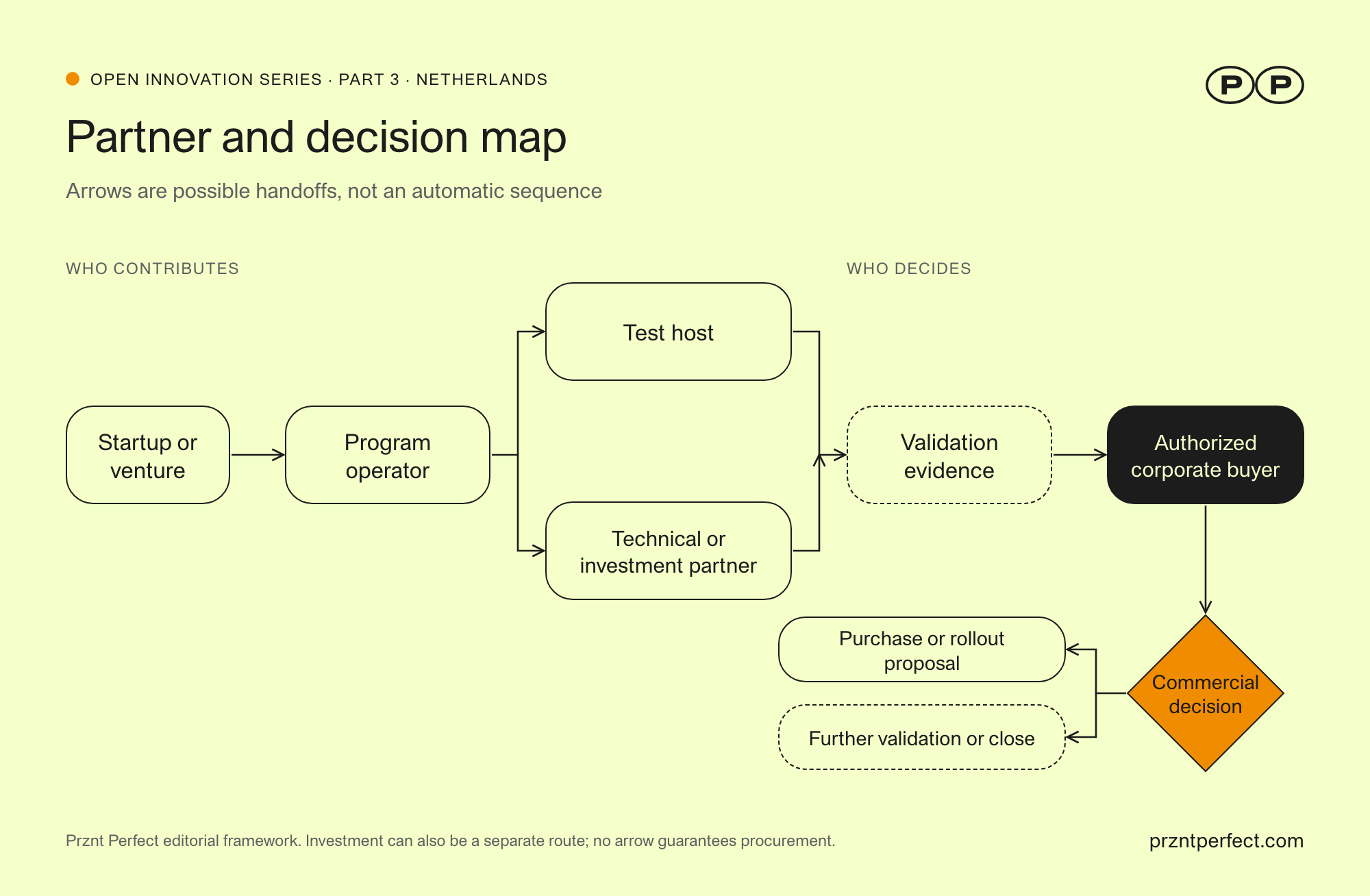
Figure 1. A proposed partner and decision map, Prznt Perfect editorial framework. The arrows represent possible handoffs, not an automatic sequence or a guarantee of procurement. Investment can also be a separate route.
| Role | Typical contribution | Decision to clarify |
|---|---|---|
| Program operator | Scouting, matching, coordination | Who can enter and how is selection managed? |
| Test host | Site access, workflow, facilities | What can be tested and under what conditions? |
| Technical or investment partner | Expertise, technology, capital | What resources or rights will be committed? |
| Corporate buyer | Commercial authority and budget | Who can commission subsequent work or purchase? |
A company may reasonably pursue a validation opportunity without a named buyer. It should describe that opportunity accurately rather than present it as a route to guaranteed adoption.
Rotterdam: a testbed is valuable when it connects to a real use case
PortXL's Rotterdam program describes partner assessment of proposed use cases and a period of collaboration with selected startups. The value of an industrial or maritime testbed lies in the possibility of evaluating a relevant technology in a real context, with organizations that understand local operating requirements.
The Port of Rotterdam Authority's announcement of pilot agreements identifies a collaboration to assess ECOncrete's environmental applications on quay walls. A separate Amaliahaven quay-wall construction project page identifies ECOncrete blocks for two locations in the project.
These are two distinct documented milestones: a named assessment relationship and a named implementation plan. They make a more meaningful account than a generic reference to participation in a maritime accelerator.
They do not establish the commercial terms, independently confirm completion of implementation or prove that the earlier collaboration caused the later decision. That causal connection would require additional reporting with the parties. We also avoid stating the total number of pilot agreements because the original announcement is internally inconsistent on that count.
For a startup preparing a partnership pitch, the lesson is to make the status of each relationship visible. “We have an agreed site for validation” and “our technology has been specified for a named project” are different claims. They should not be represented by the same unqualified logo.
Shell New Energy Challenge: different routes, different decisions
Shell's New Energy Challenge description illustrates how an open innovation challenge can bring together different organizational capabilities, including Shell's venture and GameChanger activities and supporting partners. Unknown Group's case notes describe its involvement in co-managing the multi-year challenge. Rockstart and YES!Delft have also been named in connection with the challenge; partner roles and names vary by edition.
The program illustrates that a startup may encounter several possible next steps: an early proof-of-concept opportunity, consideration for investment, or a later business collaboration. These are not successive stages that every selected venture completes.
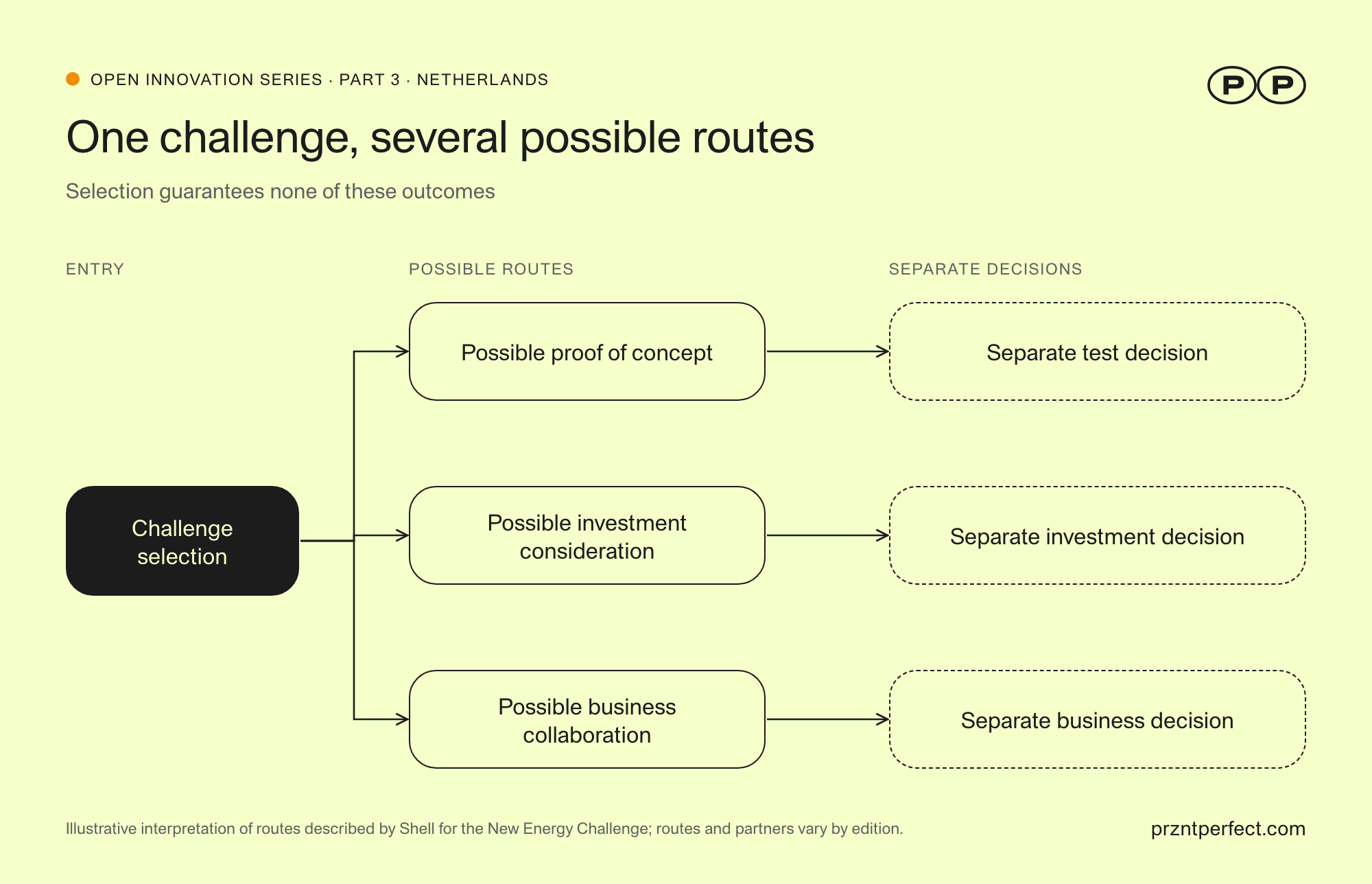
Figure 2. Illustrative branching interpretation of possible routes described by Shell. Selection guarantees none of these outcomes; routes and partners depend on the edition.
When mapping such a challenge, ask what qualifies the company for each route, who owns the corresponding decision, what evidence is needed and whether any funding or access has actually been committed. A funding conversation should not quietly become a customer claim in the pitch deck.
Eindhoven: when the objective is building a company, not finding a supplier
HighTechXL's technology-partner model offers a different mechanism. Its approach includes working with technology partners on due diligence, founding-team matching and licensing alignment. The venture-building program focuses on forming companies around technology.
This is particularly relevant when potentially valuable technology exists but the company, the founding team or the commercial structure needs to be built. Instead of sourcing a supplier that already exists, the initiative can involve assembling the team and clarifying the rights needed to commercialize the technology.
Incooling's account of its origins describes formation through an Eindhoven Start-up Alliance initiative supported by ASML and Philips and led by HighTechXL's venture-building program.
The example illustrates venture formation. It does not establish that ASML or Philips purchased Incooling's product. For a newly formed venture, distinguishing its technology partner, founding ecosystem and actual prospective customer is a core positioning task.
| Case | Mechanism illustrated | Documented boundary |
|---|---|---|
| PortXL / Port Authority / ECOncrete | Industrial test access and use-case assessment | Assessment relationship and separate implementation plan; causal link and commercial terms unconfirmed |
| Shell / Rockstart / Unknown Group / YES!Delft | Multi-partner innovation challenge | Several possible next steps; no guaranteed test, investment or purchase |
| HighTechXL / Incooling | Technology-based venture formation | Formation support, not proof of procurement by technology partners |
Build a brand that works without the partner logo wall
A startup participating in a complex program has at least two communication problems: explaining its own commercial proposition and explaining how the surrounding relationships contribute to it. Combining them into one undifferentiated credibility story makes both harder to understand.
Research on startup–corporate partnership formation discusses completed pilots, credentials and affiliations as capability signals, emphasizing their relevance to the recipient. That suggests a useful distinction between evidence a buyer can assess and borrowed reputation. A separate Technovation study provides a research basis for examining collaboration processes and governance. Neither research source validates the specific partner map proposed here or guarantees commercial adoption.
Imagine a fictional logistics startup introducing itself with the statement “Trusted by major ports and logistics partners.” The names may be recognizable, but the proposition is vague and the nature of the relationships is unclear.
A stronger version: “We provide a tool for detecting missed handoffs in freight workflows. A terminal operator has agreed to host a validation test; a separate logistics buyer will review the result. There is no purchase commitment.”
The second version describes the product, the test relationship and the prospective decision. It provides fewer opportunities for misunderstanding as the material circulates.
A standalone company profile should lead with the startup's own identity, value and evidence. Partners can appear in a distinct area, with role labels, dates and any necessary qualifications. Use names and logos only where their use has been approved. If a relationship cannot be described publicly, prepare a version suitable for circulation without it.
The partner and decision map: a working tool
Before a multi-partner pilot, document four fields for every actor. The example below is fictional and intended for adaptation.
| Actor | Contribution | Decision authority | Handoff |
|---|---|---|---|
| Startup | Freight workflow tool and implementation | Commits supplier resources | Delivers validation report |
| Program operator | Matches startup with relevant organizations | Coordinates program and agreed selection process | Connects site and startup |
| Terminal host | Test site and operational access | Approves site conditions | Reviews operational evidence |
| Technical partner | Integration expertise | Approves own technical contribution | Flags integration requirements |
| Logistics buyer | Commercial evaluation | Authorizes next step if empowered | Procurement or further validation |
Funding line: record separately the operator fee, test fee, investment capital and potential rollout budget. Specify the payer or funder, recipient, conditions and whether each commitment is confirmed or only proposed. A pilot funded by a third party does not establish that the test host has made a purchasing commitment.
Use the completed map to check every partner claim in the pitch. For each affiliation, ask whether the role is accurate, the relationship is current, and the company has permission to publish it.
Design the commercial handoff before the first test
The first practical question is who can initiate vendor onboarding, commission a subsequent test or negotiate commercial terms. Identify that person or function before testing, if possible. A site host that cannot answer the question may still be offering valuable validation, but the commercial path remains unresolved.
At the review, give the sponsor, technical reviewer and buyer a common evidence base rather than three inconsistent company stories. The technical appendix might go deeper than the executive deck, but it should support the same claims.
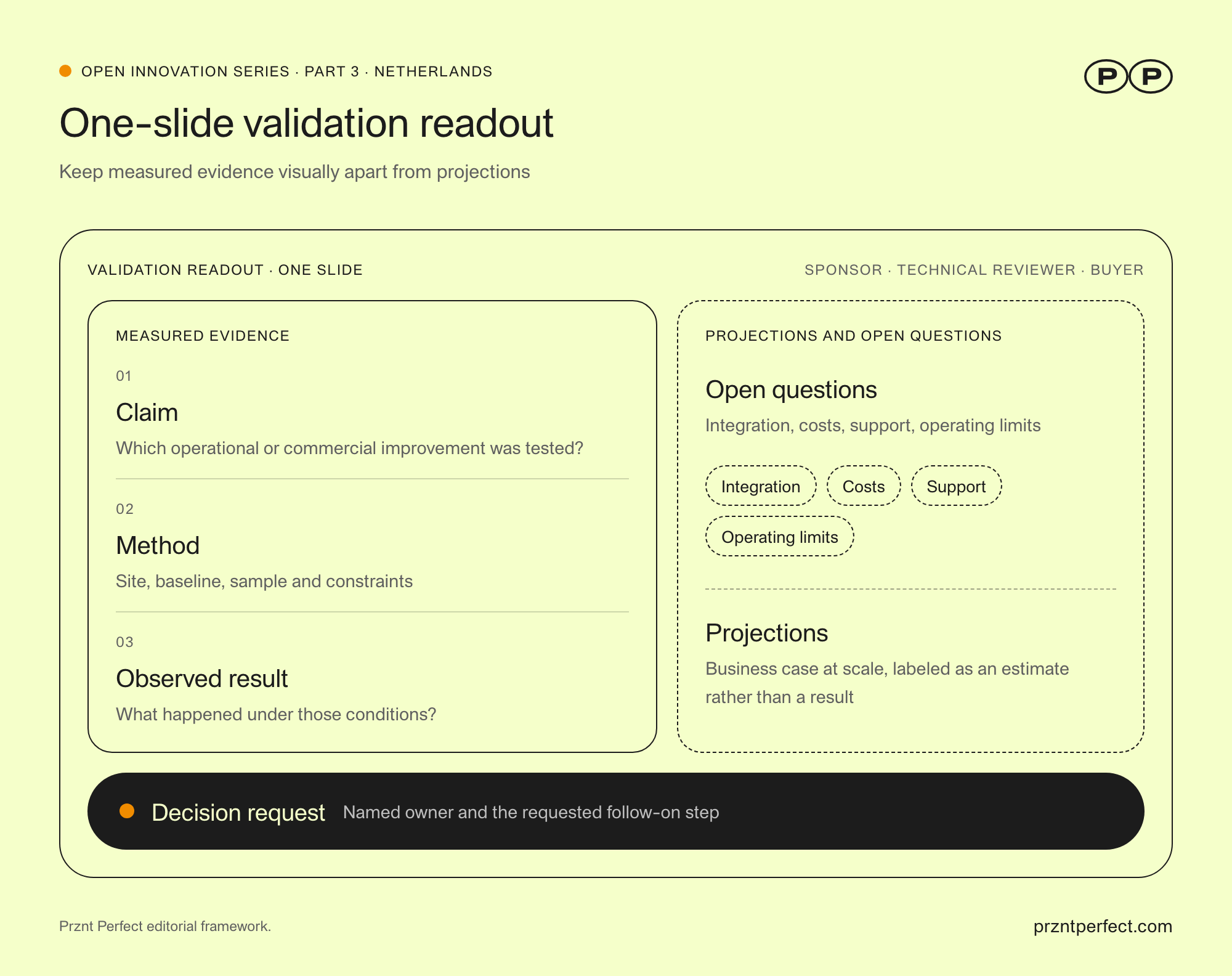
Figure 3. One-slide validation readout. Visually separate measured evidence from projections and open questions.
If a result supports a commercial proposition, request a specific next decision. If it does not, identify the unresolved question or close the test. The purpose of the readout is not to make every pilot appear successful but to make the next action rational and clear.
A consistent company identity in a complex ecosystem
At Prznt Perfect, our LARTA brand case illustrates clarifying an organization's role within a complex ecosystem across visual identity, web and events. It is a design example, not a Dutch case or evidence of a commercial outcome.
For ventures building corporate relationships, the design challenge is similar: establish a distinct positioning and a brand system robust enough to appear alongside other institutions' identities, while preserving the company's own contribution. Extend that system to company profiles, partner maps, technical diagrams and decision decks.
Design does not assign authority, negotiate licensing rights or approve procurement. It can make the responsibilities, claims and next decisions legible to the people who do.
Plan your partner pitch. Talk to Prznt Perfect about communicating your technology and company role in a multi-partner ecosystem.
Read Part 1: Get the corporate mandate for sponsorship and approval, and Part 2: From challenge to paid pilot for test scoping and evidence.