


AI-pluggable brand identity
How deep-tech companies can make their brand design systems AI-pluggable at scale, whether through enterprise-grade MCP infrastructure or more lightweight AI-ready brand kits.
We're witnessing a twofold evolution of how AI is affecting brand design processes in deep-tech companies, including cybersecurity, semiconductors, and advanced materials.
First, AI is expanding creative production faster than companies can control it.
There are now more stakeholders involved in creating designs hands-on. The more hands you have touching the design (both human and AI hands), the more guardrails you need to keep the brand within its consistency thresholds.
Larger enterprises have traditionally been better equipped for that, with centralized brand portals, asset libraries, design systems, and governance workflows. But even they seem to be struggling with the rapidly expanding creative capacity AI brings.
In-house creative directors and design leads are facing increasing pressure from business leadership to deliver faster, often with raw AI-generated concepts already on the table. They don't always have enough leverage to push back, especially when they can't offer an equally fast alternative. And that's how raw AI-generated concepts end up in production, bypassing the usual brand consistency checks.
Second, while AI-generated brand identities remain questionable, AI-assisted brand production is becoming hard to ignore.
The prevailing view in the creative community remains skeptical of AI-generated brand identities, particularly when it comes to defining the brand's core. Concerns center on the growing sameness of fast-born brands, the proliferation of AI slop, and the lack of genuine differentiation. While AI-generated identities are gaining ground at the lower end of the market, established brands and larger businesses remain considerably more cautious, with authenticity and distinctiveness still taking priority.
At the same time, the AI-boosted capabilities of growing a brand beyond its existing core, and speeding up production, are not being ignored by business owners and leaders. And this is where AI agents can be fair and efficient players, provided they're plugged into a proper brand design system.
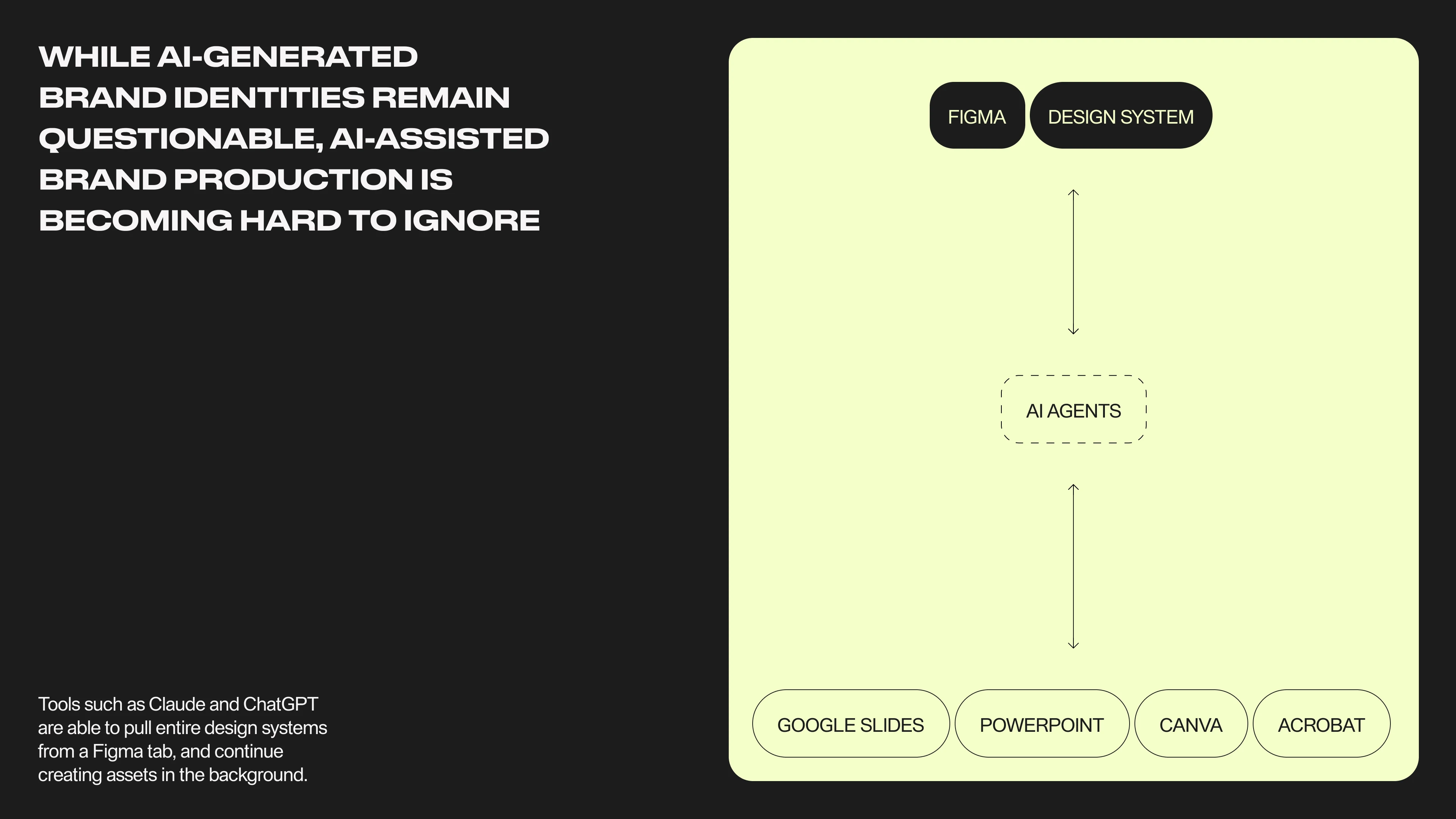
Think about generating new illustrations within an established visual language, adapting technical diagrams, creating branded 3D graphics, or building presentation slides using approved layouts.
For deep-tech companies, much of the brand lives precisely there: across investor decks, sales presentations, technical whitepapers, and other business communications that different teams update almost daily.
So the challenge isn't how to keep AI out of brand production, but how to make it work within the brand's established rules.
Can this be done without putting the brand's consistency and authenticity at risk? And how?
From brand guidelines to AI-pluggable design systems
At Prznt Perfect, we've been exploring these capabilities at scale since Q2 2026, when requests for AI-pluggable brand identity kits and style guides started growing sharply.
Unlike product design, where reusable components, tokens, and machine-readable design systems have been evolving for years, brand identity systems are still catching up.
There's no universally reliable approach that guarantees brand-compliant AI output for every brand and every use case. But best practices are maturing, and some are already reaching a good-enough level of reliability for everyday production.
So if you're building or updating a design system for your brand, making it AI-readable and AI-pluggable should already be part of the brief.
There are two main approaches.
Approach 1. Enterprise-scale infrastructure
The first is more tech-heavy, with practices already emerging from larger companies like Spotify and Shopify.
The idea is to build an infrastructure that makes the design system directly accessible to AI agents, rather than expecting them to interpret static guidelines.
This typically involves:
- Machine-readable brand rules: design tokens, typography, colors, spacing, and component specifications.
- An MCP server: allowing AI agents to retrieve approved assets, rules, and component documentation on demand.
- A layered component library: reusable building blocks agents can work with rather than inventing from scratch.
- Persistent agent instructions: critical design foundations that should always be followed.
- An evaluation framework: automated checks to assess the generated output against the design system.
A good example is Spotify, which has been making its Encore design system AI-ready, introducing MCP-based access to components and documentation, alongside an evaluation framework for generated implementations.
But this still doesn't guarantee perfect output.
A typical failure: an agent retrieves the correct component but uses the wrong spacing, font, or color. MCP only returns what the agent asks for, while the model fills in missing information from its general training.
One emerging best practice is therefore to keep fundamental design rules in always-on instructions, while using MCP to retrieve specific components and documentation.
Shopify's Polaris follows a related approach, making approved UI components and development guidance accessible to coding agents.
Both examples come from product design rather than corporate brand identity, but the underlying principles are transferable.
The main limitation is implementation and maintenance complexity. Building this infrastructure requires substantial coordination between design, engineering, and IT teams, which can be justified for large enterprises but rarely for a deep-tech startup with two or three designers in-house.
Approach 2. Lightweight AI-ready brand kits
This is the approach we typically implement for pre-Series C startups and deep-tech companies with fewer than 500 employees, often with only two or three in-house designers.
Instead of building a dedicated MCP infrastructure, we make the existing brand design system accessible to the AI tools the company already uses.
There are five main elements:
- Machine-readable brand guidelines. Replace vague descriptions like "minimal, premium, technical" with explicit rules for illustration geometry, composition, colors, typography, and acceptable variations. Separate strict constraints from areas where AI has creative freedom.
- Reusable assets and examples. Give agents approved illustrations, 3D models, icons, templates, and representative examples of correct output. For presentations, Microsoft's Copilot guidance specifically emphasizes sample slides, rather than relying on Slide Masters alone.
- Reusable AI skills and instructions. Package recurring tasks into workflows that employees and their AI agents can reuse, rather than requiring detailed prompting every time. These can run through Claude skills and Projects, custom GPTs, Copilot, or other AI environments.
- Custom branded graphics generators. These can now be vibe-coded without substantial engineering investment. Unlike general-purpose AI image generators, they deliberately limit creative freedom through predefined parameters: shapes, colors, compositions, materials, and lighting. This makes them less useful for open-ended exploration, but more reliable for repetitive production of branded 3D icons, illustrations, and diagrams. They can be used directly by non-designers or called by AI agents.
- Brand compliance evaluation. Introduce automated checks for objective requirements (colors, fonts, logos, layouts) and AI-assisted visual evaluation for more nuanced consistency issues. Human review is still needed for complex or high-visibility materials.
The point isn't to promise 100% compliance, but to reduce the number of inconsistent outputs and the manual effort required to fix them.
Which approach should you choose?
Both follow essentially the same logic:
Brand rules and assets → AI-accessible system → Reusable production workflows → Brand compliance evaluation.
The difference is mostly in the implementation complexity.
For larger enterprises with mature design systems, dedicated MCP infrastructure and automated evaluation may justify the investment. For growing companies with smaller design teams, a structured brand kit, reusable AI skills, custom graphics generators, and lightweight checks can already cover much of everyday production.
The important distinction is between making a brand AI-readable and making AI-generated output reliably brand-compliant.
The first is relatively straightforward. The second is where the industry is still experimenting.
But the direction is clear: brand guidelines are becoming something AI agents need to work with, not just something human designers read.
FAQ
What is an AI-pluggable brand identity?
An AI-pluggable brand identity is a brand design system packaged so AI agents can apply it: machine-readable rules, approved assets and examples, reusable instructions, and compliance checks. The goal is AI output that stays within the brand's rules instead of drifting from them.
Can AI agents follow brand guidelines reliably?
Partly. Agents often retrieve the right component but apply the wrong spacing, font, or color, filling gaps from their general training. Keeping core rules in always-on instructions, adding automated checks, and keeping human review for high-visibility materials reduces errors, but none of it guarantees 100% compliance.
Do you need an MCP server to make a brand AI-ready?
Not always. A dedicated MCP server suits large enterprises with mature design systems and engineering capacity. Smaller teams can get most of the benefit from a structured brand kit, reusable AI skills, custom graphics generators, and lightweight compliance checks.
What should an AI-ready brand kit include?
Five elements: machine-readable brand guidelines, reusable assets and examples, reusable AI skills and instructions, custom branded graphics generators, and brand compliance evaluation.
How do you check AI-generated materials for brand compliance?
Automated checks cover objective requirements such as colors, fonts, logos, and layouts. AI-assisted visual evaluation catches more nuanced inconsistencies, and people still review complex or high-visibility materials.
Can Prznt Perfect design and develop an AI-ready design system for my company?
Yes. We build AI-pluggable brand systems for deep-tech companies, typically as a lightweight AI-ready brand kit: machine-readable guidelines, approved assets and examples, reusable AI skills and instructions for tools like Claude, ChatGPT, or Copilot, custom branded graphics generators, and brand compliance checks. If you already have a brand identity, we build the kit on top of it. If not, we design the identity and the AI-ready system together.
How long does it take to build an AI-ready brand kit?
An AI-ready brand kit built on an existing brand typically takes 2–4 sprints, and a new brand identity designed together with the kit takes 6+ sprints. We work in two-week design sprints at $2.9K per sprint, and you can start with a single sprint as a pilot. After a short intro call, we send over a scope and a timeline. See how we price our work.
