


Deep Tech Startup Funding: A 2026 Investor's Guide
A 2026 guide to deep tech startup funding, covering seed and Series A ranges, investor due diligence, and valuation methods by sector.

Deep tech startup funding represents one of the most challenging yet rewarding landscapes in venture capital today. Unlike software-as-a-service companies that can scale quickly with minimal capital, deep tech ventures require substantial investment in research and development, specialized equipment, regulatory compliance, and extended timelines before reaching commercial viability. Founders in quantum computing, advanced materials, synthetic biology, and aerospace face unique hurdles when pitching to investors who must balance technical risk against transformative potential. Understanding the funding ecosystem, investor expectations, and capital strategies has become essential for any deep tech entrepreneur seeking to bring breakthrough innovations from laboratory to market.
The Deep Tech Funding Landscape in 2026
The deep tech funding environment has matured considerably over the past five years. Investors now recognize that these capital-intensive ventures require patient capital and specialized expertise, leading to the emergence of dedicated deep tech funds and government-backed initiatives.
Market dynamics have shifted substantially:
- Global deep tech funding reached $92 billion across 4,200+ deals in 2025, according to data-driven European deep tech market reports
- Average seed rounds for hardware-centric startups now exceed $3.5 million
- Series A rounds frequently require demonstrable technical validation and early customer traction
- Corporate venture capital arms have increased their allocation to deep tech by 40% since 2023
Deep tech startup funding follows distinct patterns compared to traditional venture investments. These companies typically spend 18-36 months in stealth mode conducting foundational research before seeking institutional capital. The technical complexity demands investors with domain expertise who can evaluate scientific validity and commercial potential simultaneously.
Sector-Specific Capital Requirements
Different deep tech sectors command vastly different capital needs and timeline expectations. Understanding these nuances helps founders set realistic fundraising targets and investor expectations.
| Sector | Typical Seed Capital | Series A Range | Time to Revenue |
|---|---|---|---|
| Quantum Computing | $4M - $8M | $15M - $35M | 4-7 years |
| Advanced Materials | $2M - $5M | $10M - $25M | 3-5 years |
| Synthetic Biology | $5M - $12M | $20M - $50M | 5-8 years |
| Space Technology | $3M - $10M | $25M - $75M | 4-6 years |
| Fusion Energy | $10M - $30M | $50M - $200M | 8-12 years |
The Harvard Business Review examination of lean startup methods for deep tech reveals that traditional Silicon Valley playbooks often fail in these contexts. Deep tech founders cannot simply "pivot" when facing fundamental physics constraints or regulatory barriers.
Investor Expectations and Due Diligence
Deep tech investors conduct far more rigorous technical due diligence than their software-focused counterparts. This process often extends 4-8 months and involves external scientific advisors, patent analysis, and competitive landscape mapping.
Sophisticated investors evaluate five critical dimensions before committing capital:
- Scientific validity - Can the underlying technology actually work at scale?
- Freedom to operate - Does the startup have clear intellectual property rights?
- Manufacturing feasibility - Can the product transition from lab to production?
- Regulatory pathway - What approvals are required and what timeline is realistic?
- Market timing - Will customers be ready when the product launches?
The Technical Pitch Deck
Presenting complex scientific concepts to investors requires exceptional visual communication skills. Deep tech founders must balance slide aesthetics with information density while maintaining credibility with both technical and financial stakeholders.
Essential components of a deep tech pitch deck include:
- Problem statement grounded in market pain points, not just technical curiosity
- Technology explanation accessible to non-specialists yet credible to domain experts
- Competitive landscape showing both direct competitors and alternative approaches
- Development roadmap with clear technical milestones and capital efficiency metrics
- Team credentials demonstrating both scientific expertise and commercial acumen
- Financial projections that acknowledge long development cycles and capital intensity
The most successful deep tech presentations tell a compelling narrative arc that connects fundamental research to massive commercial opportunity. Investors need to understand not just what you have invented, but why it matters and why now is the right time.
Government Support and Non-Dilutive Funding
Deep tech startup funding increasingly incorporates non-dilutive sources that extend runway without sacrificing equity. Government programs, research grants, and innovation prizes can provide millions in early-stage capital while companies validate their technology.
The UNDP research on global deep tech ecosystems highlights how coordinated policy support accelerates commercialization timelines. Countries that integrate grant funding, tax incentives, and procurement commitments create more robust deep tech ecosystems.
Major non-dilutive funding sources in 2026:
- Small Business Innovation Research (SBIR) grants up to $2.5M for U.S. companies
- Horizon Europe program offering €95B through 2027 for European researchers
- Advanced Research Projects Agency (ARPA) programs in energy, health, and defense
- Innovation challenge prizes ranging from $100K to $10M for specific breakthroughs
- University technology transfer offices providing sponsored research agreements
Strategic founders layer these sources beneath venture capital to reduce burn rate and extend technical development timelines. A biotech company might secure $1.5M in SBIR grants, $800K from a foundation, and $5M in venture funding to reach clinical trial initiation.

Strategic Corporate Partnerships
Corporate venture capital and strategic partnerships have become essential components of deep tech startup funding strategies. Large corporations provide not just capital but also manufacturing capabilities, distribution channels, and technical validation.
Benefits Beyond Capital
Strategic investors offer advantages that pure financial investors cannot match. These relationships accelerate commercialization while de-risking technology development.
| Strategic Advantage | Financial Impact | Timeline Reduction |
|---|---|---|
| Manufacturing expertise | 30-50% lower production costs | 12-18 months faster to market |
| Regulatory navigation | $2M - $5M saved on compliance | 6-12 months faster approval |
| Customer validation | 3-5x higher Series A valuation | Immediate revenue potential |
| Technical resources | 40% reduction in R&D costs | Access to specialized equipment |
The Royal Academy of Engineering's State of UK Deep Tech 2024 report demonstrates that university spinouts with corporate partnerships achieve commercialization 22 months faster than those relying solely on venture capital.
However, corporate partnerships require careful negotiation around intellectual property rights, exclusivity terms, and strategic alignment. Founders must ensure these relationships enhance rather than constrain future financing options.
Valuation Methodologies for Deep Tech
Traditional software startup valuation models fail spectacularly when applied to deep tech ventures. Revenue multiples mean little when a company will not generate meaningful revenue for five years. Deep tech startup funding valuations instead rest on technical milestone achievement, intellectual property strength, and comparable acquisition multiples.
Sophisticated investors use discounted cash flow models that incorporate long development timelines and high technical risk. They evaluate the probability-weighted value of multiple outcome scenarios rather than relying on simple multiples.
Key valuation drivers include:
- Patent portfolio strength and freedom to operate clearance
- Technical validation through peer-reviewed publications or independent testing
- Quality and completeness of the founding team across science, engineering, and business
- Size and growth rate of the addressable market once technology matures
- Capital efficiency demonstrated in achieving development milestones
A quantum computing startup with three foundational patents, Nature publication validation, and a team including two quantum physicists and an experienced semiconductor CEO might command a $25M pre-money valuation despite zero revenue. This reflects the option value on transformative technology rather than current financial performance.
Fundraising Strategy and Timing
Deep tech founders must approach fundraising strategically, aligning capital raises with technical milestone achievement rather than arbitrary timelines. The DCVC Deep Tech Opportunities report emphasizes that investor appetite peaks immediately following major technical breakthroughs.
Smart founders maintain continuous investor dialogue throughout development, educating potential backers on progress and building conviction over 12-18 months before formally raising capital. This approach yields higher valuations and better term sheets.
Multi-Stage Capital Planning
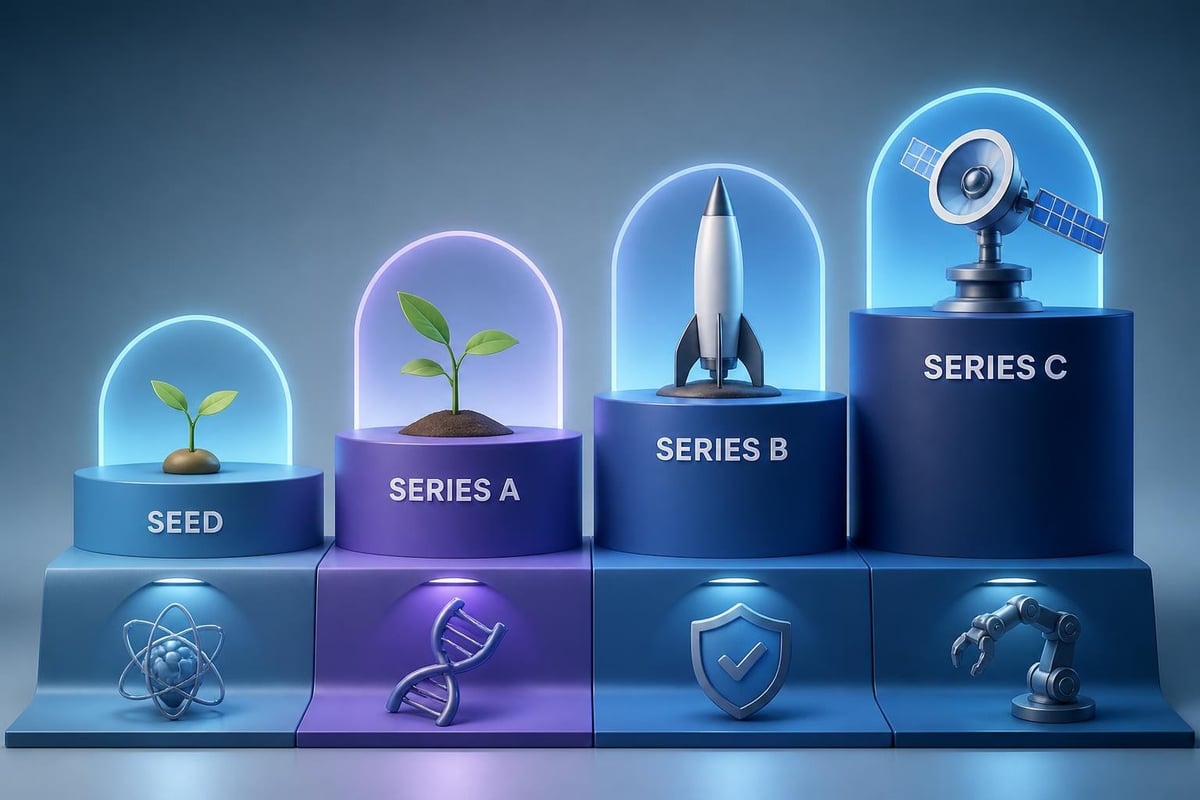
Deep tech startup funding requires planning across multiple stages with different investor profiles at each phase:
- Pre-seed ($500K - $2M): Angels, university funds, and research grants fund initial proof-of-concept
- Seed ($2M - $8M): Specialized deep tech seed funds support prototype development and patent filing
- Series A ($10M - $40M): Growth-stage VCs enter after technical validation and early customer conversations
- Series B+ ($30M - $150M): Late-stage funds and corporates finance manufacturing scale-up and market entry
Each stage demands progressively more concrete evidence of commercial viability. The analysis of deep tech funding dynamics from Crunchbase shows that companies progressing smoothly through these stages achieve 2.3x higher exit valuations than those experiencing financing gaps.

Regional Ecosystem Dynamics
Geography significantly influences deep tech startup funding opportunities and strategies. Certain regions offer concentrated expertise, specialized investors, and supportive infrastructure that accelerate development.
Leading deep tech hubs in 2026:
- Boston: Life sciences and biotechnology with $8.2B invested annually
- San Francisco Bay Area: Quantum computing and AI hardware with $12.1B annual investment
- London: Advanced materials and climate tech with £4.3B annual deployment
- Berlin: Industrial automation and robotics with €3.1B yearly funding
- Singapore: Semiconductor innovation and clean energy with $2.9B annual capital
The CFA Institute analysis on deep tech venture capital trends reveals that emerging ecosystems like Bangalore and Tel Aviv increasingly compete with traditional hubs by offering lower development costs and specialized talent pools.
Founders should consider relocating to ecosystems aligned with their sector focus. A space technology startup will find more relevant investors, talent, and testing facilities in Los Angeles than in New York. A synthetic biology venture benefits from proximity to Boston's concentration of academic labs and pharmaceutical partners.
Presentation Excellence in Deep Tech Fundraising
The complexity of deep tech creates unique communication challenges during fundraising. Investors need to grasp sophisticated science without drowning in technical details, while maintaining confidence in the team's expertise.
Professional creative pitch deck design becomes especially critical when explaining quantum coherence times, novel catalytic processes, or orbital mechanics to generalist investors. Visual storytelling transforms abstract concepts into compelling investment opportunities.
Design Principles for Technical Presentations
Effective deep tech presentations employ specific design strategies that enhance comprehension without oversimplifying:
- Custom infographics that visualize molecular structures, system architectures, or process flows
- Data visualizations emphasizing key performance metrics against theoretical limits or competitive benchmarks
- Progressive disclosure techniques that layer complexity appropriately for different audience segments
- Analogies and case studies that ground abstract technology in familiar contexts
Many deep tech founders underestimate the importance of visual communication, focusing exclusively on technical content. This creates a disconnect with investors who need both confidence in the science and excitement about commercial potential. Considering whether to rebrand before or after raising capital becomes relevant as companies transition from research project to commercial entity.
Capital Efficiency and Burn Rate Management
Deep tech startup funding must last far longer than typical software venture capital. A $10M Series A might need to sustain a 25-person team for 36 months while reaching critical technical milestones. Disciplined capital allocation separates successful ventures from those that run out of runway mid-development.
Strategies for extending capital efficiency:
- Prioritize experiments that directly validate commercial viability over pure scientific exploration
- Leverage cloud-based simulation and modeling tools before expensive physical prototypes
- Establish academic collaborations that provide equipment access and graduate student talent
- Pursue revenue-generating consulting or testing services that align with core technology
- Maintain flexible team structures with contractors and part-time advisors until product-market fit
The AlbionVC Deep Tech & Future of Compute report benchmarks typical burn rates across sectors, revealing that quantum computing startups average $1.1M monthly spend while advanced materials companies operate at $450K monthly. Understanding these benchmarks helps founders set appropriate fundraising targets.
Investors increasingly scrutinize capital efficiency metrics, rewarding teams that achieve technical milestones under budget. A company that reaches prototype validation for $4M instead of projected $6M demonstrates execution capability that translates to higher subsequent valuations.
Preparing for Institutional Due Diligence
Deep tech startup funding processes involve extensive technical validation that goes far beyond typical venture diligence. Investors engage independent scientific advisors, conduct patent landscape analysis, and assess manufacturing feasibility before committing capital.
Founders should prepare comprehensive data rooms containing:
- All intellectual property documentation including patent applications and prior art searches
- Technical validation reports from independent testing facilities or academic collaborators
- Detailed bill-of-materials and manufacturing process documentation
- Regulatory pathway analysis including agency pre-submissions when applicable
- Competitive landscape mapping showing both direct competitors and alternative technological approaches
- Financial models with sensitivity analysis on key technical and market assumptions
The most sophisticated deep tech teams maintain these materials continuously rather than scrambling during active fundraising. This preparation signals professionalism while accelerating diligence timelines by 6-8 weeks.
Building a Deep Tech Investor Network
Successful deep tech startup funding depends heavily on relationships with specialized investors who understand sector-specific dynamics. Generic venture capitalists rarely possess the technical expertise or patience required for capital-intensive, long-timeline ventures.
Identifying the right investor partners involves:
- Researching funds with track records in your specific technology domain
- Attending specialized conferences like DCVC's Deep Tech Summit or sector-specific scientific meetings
- Leveraging academic advisors and board members for warm introductions
- Building relationships 12-18 months before needing capital through regular progress updates
- Seeking investors who add strategic value beyond capital through technical networks and operational expertise
The most valuable investors bring domain expertise that accelerates technical development. A venture partner who previously led engineering at a semiconductor company provides immense value to a quantum computing hardware startup beyond their fund's capital.
Deep tech startup funding in 2026 demands strategic planning, exceptional communication, and unwavering focus on technical milestone achievement. Founders who master the unique dynamics of patient capital, maintain disciplined execution, and clearly articulate commercial vision position themselves for successful fundraising. When it comes time to present your breakthrough technology to sophisticated investors, Prznt Perfect transforms complex scientific concepts into compelling visual narratives that resonate with both technical and financial stakeholders, helping deep tech founders secure the capital they need to bring world-changing innovations to market.
