
Cybersecurity Brand Identity: Building Trust in Tech

In the digital age, cybersecurity companies face a unique branding challenge. They must communicate technical sophistication while building emotional trust with decision-makers who often lack deep technical expertise. A strong cybersecurity brand identity does more than differentiate your company from competitors; it serves as a visual and verbal promise that you can protect what matters most. For presentation designers working with financial and tech clients, understanding how these brands establish credibility through visual communication is essential to creating pitch decks and corporate materials that resonate with security-conscious stakeholders.
The Foundation of Cybersecurity Brand Identity
Building a cybersecurity brand identity requires balancing technical authority with accessibility. Security companies must demonstrate expertise without overwhelming potential clients with jargon, while simultaneously proving they understand the nuanced threats facing modern enterprises.
Trust as the Core Brand Element
Every cybersecurity brand ultimately sells trust. According to research on technology trust from Harvard Business Review, companies must demonstrate they can be trusted with technology through transparent practices and clear communication. This principle applies doubly to security vendors, who handle the most sensitive aspects of an organization's digital infrastructure.
Visual communication plays a critical role in establishing this trust. When creating cybersecurity pitch decks, designers must craft narratives that balance technical credibility with emotional reassurance. The color palette, typography, imagery, and layout all contribute to perceptions of reliability and competence.
Key trust signals in cybersecurity branding include:
- Industry certifications and compliance badges prominently displayed
- Clear, jargon-free explanations of complex security concepts
- Case studies with measurable results and named clients (when permitted)
- Transparent communication about security practices and incident response
- Professional design that conveys attention to detail
Research from NIST on transparency and trust emphasizes that transparent communication about security and privacy builds user trust more effectively than obscure technical specifications alone.
Visual Language and Design Principles
A cybersecurity brand identity must communicate protection, vigilance, and technological sophistication through visual means. The design choices you make in presentations, pitch decks, and marketing materials either reinforce or undermine your security message.
Color Psychology in Security Branding
Color selection carries significant psychological weight in the cybersecurity sector. Traditional choices include deep blues (suggesting stability and trust), blacks and grays (conveying sophistication and seriousness), and strategic accent colors that add energy without undermining professionalism.

| Color Family | Psychological Association | Use Case in Security Branding |
|---|---|---|
| Deep Blue | Trust, stability, expertise | Primary brand colors, backgrounds |
| Black/Charcoal | Sophistication, authority | Typography, premium positioning |
| Green | Safety, verification, go-ahead | Success states, compliance indicators |
| Red/Orange | Alert, urgency, threat | Threat visualization, call-to-action |
| White/Light Gray | Clarity, transparency | Backgrounds, data presentation |
When working with clients on their sales pitch deck for cybersecurity, these color choices should align with both industry expectations and the specific positioning of the company. A startup disrupting legacy security might embrace bolder, more contemporary colors, while an enterprise solution provider typically adheres to conservative, established palettes.
Typography and Readability
Typography in cybersecurity brand identity must balance technical precision with readability. Sans-serif fonts dominate the industry because they convey modernity and clarity, essential qualities when explaining complex security concepts.
The typography hierarchy in security presentations should guide viewers through technical information without overwhelming them. Headers establish the narrative structure, body text delivers detailed explanations, and carefully designed data visualizations transform complex threat landscapes into actionable insights.
Messaging Architecture and Voice
Beyond visual elements, cybersecurity brand identity depends heavily on how you communicate. The voice, tone, and messaging framework must align with both technical accuracy and business accessibility.
Positioning Statements That Resonate
Effective cybersecurity positioning balances three elements: the specific problem you solve, the unique approach you take, and the measurable outcomes clients achieve. Generic claims about "best-in-class security" lack the specificity needed to differentiate in a crowded market.
Strong positioning statements typically include:
- A clearly defined target audience (mid-market financial institutions, healthcare providers, SaaS companies)
- The specific security challenge you address (ransomware prevention, compliance automation, threat intelligence)
- Your differentiated approach (AI-powered detection, zero-trust architecture, managed services)
- Quantifiable business outcomes (reduced breach risk by X%, compliance achieved in Y days)
According to Forrester research on business-buyer trust in IT services, buyers prioritize vendors who demonstrate deep understanding of their industry-specific challenges. Generic security messaging fails to establish this credibility.
Technical Communication Without Jargon
One of the most challenging aspects of cybersecurity brand identity involves explaining sophisticated technical capabilities to non-technical decision-makers. CFOs, CEOs, and board members need to understand security value without wading through acronym-heavy technical specifications.
This is where visual storytelling through presentations becomes essential. Complex security architectures, threat detection workflows, and incident response procedures can be transformed into clear visual narratives that communicate capability without requiring technical expertise from the audience.
The Nielsen Norman Group's research on UX writing provides evidence-backed guidance for clarity and tone in technical communication. Their principles apply directly to security messaging: use concrete language, avoid unnecessary technical terms, and structure information to support scanning and comprehension.
Brand Consistency Across Touchpoints
A cybersecurity brand identity must maintain consistency across every customer touchpoint, from initial pitch deck to product interface to customer support communications. Inconsistency creates doubt, and doubt is fatal when selling security solutions.
Presentation Design as Brand Expression
For cybersecurity companies, pitch presentations represent critical brand touchpoints. A cybersecurity startup pitch deck must communicate both the severity of the security landscape and the confidence that your solution provides effective protection.
Design consistency in these materials includes:
- Unified color palette across all slides and sections
- Consistent typography hierarchy and spacing
- Standardized data visualization approaches
- Cohesive iconography and illustration style
- Aligned photographic or illustrative treatments
When agencies like Prznt Perfect work with cybersecurity clients, they ensure these brand elements work together to create a professional, trustworthy impression that supports the technical narrative.
Digital and Physical Brand Touchpoints
The cybersecurity brand identity extends beyond presentations to websites, product interfaces, marketing materials, and even office environments for companies with physical locations. Each touchpoint should reinforce core brand attributes.
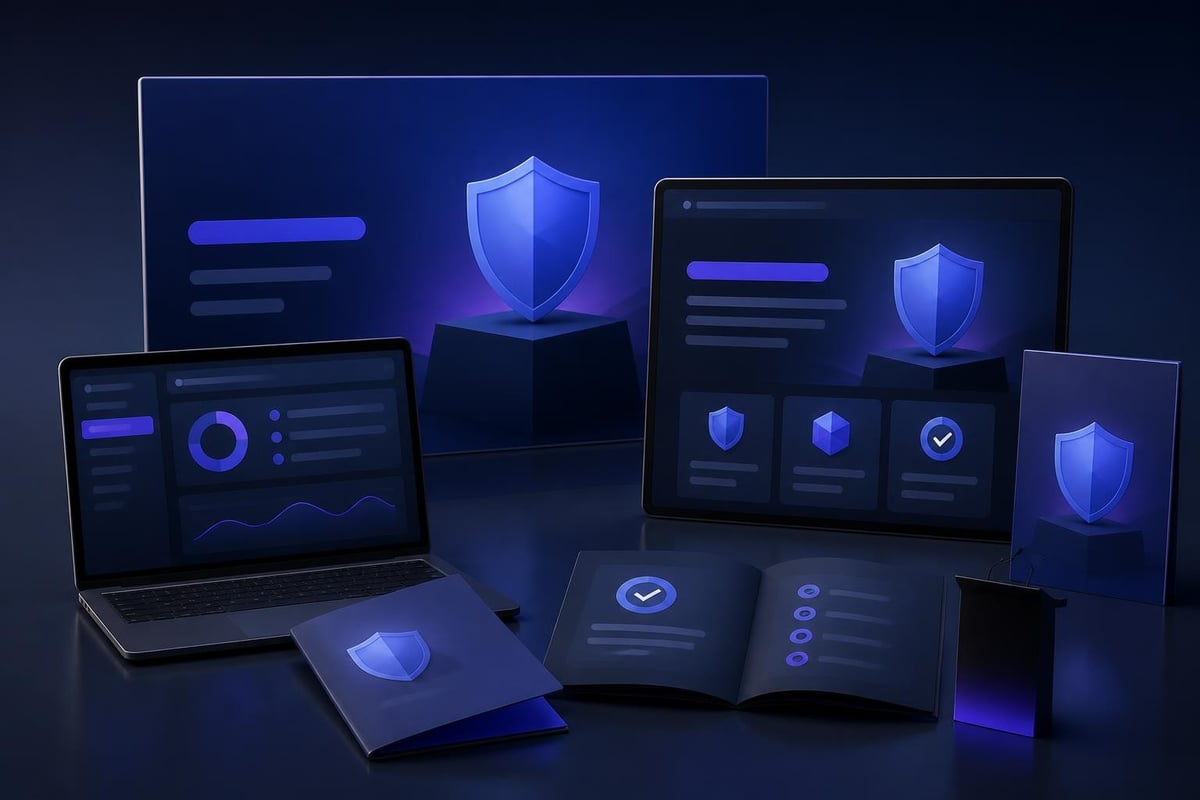
Research on designing trustworthy user interfaces shows that interface features significantly influence user trust. For cybersecurity products, this means dashboard design, alert systems, and reporting interfaces must align with brand promises about clarity, control, and reliability.
Data Visualization and Technical Credibility
Cybersecurity companies deal with complex data: threat intelligence, vulnerability assessments, network traffic analysis, and compliance metrics. How you visualize this data directly impacts brand perception.
Transforming Complex Data Into Clear Narratives
Effective data visualization in cybersecurity brand materials serves two purposes: it demonstrates technical sophistication while making complex information accessible. Well-designed charts, graphs, and infographics prove you understand the security landscape and can communicate insights clearly to stakeholders.
Best practices for security data visualization:
- Use consistent chart types for similar data categories
- Employ color coding that aligns with industry conventions (red for threats, green for secure)
- Include clear labels and context for all metrics
- Avoid overwhelming audiences with too many data points in a single view
- Provide clear takeaways and action items from data insights
When creating presentations for tech and financial clients, designers must translate raw security data into visual stories that support decision-making. A fintech pitch deck discussing cybersecurity might visualize fraud detection accuracy, transaction security protocols, or compliance coverage using carefully designed infographics that build confidence without requiring technical interpretation.
Proof Points and Social Proof
Cybersecurity brand identity benefits enormously from concrete proof points: customer testimonials, case studies, third-party validations, and industry recognitions. These elements must be incorporated into brand materials with design treatments that highlight credibility without appearing boastful.
| Proof Type | Brand Impact | Presentation Approach |
|---|---|---|
| Customer logos | Association with recognized brands | Clean grid layout, subtle treatment |
| Case study metrics | Quantifiable results | Bold numbers, context in supporting text |
| Industry awards | Third-party validation | Badge display with brief descriptions |
| Certifications | Compliance and standards | Professional badge treatment, linked details |
| Media mentions | Thought leadership | Quoted excerpts with source attribution |
Privacy, Compliance, and Brand Promise
Modern cybersecurity brand identity increasingly intersects with privacy commitments. As data protection regulations expand globally, security vendors must communicate how they protect not just systems but also personal information.
Integrating Privacy Into Brand Messaging
According to IAPP research on privacy and consumer trust, privacy practices significantly affect brand perception. Security companies that transparently communicate data handling, storage, and protection practices build stronger trust with both enterprise clients and end users.
This transparency should extend to visual communication. Privacy policies, data handling procedures, and compliance frameworks can be presented through clear, accessible infographics rather than dense legal text. When working with developers who need to understand security protocols, platforms like FreelanceDEV benefit from clear visual documentation of security requirements and data protection standards.
Regulatory Compliance as Brand Differentiator
Compliance certifications (SOC 2, ISO 27001, GDPR, HIPAA) represent significant brand assets for cybersecurity companies. These should be prominently featured in pitch materials, with clear explanations of what each certification means for client protection.
Deloitte's research on trust and cybersecurity provides case studies showing how organizations build credibility through demonstrated compliance and transparent security practices. Visual presentation of compliance coverage, audit results, and security protocols reinforces brand promises with verifiable evidence.
Brand Evolution and Market Positioning
Cybersecurity brand identity must evolve with the threat landscape while maintaining core brand recognition. Successful security brands balance consistency with adaptation.
Responding to Emerging Threats
The cybersecurity sector faces constant change: new attack vectors, evolving regulations, emerging technologies, and shifting client priorities. Brand identity must flex to address these changes without losing core recognition.
When ransomware surged as a primary threat, security brands adjusted messaging and visual materials to address this specific concern. When zero-trust architecture became the industry standard, brand positioning evolved to highlight relevant capabilities. This adaptability should be reflected in presentation materials, website content, and product interfaces.

Competitive Differentiation Through Brand
The cybersecurity market grows increasingly crowded, with hundreds of vendors competing for attention. Strong brand identity provides differentiation when product capabilities appear similar on the surface.
Visual differentiation matters significantly in this context. While most security vendors use similar color palettes and design approaches, thoughtful variation within industry norms creates memorability. A distinctive illustration style, unique data visualization approach, or characteristic layout methodology can make presentations and marketing materials instantly recognizable.
Financial advisors like Brookwood Investment Group evaluate cybersecurity vendors for client portfolios based partly on brand professionalism and communication clarity. Well-designed pitch materials that clearly articulate value propositions make stronger impressions than technically dense presentations that obscure key benefits.
Strategic Design Decisions for Long-Term Impact
Building a cybersecurity brand identity involves strategic decisions that impact long-term market perception and business success.
Designing for Multiple Audiences
Cybersecurity companies typically serve multiple stakeholder groups: technical buyers (CISOs, IT managers), business buyers (executives, board members), end users, and partners. Brand identity must resonate across these diverse audiences without diluting core messages.
This multi-audience challenge appears prominently in presentation design. A technical deep-dive for security teams requires different visual treatment than an executive overview for board members. However, both should share consistent brand elements that create recognition and reinforce key differentiators.
Investment in Professional Design
Many cybersecurity startups underestimate the importance of professional design in establishing credibility. DIY presentations using template solutions may work for internal communications, but investor pitches, sales presentations, and conference keynotes demand professional polish.
The Nielsen Norman Group's research on ecommerce trust and credibility shows that design quality significantly influences trust perceptions. In cybersecurity, where trust is the product, subpar design directly undermines brand value.
Benefits of professional design investment:
- Enhanced credibility with investors and enterprise buyers
- Improved communication of complex technical concepts
- Stronger differentiation from competitors with generic branding
- More effective sales enablement materials
- Consistent brand expression across all touchpoints
When evaluating whether to hire your first graphic designer or partner with a specialized agency, consider the strategic importance of visual communication in establishing cybersecurity brand identity.
Measuring Brand Impact
Unlike product features, brand impact can be challenging to measure. However, cybersecurity companies can track several indicators of brand strength and effectiveness.
Quantitative Brand Metrics
Key performance indicators for cybersecurity brand identity include:
- Brand awareness in target markets (aided and unaided recall)
- Share of voice in industry publications and events
- Website traffic from branded search terms
- Sales cycle length (strong brands typically shorten cycles)
- Win rates in competitive evaluations
- Customer acquisition cost trends
- Net promoter score and customer satisfaction ratings
When presenting to investors or board members, these metrics demonstrate brand value beyond subjective assessments. Tech startup pitch decks should include brand metrics alongside product and financial data to show comprehensive business health.
Qualitative Brand Assessment
Beyond numbers, qualitative feedback provides insight into brand perception. Customer interviews, prospect surveys, and win/loss analysis reveal how your cybersecurity brand identity influences buying decisions.
Pay particular attention to how customers describe your company when making referrals. The language they use, the attributes they emphasize, and the comparisons they make all reflect brand positioning effectiveness. This feedback should inform ongoing refinement of visual identity, messaging architecture, and presentation approaches.
A strong cybersecurity brand identity combines visual sophistication, clear messaging, and consistent execution across every touchpoint to build the trust essential for security solutions. From color palettes and typography to data visualization and compliance communication, every design decision either reinforces or undermines your credibility in protecting what matters most. Prznt Perfect specializes in transforming complex technical narratives into compelling visual stories that resonate with investors, clients, and stakeholders, helping cybersecurity and fintech companies establish the professional brand presence that drives business growth.


- This is some text inside of a div block.lay out the facts clearly and compellingly. Use data to establish the ground reality, but remember that facts alone are like the individual strands of a tapestry—necessary but not complete.lay out the facts clearly and compellingly. Use data to establish the ground reality, but remember that facts alone are like the individual strands of a tapestry—necessary but not complete.
- This is some text inside of a div block.lay out the facts clearly and compellingly. Use data to establish the ground reality, but remember that facts alone are like the individual strands of a tapestry—necessary but not complete.

.png)
