
Cybersecurity Design Agency: Visual Strategy Guide
The cybersecurity industry faces a unique communication challenge in 2026. While the technology protecting digital assets grows increasingly sophisticated, explaining these complex solutions to stakeholders, investors, and clients demands a specialized approach. A cyversecurity design agency bridges this gap by translating technical security concepts into visually compelling narratives that resonate with decision-makers. This specialized expertise has become essential for security firms competing in markets where trust, clarity, and professionalism directly impact business outcomes.
Understanding the Cybersecurity Design Landscape
The cybersecurity sector requires design approaches that differ fundamentally from other industries. Security companies must balance technical credibility with accessibility, ensuring their visual communications demonstrate expertise without overwhelming audiences. A cyversecurity design agency specializes in this delicate equilibrium, understanding both the technical nuances of security solutions and the psychological triggers that drive business decisions.
Financial institutions and technology companies investing in cybersecurity solutions evaluate vendors based on multiple criteria. Beyond technical capabilities, they assess how well potential partners communicate their value proposition. Professional presentation design plays a critical role in these evaluations, particularly during high-stakes pitch meetings and quarterly business reviews.
Key Differentiators in Security-Focused Design
Effective cybersecurity visual communication requires several specialized competencies:
- Technical accuracy in representing security architectures, threat models, and compliance frameworks
- Risk visualization that quantifies vulnerabilities without triggering unnecessary alarm
- Trust-building aesthetics that reinforce professionalism and reliability
- Data simplification for complex security metrics and performance indicators
- Regulatory awareness ensuring visuals align with industry compliance standards
Organizations working with a cyversecurity design agency gain access to designers who understand zero-trust architectures, endpoint detection systems, and threat intelligence platforms. This technical fluency ensures visual communications accurately represent security capabilities while remaining accessible to non-technical stakeholders.

Visual Communication Challenges in Security Marketing
Security companies encounter distinct obstacles when presenting their solutions. The secure by design approach that defines modern cybersecurity development requires equally thoughtful visual strategy. Traditional marketing materials often fail to address the specific concerns of security-conscious buyers in financial services and technology sectors.
Common Pitfalls in Cybersecurity Presentations
Many security firms struggle with presentation materials that undermine their credibility:
- Over-reliance on technical jargon that alienates executive audiences
- Generic stock imagery showing hooded figures and binary code that fails to differentiate brands
- Dense text slides overwhelming viewers with feature lists instead of benefits
- Inconsistent branding across pitch decks, white papers, and investor materials
- Poor data visualization making security metrics incomprehensible to stakeholders
A specialized cyversecurity design agency addresses these challenges through strategic visual frameworks. By studying successful cybersecurity pitch decks, designers identify patterns that convert technical capabilities into compelling business cases.
| Design Challenge | Traditional Approach | Specialized Agency Solution |
|---|---|---|
| Explaining threat detection | Flowcharts with technical terms | Visual narratives showing business impact |
| ROI demonstration | Spreadsheet screenshots | Interactive data visualizations |
| Compliance messaging | Text-heavy regulatory lists | Visual compliance roadmaps |
| Product differentiation | Feature comparison tables | Value-based visual hierarchies |
The financial consequences of ineffective visual communication extend beyond lost sales opportunities. Security firms competing for enterprise contracts often face situations where equally capable solutions differentiate primarily through presentation quality and brand perception.
Strategic Frameworks for Security Presentations
Developing compelling cybersecurity presentations requires structured methodologies that balance technical depth with strategic clarity. A cyversecurity design agency employs frameworks specifically designed for security sector communication challenges.
The Security Value Pyramid
Effective security presentations follow a hierarchical structure that addresses stakeholder priorities:
Foundation: Risk Mitigation At the base, visuals establish the threat landscape and quantify risks specific to the prospect's industry. This foundation uses data-driven visualizations that demonstrate understanding of the client's security challenges.
Middle: Solution Architecture The second tier illustrates how specific security capabilities address identified risks. Visual storytelling techniques transform complex technical architectures into understandable protection mechanisms.
Apex: Business Outcomes The pyramid culminates in clear business metrics: reduced breach probability, compliance achievement, operational efficiency gains, and competitive advantages.
This framework ensures presentations resonate across diverse audiences, from CISOs evaluating technical fit to CFOs assessing return on security investments. Building cyber resilience through design requires visual communications that acknowledge both technical and business perspectives.

Audience-Specific Design Adaptations
Different stakeholder groups require tailored visual approaches:
- Executive leadership: Focus on risk reduction, compliance status, and competitive positioning through high-level dashboards
- Technical teams: Provide detailed architecture diagrams, integration workflows, and performance benchmarks
- Board members: Emphasize governance frameworks, regulatory compliance, and fiduciary risk mitigation
- Investors: Highlight market opportunity, competitive differentiation, and scalability metrics
A cyversecurity design agency maintains design systems that enable rapid customization across these audience segments while preserving brand consistency. This efficiency proves particularly valuable for security startups building multiple presentation variations for different funding rounds and partnership discussions.
Design Elements That Build Security Brand Trust
Visual credibility in cybersecurity extends beyond aesthetic appeal. Every design choice either reinforces or undermines the trust essential for security partnerships. Research examining user-centered design in cybersecurity reveals how visual elements influence perception of security expertise.
Color Psychology in Security Branding
Color choices communicate subliminal messages about security capabilities:
Blues and Grays: Convey reliability, professionalism, and technical competence. Dominant in enterprise security brands because they suggest stability and trustworthiness.
Accent Colors: Strategic use of red (alerts), green (secure status), and yellow (warnings) creates intuitive visual systems that audiences understand instinctively.
Contrast and Readability: High contrast ensures presentations remain legible in various viewing conditions, from bright conference rooms to dimly lit auditoriums.
Professional agencies working on cybersecurity startup pitch decks understand how color systems create cohesive brand experiences across investor presentations, product demonstrations, and marketing materials.
Typography and Information Hierarchy
Font selection and text hierarchy significantly impact credibility:
- Primary typefaces: Modern sans-serif fonts project contemporary technical expertise
- Heading weights: Bold, clear headings enable quick information scanning
- Body text: Optimal sizing (minimum 18pt for presentations) ensures readability
- Code elements: Monospace fonts for technical specifications maintain authenticity
A cyversecurity design agency develops comprehensive typography systems that maintain consistency across presentation formats, from detailed investor decks to concise executive summaries.
Case Study Applications Across Security Sectors
Examining real-world implementations reveals how specialized design agencies deliver measurable value. The Eclypsium case study demonstrates how strategic branding strengthens market positioning for security technology providers.
Enterprise Security Platform Launch
A mid-market security platform approached a design agency needing investor presentations for Series B funding. The challenge involved explaining machine learning-based threat detection to venture capitalists without security backgrounds.
The agency developed a visual narrative framework showing:
- Threat evolution timelines illustrating growing attack sophistication
- ML model visualizations demonstrating detection capabilities without technical complexity
- ROI calculators showing cost savings versus traditional security approaches
- Customer success metrics presented through compelling before/after scenarios
This approach, similar to strategies detailed in the Bowtie cybersecurity case study, translated complex technology into clear business benefits. The resulting presentation helped secure $15 million in funding.
Identity Management Solution Positioning
An identity management startup needed to differentiate in a crowded market. Working with a specialized cyversecurity design agency, they developed presentations emphasizing unique architectural advantages through visual comparison frameworks.
| Design Element | Before Agency | After Redesign |
|---|---|---|
| Slide count | 47 slides | 23 slides |
| Average text per slide | 85 words | 22 words |
| Visual-to-text ratio | 30% visual | 70% visual |
| Conversion rate | 12% | 34% |
The streamlined approach, informed by principles similar to those in designing for SME cybersecurity, doubled their sales presentation effectiveness.
Presentation Design Process for Security Companies
Creating high-impact cybersecurity presentations requires systematic workflows that ensure technical accuracy and visual excellence. A professional cyversecurity design agency follows structured processes that deliver consistent results.
Discovery and Technical Validation
Initial project phases focus on understanding both the security technology and target audiences:
- Technical briefings with security architects and product managers
- Competitive analysis examining how rivals position similar solutions
- Audience profiling identifying decision criteria and information priorities
- Content audits evaluating existing materials for technical accuracy and messaging gaps
This foundation ensures designers grasp security concepts sufficiently to represent them accurately. Similar to approaches used in gamification for cybersecurity education, the goal involves making complex concepts accessible without sacrificing accuracy.
Visual Development and Iteration
The design phase transforms technical content into compelling narratives:
- Wireframing: Establishing information architecture and slide flow
- Visual concepting: Developing metaphors and visual systems for abstract security concepts
- Data visualization: Creating charts, diagrams, and infographics that clarify metrics
- Refinement cycles: Iterating based on stakeholder feedback and technical review
Many organizations exploring new presentation design approaches discover that specialized agencies bring efficiency to this process through established security-focused design systems.
Quality Assurance and Delivery
Final stages ensure presentations perform across various contexts:
- Technical review: Validating accuracy with subject matter experts
- Format optimization: Testing across devices, screen sizes, and presentation software
- Accessibility compliance: Ensuring materials meet WCAG standards
- Version management: Delivering master files with editable components for future updates
Professional agencies provide comprehensive delivery packages including presentation files, brand guidelines, and template systems enabling internal teams to maintain visual consistency.
Measuring Design Impact on Security Business Outcomes
Quantifying the return on professional design investment requires tracking specific metrics. A cyversecurity design agency helps clients establish measurement frameworks connecting visual communications to business results.
Conversion Metrics
Effective presentations drive measurable outcomes:
- Pitch-to-proposal conversion: Percentage of presentations leading to formal proposals
- Proposal-to-contract: Win rate for proposals following strong presentations
- Average deal size: Correlation between presentation quality and contract value
- Sales cycle duration: Time from first pitch to signed agreement
Organizations tracking these metrics typically observe 25-40% improvements after implementing professionally designed presentation systems. Similar patterns appear across various cybersecurity agency case studies, demonstrating consistent value delivery.
Brand Perception Indicators
Beyond immediate sales metrics, design quality influences long-term brand strength:
| Metric | Measurement Method | Target Improvement |
|---|---|---|
| Brand recall | Post-presentation surveys | +30% |
| Perceived expertise | Stakeholder interviews | +25% |
| Referral likelihood | Net Promoter Score | +15 points |
| Media coverage quality | PR mention analysis | +40% |
These indicators demonstrate how a cyversecurity design agency contributes to broader market positioning beyond individual sales opportunities.
Integration with Broader Marketing Strategy
Effective security presentations exist within comprehensive marketing ecosystems. A specialized design agency ensures visual consistency across all customer touchpoints, from initial awareness through post-sale relationships.
Multi-Channel Design Systems
Security companies require coordinated visual experiences across:
Digital Properties: Websites, landing pages, and online demos using design systems aligned with presentation aesthetics. Firms like Fixel specialize in creating cohesive digital experiences for security companies.
Sales Enablement: Pitch decks, one-pagers, case studies, and proposal templates sharing common visual language.
Marketing Collateral: White papers, infographics, webinar slides, and conference materials reinforcing brand identity.
Investor Relations: Quarterly updates, annual reports, and funding presentations maintaining professional standards.
This integrated approach mirrors strategies used by agencies serving financial technology clients, where visual consistency across touchpoints builds cumulative trust.
Content Repurposing Frameworks
Professional agencies design modular systems enabling efficient content adaptation:
- Master slide libraries: Comprehensive component collections for rapid assembly
- Data visualization templates: Reusable chart frameworks for consistent metric presentation
- Icon systems: Custom security-focused icon sets reinforcing brand identity
- Animation templates: Motion design elements adding polish to key messages
These systems reduce ongoing design costs while maintaining quality. Organizations frequently report 60-70% time savings on presentation development after implementing comprehensive design systems.
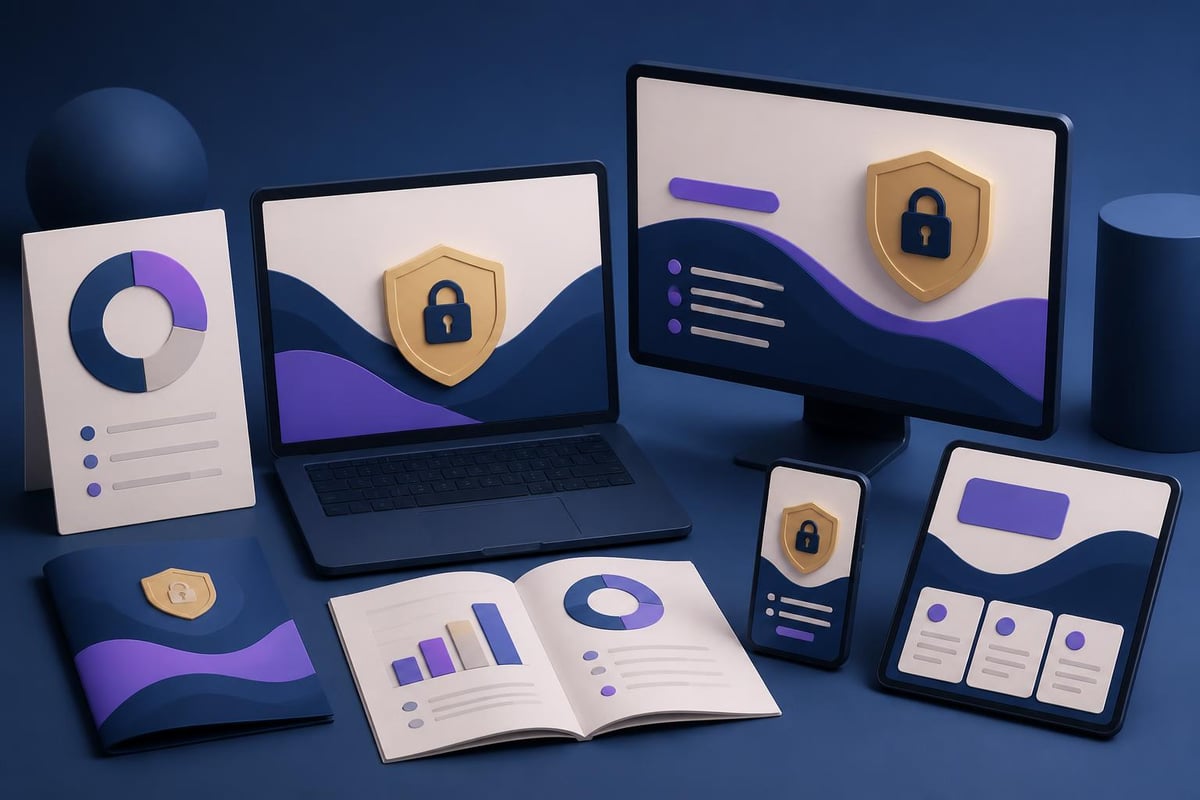
Specialized Considerations for Financial and Tech Sectors
Security companies serving financial services and technology sectors face additional design considerations. A cyversecurity design agency familiar with these markets understands regulatory constraints and audience expectations specific to these industries.
Financial Services Requirements
Presentations for banking, investment, and insurance clients must address:
- Regulatory compliance: Visual references to relevant frameworks (SOC 2, PCI-DSS, GDPR)
- Risk quantification: Financial impact modeling showing breach cost avoidance
- Audit readiness: Documentation standards supporting compliance reviews
- Fiduciary responsibility: Messaging addressing board-level governance concerns
Similar considerations apply when developing presentations for other regulated contexts, as demonstrated by professional firms like the Law Offices of Darrin T. Mish, P.A., which must communicate complex regulatory matters clearly to diverse audiences.
Technology Sector Expectations
Tech company audiences demand:
Integration clarity: Visual representations of API connections, cloud architectures, and development workflows
Scalability narratives: Growth projections showing security solutions adapting to expanding operations
Innovation indicators: Design aesthetics suggesting cutting-edge capabilities and forward-thinking approaches
Developer-friendly content: Technical depth satisfying engineering stakeholders while remaining accessible to business leaders
These sector-specific requirements necessitate design partners who understand industry nuances beyond general presentation skills.
Future Trends in Cybersecurity Design
The evolution of security threats and business models drives continuous innovation in how companies communicate their protective capabilities. A forward-thinking cyversecurity design agency anticipates these trends, positioning clients for emerging opportunities.
Interactive and Dynamic Presentations
Static slides increasingly give way to interactive experiences:
- Embedded demonstrations: Live security platform interfaces within presentations
- Scenario simulators: Interactive threat response walkthroughs showing solution capabilities
- Personalized content: Dynamic presentations adapting based on audience responses
- Real-time data integration: Live dashboards showing current threat landscapes
These approaches, informed by research on serious games for cybersecurity education, create memorable experiences differentiating security vendors.
AI-Enhanced Design Processes
Artificial intelligence transforms presentation development workflows:
- Content generation: AI drafting initial technical descriptions requiring designer refinement
- Data visualization: Automated chart creation from raw security metrics
- Accessibility optimization: AI ensuring WCAG compliance across presentation elements
- Localization: Machine translation with human oversight for international markets
Professional agencies leverage these tools while maintaining the strategic thinking and creative excellence that artificial intelligence cannot replicate, similar to how platforms like CreateSell empower entrepreneurs to build scalable digital products through systematic processes.
Sustainability and Efficiency
Environmental consciousness influences design practices:
- Digital-first delivery: Reducing printed materials through interactive digital presentations
- Efficient file formats: Optimized presentations minimizing storage and transmission energy
- Reusable design systems: Modular components reducing redundant design work
- Remote collaboration: Virtual design processes eliminating travel-related carbon footprints
These considerations align with broader corporate responsibility initiatives while reducing operational costs.
Selecting the Right Design Partner
Security companies evaluating design agencies should assess specific capabilities beyond general creative expertise. The selection process determines whether visual communications enhance or undermine technical credibility.
Essential Evaluation Criteria
When choosing a cyversecurity design agency, prioritize these factors:
Security Industry Experience: Review portfolios showing previous cybersecurity clients and understanding of technical concepts. Agencies like 40fi.digital specialize specifically in security sector design.
Technical Fluency: Assess whether designers can discuss security architectures, threat models, and compliance frameworks intelligently during discovery conversations.
Process Maturity: Evaluate workflows ensuring technical accuracy, including subject matter expert review cycles and quality assurance protocols.
Portfolio Quality: Examine previous cybersecurity work for visual sophistication, information clarity, and brand consistency.
Client References: Speak with previous clients about collaboration effectiveness, deadline adherence, and business impact.
Red Flags and Warning Signs
Avoid agencies demonstrating these concerning characteristics:
- Generic portfolios lacking security-specific examples
- Inability to discuss technical security concepts during initial consultations
- Over-reliance on stock imagery and template-based approaches
- Lack of revision processes incorporating technical feedback
- Absence of measurable outcomes from previous client engagements
The partnership between security companies and design agencies requires mutual respect for technical and creative expertise. Successful relationships balance security team input with design professional judgment.
Building Long-Term Design Partnerships
The most valuable relationships between security companies and design agencies extend beyond individual projects. A strategic cyversecurity design agency becomes an extension of internal marketing teams, developing deep understanding of products, markets, and audiences over time.
Retainer and Ongoing Support Models
Continuous collaboration delivers compounding benefits:
Monthly Design Allocation: Reserved design hours for presentations, updates, and new materials as needs arise
Quarterly Strategy Reviews: Regular sessions assessing market changes, competitive developments, and messaging refinement opportunities
Template Maintenance: Ongoing updates ensuring design systems remain current with brand evolution and platform updates
Priority Access: Guaranteed capacity for urgent presentation needs supporting critical business opportunities
These arrangements provide cost predictability while ensuring design resources availability when needed, much like how professional service providers such as John Logan Consulting offer ongoing career support rather than one-time interventions.
Knowledge Transfer and Team Development
Mature design partnerships include capability building:
- Design system training: Teaching internal teams to maintain brand consistency
- Best practices workshops: Educating sales and marketing staff on effective visual communication
- Template customization guidance: Empowering teams to adapt materials for specific situations
- Quality review services: Providing feedback on internally created materials
This approach balances professional design quality with organizational self-sufficiency.
International Market Considerations
Security companies expanding globally encounter additional presentation challenges. A sophisticated cyversecurity design agency addresses localization requirements extending beyond simple translation.
Cultural Design Adaptations
Visual communication effectiveness varies across cultures:
- Color symbolism: Colors carrying different meanings in various markets require strategic adjustment
- Information density: Preferences for detailed versus simplified presentations differ regionally
- Authority indicators: Trust signals varying from technical certifications to industry partnerships
- Visual metaphors: Imagery resonating in one culture potentially confusing or offensive in another
Professional agencies maintain cultural advisors ensuring presentations perform effectively across target markets, similar to how financial advisors like Roling Advies must understand local regulatory frameworks when serving international clients.
Regulatory Compliance Across Jurisdictions
International security presentations must address varied regulatory landscapes:
| Region | Key Regulations | Design Implications |
|---|---|---|
| European Union | GDPR, NIS Directive | Privacy-first messaging, data sovereignty emphasis |
| United States | CCPA, HIPAA, SOX | Sector-specific compliance frameworks |
| Asia-Pacific | APPI, PDPA variants | Localized privacy standards |
| Middle East | NESA, CITC | Government alignment messaging |
These requirements necessitate flexible presentation systems accommodating regional variations while maintaining core brand identity.
Resource Investment and Budget Planning
Understanding the financial commitment required for professional presentation design helps security companies plan appropriately. A cyversecurity design agency provides transparent pricing aligned with project scope and business value.
Typical Investment Ranges
Professional presentation design costs vary based on complexity and deliverables:
Single Presentation Projects: $3,000-$15,000 for comprehensive pitch decks, depending on slide count, custom illustration needs, and revision cycles
Design System Development: $15,000-$50,000 for complete brand systems including templates, guidelines, and component libraries
Ongoing Retainers: $2,000-$10,000 monthly for continuous design support and materials development
Enterprise Programs: $50,000+ annually for comprehensive visual communication programs serving large organizations
These investments deliver returns through improved conversion rates, shortened sales cycles, and enhanced brand perception. Organizations tracking metrics typically observe 3-5x ROI from professional presentation design within the first year.
Cost-Benefit Analysis Framework
Evaluating design investment value requires considering:
- Deal size impact: How presentation quality influences contract value
- Win rate improvement: Conversion increase from professional materials
- Time savings: Internal resource allocation benefits
- Brand equity: Long-term market positioning enhancement
- Competitive advantage: Differentiation value in crowded markets
Companies approaching design as strategic investment rather than expense consistently achieve superior outcomes compared to those viewing it as discretionary spending.
Professional visual communication has evolved from nice-to-have to competitive necessity in the cybersecurity sector. The specialized expertise a cyversecurity design agency provides translates complex security technologies into compelling narratives that drive business results across financial services, technology, and enterprise markets. When your security company needs presentation materials that demonstrate technical credibility while converting stakeholder meetings into signed contracts, Prznt Perfect delivers the specialized design expertise that transforms how clients and investors perceive your security solutions.

- This is some text inside of a div block.lay out the facts clearly and compellingly. Use data to establish the ground reality, but remember that facts alone are like the individual strands of a tapestry—necessary but not complete.lay out the facts clearly and compellingly. Use data to establish the ground reality, but remember that facts alone are like the individual strands of a tapestry—necessary but not complete.
- This is some text inside of a div block.lay out the facts clearly and compellingly. Use data to establish the ground reality, but remember that facts alone are like the individual strands of a tapestry—necessary but not complete.

.png)
