State of Pitch Decks in 2026: industry report

Intro
Okay, we’re still designing slides in 2026, and here’s why. We built this report because nobody was measuring the thing we actually do (as for who we are, you can read more here).
There’s a popular idea that nobody needs slides anymore, that everything moved to the web, to product-led demos, to a Loom link. From where a lot of people sit, that looks true. From where we sit, it doesn’t. The presentation industry is thriving in 2026. You just can’t see most of it.
5 things about decks
Attention is short, and still shrinking Investor time spent on a deck has been falling for almost a decade. The latest publicly available data by DocSend states that investors spent about 2.4 minutes on a deck in 2023, and that number has likely fallen even further since then.
You are not writing for a reader. You are writing for someone deciding, in seconds, whether to keep reading.
A committee decides, not a person Six to ten people typically sit inside a B2B decision (Gartner).
Forrester now counts 13 internal plus 9 external on average. You are not writing for a reader. You are writing for someone deciding, in seconds, whether to keep reading.
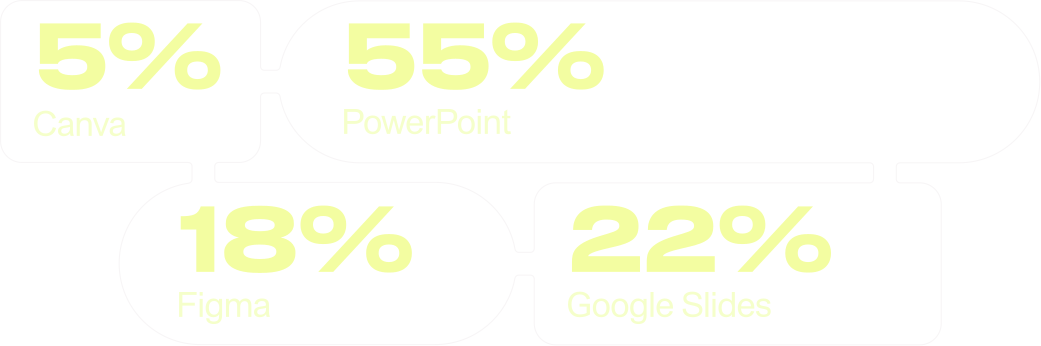
The tool is no longer the question PowerPoint, Figma, Google Slides, or even Lovable: it matters far less than whether the argument holds. We will come back to why the tool debate is a distraction.

AI hype and AI reality are far apart Only 4.8% of the projects in our sample publicly credited the use of AI production, despite the industry-wide conversation suggesting that the AI takeover is inevitable. That doesn’t necessarily mean AI wasn’t used, just that its use wasn’t disclosed.
% mentioned AI useThe buyer is already most of the way there. Around 61% of the buying journey happens before the first contact with a seller, and 77% of buyers end up choosing their top-ranked vendor. Getting your message across early is critical.
A slide deck isn’t one thing

Here’s the second thing the “do we even need slides” conversation misses: “a deck” isn’t a single product.
There are several kinds, each built for a different purpose, a different audience, and a different set of rules — because the slide’s job changes with the deck’s job. And that’s the question worth asking before anyone opens a design tool: what is this slide actually for?
Not “what should it say” — what should it do to the person reading it. A slide’s job is never to look nice. It’s to move one specific reader one step closer to one specific decision. Everything else serves that.
Presented vs read alone

Cross-cutting both types is a question that matters just as much: is someone presenting this, or reading it alone?
A deck someone presents in a meeting and a deck someone reads alone from a link are not the same document. They get built as one file all the time, and it’s almost always a compromise.
Stands on its own
Universal
Tools & formats
This is a direction in a verified sample, not “market share.” Our dataset includes 28 projects with a confirmed tool.
AI + decks helps & breaks
AI adoption is widespread, but professionals still hesitate to trust it with an entire presentation. 80% use AI in their presentation workflows, but only 27% use it to generate complete presentations. In Europe, just 14% are satisfied with presentations generated from scratch.
Demand for AI is strongest in frequent, internal, and time-sensitive presentation tasks. For investor pitches, board meetings, and high-stakes presentations, AI remains primarily a drafting tool and a sounding board. Humans still take responsibility for the final deliverable.