


Wealth Management Pitchbook Design: Complete Guide
How to plan wealth management pitchbook design: section structure, performance charts, compliance disclosures and modular slides for RIAs and private banks.

The wealth management industry operates in a sphere where trust, credibility, and clarity drive every client relationship. In this high-stakes environment, a pitchbook serves as more than a simple marketing tool. It functions as a strategic instrument that communicates investment philosophy, demonstrates track record, and builds confidence with prospective high-net-worth clients. Effective wealth management pitchbook design blends rigorous financial analysis with visual storytelling that resonates with sophisticated investors who demand both substance and polish.
Understanding the Strategic Role of Pitchbooks in Wealth Management
Wealth management pitchbooks serve multiple functions across the client acquisition journey. They introduce investment strategies to prospects, reinforce credibility during due diligence, and provide ongoing reference material for existing relationships.
The most successful pitchbooks balance technical depth with accessibility. Financial advisors need materials that speak to CFOs, family office executives, and individual investors simultaneously. This requires careful calibration of content hierarchy and visual design.
Key objectives every pitchbook must achieve:
- Establish institutional credibility through performance data and team credentials
- Communicate investment philosophy in clear, differentiated terms
- Present complex portfolio strategies through accessible visualizations
- Demonstrate compliance with regulatory standards and fiduciary responsibilities
- Provide customizable sections for prospect-specific scenarios
Unlike generic marketing materials, wealth management pitchbooks must withstand rigorous scrutiny. Prospects often review these documents multiple times, share them with advisors and legal counsel, and use them as benchmarks when comparing firms.

Structuring Content for Maximum Impact
The architecture of your pitchbook determines how effectively you guide prospects through your value proposition. Professional wealth management pitchbook design follows a logical progression that mirrors the client decision-making process.
Opening Section: Firm Overview and Differentiation
Begin with a concise firm introduction that immediately establishes credibility. This section should answer fundamental questions within the first 3-4 slides.
Essential elements for the opening:
- Assets under management and client composition
- Years in operation and key leadership tenure
- Regulatory registrations and affiliations
- Core competencies and target client segments
Avoid generic mission statements. Instead, articulate specific differentiators that matter to your target audience. A multi-family office might emphasize bespoke estate planning integration, while a technology-focused RIA might highlight expertise in equity compensation strategies.
Investment Philosophy and Process
This section forms the intellectual foundation of your pitch. Stanford Graduate School of Business research on compelling pitches emphasizes the importance of clear frameworks and logical narrative flow, principles that apply directly to explaining investment methodology.
Present your philosophy through a clear visual framework rather than dense paragraphs. Use process diagrams that show how research transforms into portfolio decisions. Break down complex allocation strategies into digestible visual hierarchies.
| Section Component | Content Focus | Recommended Slides |
|---|---|---|
| Philosophy Statement | Core beliefs and approach | 1-2 |
| Research Process | Sources, analysis, validation | 2-3 |
| Portfolio Construction | Allocation methodology | 2-3 |
| Risk Management | Monitoring and rebalancing | 1-2 |
| Performance Attribution | Return drivers and benchmarks | 2-3 |
Performance Presentation and Compliance
Performance data represents the most scrutinized section of any pitchbook. CFA Institute's Standards of Practice provide authoritative guidance on ethical performance presentation that every wealth manager must follow.
Design this section with meticulous attention to disclosure requirements. Every performance chart needs appropriate disclaimers, time period specifications, and benchmark comparisons. Net-of-fee returns should be prominently displayed alongside gross returns.
Compliance considerations for performance sections:
- Include GIPS-compliant composite construction details
- Specify calculation methodology for all return figures
- Display appropriate benchmark comparisons with correlations
- Highlight any back-tested or hypothetical performance clearly
- Include complete fee schedule impact on illustrated returns
Visual clarity becomes especially critical here. Dense performance tables overwhelm prospects, while oversimplified charts omit necessary detail. The Financial Times Visual Vocabulary offers excellent guidance on selecting appropriate chart types for different financial data relationships.
Visual Design Principles for Financial Credibility
Wealth management pitchbook design must project institutional sophistication while maintaining readability. The visual language you choose communicates as much about your firm as the content itself.
Typography and Hierarchy
Select typefaces that convey professionalism and maintain legibility across print and digital formats. Serif fonts work well for body text in traditional wealth management contexts, while clean sans-serif options suit modern, technology-forward firms.
Establish clear visual hierarchy through consistent sizing. Primary headlines should dominate, secondary headings should create clear section breaks, and body text should remain comfortably readable at standard viewing distances.
Typography best practices:
- Limit presentations to two font families maximum
- Use minimum 11-point font for body text
- Maintain 1.4-1.6 line spacing for readability
- Reserve all-caps styling for brief labels only
Color Strategy and Brand Consistency
Color choices in wealth management materials carry psychological weight. Blues and grays convey stability and trust, while strategic accent colors draw attention to key metrics without appearing aggressive.
Build a limited color palette that aligns with your brand guidelines. Typically, this includes one primary brand color, one or two complementary accent colors, and a range of neutrals for data visualization.
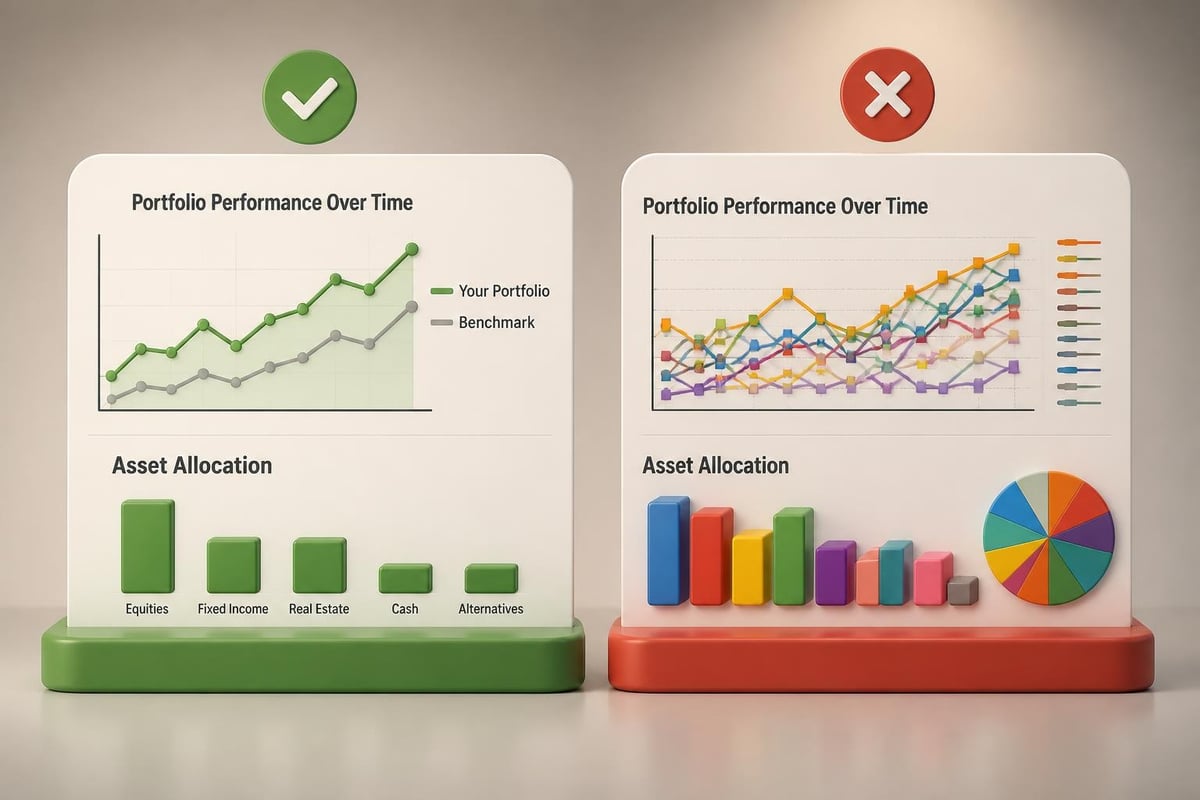
Data visualizations require particular attention to color accessibility. Avoid red-green combinations that create issues for colorblind readers. Use color purposefully to highlight trends rather than decoratively.
Data Visualization Excellence
Charts and graphs transform complex investment data into compelling narratives. Poor visualization obscures insights, while thoughtful design reveals patterns that build confidence.
Harvard Business Review's guide to effective slide decks emphasizes the principle of one key message per slide, which applies perfectly to financial data presentation.
Choose chart types based on the relationship you're illustrating:
| Data Relationship | Recommended Visualization | Use Case |
|---|---|---|
| Performance over time | Line charts | Portfolio returns vs. benchmarks |
| Portfolio composition | Pie or treemap charts | Asset allocation breakdowns |
| Comparison across categories | Bar charts | Sector weightings or fee structures |
| Correlation relationships | Scatter plots | Risk-return positioning |
| Part-to-whole over time | Stacked area charts | Account growth contributions |
Customization and Personalization Frameworks
Generic pitchbooks fail to resonate with sophisticated prospects who expect tailored solutions. The most effective wealth management pitchbook design incorporates modular sections that enable rapid customization without sacrificing quality.
Building Modular Content Libraries
Develop a comprehensive library of pre-approved slides organized by topic and client segment. This approach maintains brand consistency while enabling advisors to assemble prospect-specific narratives quickly.
Core content modules to maintain:
- Multiple case study variations for different client types
- Sector-specific portfolio examples
- Various time-horizon scenarios
- Alternative fee structure presentations
- Tax strategy supplements for high-net-worth prospects
Tag each module with metadata indicating appropriate use cases, compliance approval dates, and required disclosures. This system ensures advisors can customize confidently while maintaining regulatory compliance.
Prospect-Specific Scenario Planning
WealthManagement.com's guidance on building effective pitchbooks emphasizes the importance of regular updates and client-facing customization, particularly for RIAs and private banks competing for sophisticated mandates.
Create scenario-planning slides that illustrate your strategies under different market conditions. Show how portfolios performed during the 2022 rate spike, the 2020 pandemic volatility, or the 2008 financial crisis. Prospects appreciate evidence-based confidence in your approach.
Include customizable sections that address specific prospect concerns. If you're pitching a technology executive, prepare slides on concentrated stock positions and tax-loss harvesting. For a business owner nearing exit, develop liquidity planning and diversification narratives.
Technology Integration and Digital Delivery
The evolution of wealth management pitchbook design increasingly incorporates digital delivery mechanisms that enhance interactivity while maintaining the substance of traditional formats.
Interactive Digital Pitchbooks
Modern prospects expect digital experiences that allow non-linear exploration. Interactive PDFs with clickable navigation enable prospects to dive deep into areas of interest while skipping less relevant sections.
Consider developing web-based pitchbook experiences for prospects who prefer browser access. These platforms can incorporate video explanations, interactive calculators, and real-time performance updates while maintaining security protocols for confidential information.
Morningstar's analysis of wealthtech trends highlights how technology is reshaping distribution and client engagement in wealth management, informing how forward-thinking firms structure their digital pitchbook experiences.
Print Versus Digital Considerations
Despite digital advances, many wealth management contexts still favor traditional print formats. Family office meetings, board presentations, and formal RFP responses often require physical documents.
Design your wealth management pitchbook to function seamlessly across both mediums. Ensure charts remain readable in grayscale printing. Test interactive elements degrade gracefully in PDF format. Verify color accuracy across different printing methods.
Maintain separate master files optimized for each delivery method rather than attempting one-size-fits-all solutions. Digital versions can incorporate animation and video, while print versions focus on maximum clarity and impact on paper.
Ongoing Maintenance and Performance Optimization
A pitchbook is never truly finished. Market conditions change, performance records extend, and competitive landscapes shift. Professional wealth management pitchbook design includes systematic maintenance protocols.
Quarterly Update Cycles
Establish quarterly review schedules for all performance-related content. Update returns, rebalance portfolio illustrations to current allocations, and refresh market commentary to reflect recent conditions.
Beyond numbers, quarterly reviews should assess whether messaging remains relevant. Has your competitive positioning evolved? Have new capabilities been added? Does your case study selection represent current client mix?
Quarterly update checklist:
- All performance data through most recent quarter-end
- Benchmark comparisons and attribution analysis
- Team member changes or additions
- Regulatory or compliance requirement updates
- New case studies or client testimonials
- Market outlook and positioning commentary
A/B Testing and Effectiveness Measurement
Track which pitchbook versions generate the highest conversion rates. When possible, test different narrative sequences, visual approaches, or content emphases with similar prospect segments.
Gather feedback systematically from both successful and unsuccessful pitches. Which sections generated the most questions? Where did prospects request additional detail? What objections surfaced repeatedly?
Invesco's guidance on storytelling to prospective clients offers tactical frameworks for message framing across different time formats, helping you optimize pitchbook content for various meeting lengths and presentation contexts.

Compliance Review and Risk Management
Every element of wealth management pitchbook design must satisfy rigorous regulatory standards. Marketing materials face scrutiny from multiple regulatory bodies depending on your registration status and client base.
Multi-Layer Review Processes
Implement formal approval workflows that route materials through compliance before any external distribution. This process should verify performance calculation accuracy, ensure proper disclosures appear on every relevant slide, and confirm that all claims can be substantiated.
Compliance review checkpoints:
- Performance calculation methodology verification
- Benchmark selection appropriateness
- Hypothetical or back-tested performance labeling
- Fee disclosure completeness and clarity
- Risk disclosure prominence and comprehensiveness
- Third-party endorsement compliance
Document every review with approval dates and reviewer signatures. Maintain version control that tracks all changes and ensures outdated materials are withdrawn from circulation.
Record Retention and Audit Preparedness
Treat pitchbooks as regulated communications subject to retention requirements. Archive all versions distributed to prospects along with supporting documentation that validates claims and performance figures.
Prepare for the possibility that regulators may request your marketing materials during examinations. Well-organized archives with clear approval trails demonstrate strong compliance culture and reduce examination friction.
Effective wealth management pitchbook design requires balancing sophisticated financial content with visual clarity, regulatory compliance with persuasive storytelling, and standardization with customization. When these elements align, pitchbooks become powerful tools that accelerate client acquisition while reinforcing your firm's credibility and expertise. If you're ready to transform your wealth management presentations into compelling narratives that resonate with high-net-worth prospects while maintaining the institutional rigor your practice demands, Prznt Perfect specializes in creating visually stunning, compliance-ready pitchbooks that help financial firms win more business.
