Technical PowerPoint Presentation: Best Practices

Creating a technical powerpoint presentation requires a unique blend of precision, clarity, and visual communication skills. Unlike standard business presentations, technical content demands careful attention to detail while maintaining accessibility for diverse audiences. Whether you're presenting engineering specifications, software architecture, scientific findings, or financial analytics, your slides must transform complex information into digestible insights. The challenge lies in balancing technical accuracy with visual appeal, ensuring your audience grasps sophisticated concepts without oversimplifying critical details. This comprehensive guide explores proven strategies for designing and delivering technical presentations that resonate with stakeholders, investors, and technical teams alike.

Understanding Your Technical Audience

The foundation of any successful technical powerpoint presentation starts with audience analysis. Technical presentations often address multiple stakeholder groups simultaneously, each with varying levels of expertise and different priorities.

Executive audiences typically want high-level insights, business implications, and actionable recommendations. They need to understand the "why" and "what" without getting lost in the "how." Meanwhile, technical peers expect detailed methodologies, specifications, and supporting data that validate your conclusions.

Segmenting Content by Expertise Level

Creating layered content allows you to serve multiple audience segments effectively:

  • Executive summary slides that highlight key findings and recommendations
  • Detailed technical slides with specifications, algorithms, or methodologies
  • Supporting appendix materials for deep dives during Q&A sessions
  • Visual abstracts that bridge technical and non-technical understanding

The University of Minnesota's technical writing guidelines emphasize the importance of condensing complex information while maintaining technical integrity. This balance becomes crucial when presenting to mixed audiences where C-suite executives sit alongside engineering teams.

Technical audience segmentation

Structuring Technical Content for Maximum Impact

Organization determines whether your technical powerpoint presentation communicates effectively or overwhelms your audience. Technical content requires deliberate structuring that guides viewers through complex information progressively.

The Problem-Solution-Evidence Framework

This three-part structure works exceptionally well for technical presentations:

  1. Problem Definition: Establish the technical challenge, gap, or opportunity
  2. Solution Architecture: Present your technical approach, methodology, or innovation
  3. Evidence and Validation: Demonstrate results through data, metrics, and case studies

For financial services presentations, this might translate to identifying market inefficiencies, presenting your algorithmic trading solution, and showcasing backtested performance metrics. Technology companies might frame cybersecurity challenges, architectural solutions, and penetration testing results. When designing professional PowerPoint presentations, this framework ensures logical flow while building credibility.

Progressive Disclosure Techniques

Rather than overwhelming viewers with complete system architectures or comprehensive datasets, reveal information progressively:

Technique Application Benefit
Layered diagrams Build complex systems piece by piece Prevents cognitive overload
Animated reveals Show process steps sequentially Maintains narrative flow
Zoom transitions Move from overview to detail Provides context before complexity
Appendix references Note detailed data availability Keeps main slides clean

Progressive disclosure maintains audience engagement while ensuring technical completeness remains accessible for those who need deeper investigation.

Visualizing Technical Data Effectively

Technical presentations live or die by their data visualization quality. Raw numbers, code snippets, and technical specifications require thoughtful translation into visual formats that communicate insights instantly.

Choosing the Right Chart Types

Different technical data requires specific visualization approaches:

  • Time-series data: Line charts for performance metrics, system uptime, or trend analysis
  • Comparative analysis: Bar charts for benchmarking, A/B testing results, or platform comparisons
  • Hierarchical relationships: Tree diagrams for system architecture, organizational structures, or decision trees
  • Process flows: Flowcharts for algorithms, workflows, or user journeys
  • Correlations: Scatter plots for identifying relationships between variables

The University of Waterloo's design guidelines stress the importance of design consistency across data visualizations. Maintaining uniform color schemes, font treatments, and layout patterns helps audiences process technical information more efficiently.

Simplifying Complex Diagrams

Technical diagrams often suffer from over-complexity. System architectures, network topologies, and process workflows can quickly become indecipherable tangles of boxes and arrows. Apply these simplification principles:

Focus on relevant components only. Your technical powerpoint presentation should highlight the elements pertinent to your specific message. If discussing database optimization, emphasize database layers while minimizing application tier details.

Use consistent visual language. Establish and maintain conventions for shapes, colors, and connectors throughout your presentation. Rectangles for processes, diamonds for decisions, specific colors for different system layers.

Annotate strategically. Guide viewer attention with numbered steps, highlighted paths, or contrasting colors that direct focus to critical elements. Carnegie Mellon's presentation guidelines recommend simplicity as a core principle for maintaining audience engagement.

Typography and Readability in Technical Slides

Technical presentations often fail because presenters prioritize content density over readability. Small fonts, cramped layouts, and excessive text undermine even the most brilliant technical insights.

Font Selection and Sizing

Professional technical presentations require careful typography:

  • Minimum font sizes: 24pt for body text, 32pt for headings, 18pt absolute minimum for labels
  • Font families: Sans-serif fonts like Helvetica, Arial, or Calibri for clarity
  • Monospace fonts: Use sparingly for code snippets or command-line examples
  • Hierarchical sizing: Create clear visual hierarchy through consistent size relationships

Following Sullivan University's presentation best practices, technical presenters should prioritize legibility over information density. If content doesn't fit comfortably on a slide with readable fonts, it belongs across multiple slides or in appendix materials.

Handling Code and Technical Specifications

When your technical powerpoint presentation must include code, configurations, or technical specifications, apply these formatting strategies:

  1. Syntax highlighting: Use color coding to improve code readability
  2. Line limiting: Show 8-10 lines maximum per slide
  3. Focus highlighting: Dim irrelevant code while emphasizing key lines
  4. Explanatory annotations: Add callouts explaining critical code segments
  5. Language identification: Clearly label programming languages or specification types

Consider linking to repositories, documentation, or detailed specifications rather than cramming everything into slides. Your presentation should communicate concepts, not serve as complete technical documentation.

Technical data visualization

Color Theory for Technical Presentations

Color choices significantly impact how audiences process technical information. Beyond aesthetic considerations, color serves functional purposes in technical presentations.

Functional Color Application

Color Purpose Best Practices Common Mistakes
Data differentiation Use distinct hues for different data series Using similar shades that blend together
Status indication Green for success, red for errors, yellow for warnings Ignoring colorblind accessibility
Hierarchy emphasis Bolder colors for primary information Using too many accent colors
Brand consistency Incorporate company colors strategically Forcing brand colors that reduce clarity

The SUNY Center for Professional Development emphasizes accessibility in presentation design. Approximately 8% of men and 0.5% of women have some form of color vision deficiency. Using colorblind-safe palettes and incorporating patterns or textures alongside color ensures your technical content reaches all audience members.

Creating Visual Contrast

Technical presentations benefit from high contrast ratios between text and backgrounds. Light text on dark backgrounds works well for darkened presentation rooms, while dark text on light backgrounds suits well-lit conference spaces or printed handouts.

Avoid these contrast pitfalls:

  • Low-contrast color combinations that strain visibility
  • Busy background images that compete with foreground content
  • Gradients that create readability variations across slides
  • Overly bright colors that cause visual fatigue during longer presentations

Animation and Transition Strategy

Animation in technical powerpoint presentations serves specific communication purposes rather than decorative functions. Strategic animation reveals complex information progressively, demonstrates processes, and maintains audience attention during dense technical sections.

Purposeful Animation Types

Build animations work excellently for revealing list items, process steps, or sequential data points. Rather than overwhelming audiences with complete information, builds allow controlled pacing that matches your verbal explanation.

Emphasis animations draw attention to critical data points, specification requirements, or key findings. A subtle pulse or color change highlights important elements without creating distraction.

Motion paths effectively demonstrate workflows, data flows through systems, or user journeys through interfaces. Movement communicates process in ways static diagrams cannot achieve.

Avoid gratuitous animations that distract from technical content. Every animation should serve a clear communication purpose, whether revealing information progressively, demonstrating relationships, or emphasizing critical points.

Transition Best Practices

Slide transitions in technical presentations should remain subtle and consistent:

  1. Simple fades or cuts maintain professional tone
  2. Consistent transition types throughout the presentation
  3. Brief transition durations (0.3-0.5 seconds maximum)
  4. No sound effects that distract from technical content

The American Institute of Aeronautics and Astronautics provides comprehensive guidance on technical presentation design, emphasizing that delivery strategies should support rather than overshadow technical content.

Technical presentation workflow

Template Design and Brand Consistency

Professional technical powerpoint presentations require consistent visual frameworks that reinforce credibility while maintaining brand identity. Templates establish visual coherence across presentations, particularly important for organizations delivering multiple technical presentations.

Essential Template Elements

Effective technical presentation templates include:

  • Master slide layouts for title slides, content slides, section breaks, and data visualization
  • Color palette definitions with primary, secondary, and accent colors
  • Typography specifications including font families, sizes, and weights for different content types
  • Grid systems ensuring consistent alignment and spacing
  • Logo placement maintaining brand visibility without dominating slides
  • Footer elements with slide numbers, dates, or confidentiality markers

Organizations in cybersecurity might explore specialized templates for technical sectors that address industry-specific requirements while maintaining visual appeal. Financial services firms require templates balancing regulatory compliance with sophisticated design.

Customization Without Chaos

While templates provide structure, technical presentations often require flexibility for unique content types. Build template variations that accommodate:

Full-width diagrams for system architectures requiring maximum space
Side-by-side comparisons for before/after scenarios or competitive analysis
Data-heavy layouts with increased chart areas and minimal text
Code display formats optimized for monospace fonts and syntax highlighting

Accessibility and Universal Design

Technical presentations must reach diverse audiences, including individuals with visual, auditory, or cognitive differences. Accessibility isn't just ethical consideration, it's practical necessity ensuring your technical message reaches all stakeholders.

Implementing Accessible Design

Create inclusive technical powerpoint presentations through these approaches:

  • Alt text for images: Describe charts, diagrams, and graphics for screen reader users
  • Sufficient color contrast: Maintain 4.5:1 ratio minimum for normal text
  • Multiple information channels: Don't rely solely on color to convey meaning
  • Readable fonts: Avoid decorative or script fonts for body content
  • Logical reading order: Structure content for sequential screen reader navigation

Following Old Dominion University's presentation guidelines, consistency in layout and design significantly enhances readability for all users, particularly those with cognitive processing differences.

Captions and Speaker Notes

Technical presentations benefit enormously from comprehensive speaker notes. These notes serve multiple purposes:

  1. Accessibility support for hearing-impaired audience members
  2. Presentation sharing allowing those who couldn't attend to follow your narrative
  3. Rehearsal tools helping presenters maintain consistent messaging
  4. Documentation creating permanent records of technical findings

Speaker notes should expand on slide content without duplicating it verbatim. Explain technical concepts, provide additional context, and include pronunciation guidance for specialized terminology.

Rehearsal and Delivery Preparation

Even the most brilliantly designed technical powerpoint presentation fails without effective delivery. Technical content demands extra preparation because complex information requires clear explanation and anticipation of technical questions.

Structured Practice Approaches

Effective technical presentation rehearsal includes:

Content mastery rehearsals focusing on explaining complex concepts clearly without reading slides. Practice translating technical jargon into accessible language for mixed audiences.

Timing rehearsals ensuring your presentation fits allocated time while allowing questions. Technical presentations frequently run long because presenters underestimate explanation time for complex concepts.

Technical rehearsals testing equipment, software demonstrations, and backup plans. Always have offline versions of cloud-based demonstrations and screenshots of critical system outputs.

Question anticipation preparing for likely technical challenges, methodology questions, or implementation concerns. Create backup slides addressing probable questions.

Integrating Live Demonstrations

Technical presentations often benefit from live demonstrations showing systems, software, or processes in action. However, live demonstrations carry inherent risks requiring careful management.

Demonstration Best Practices

Minimize live demonstration risks through preparation:

Risk Factor Mitigation Strategy
Network connectivity Prepare offline demonstration environments
Software bugs Test thoroughly, have recorded backup videos
Data sensitivity Use sanitized demo data, never production systems
Time constraints Set strict time limits, have skip-ahead options
Unexpected errors Prepare explanations, have screenshots as fallbacks

When executed successfully, live demonstrations provide compelling proof of technical capabilities. When they fail, they undermine credibility catastrophically. Always have backup materials ready.

Metadata and File Management

Professional technical presentations require attention to file-level details often overlooked but critical for distribution, version control, and document management.

File Organization Best Practices

Maintain professional standards through:

  • Descriptive filenames: "CompanyName_TechnicalPresentation_Topic_Date_v2.pptx"
  • Version control: Clear numbering systems tracking revisions
  • Metadata completion: Title, author, company, and description fields
  • File size optimization: Compressed images maintaining quality
  • Compatibility checking: Testing across PowerPoint versions and platforms

Technical presentations frequently get shared across organizations, uploaded to portals, or archived for future reference. Proper file management ensures your technical powerpoint presentation maintains professionalism throughout its lifecycle.

Collaborating on Technical Presentations

Technical presentations often require collaborative development involving subject matter experts, designers, and stakeholders. Efficient collaboration processes prevent version conflicts and ensure technical accuracy.

Collaborative Workflows

Establish clear collaboration protocols:

  1. Role definition: Separate content development, design implementation, and review responsibilities
  2. Version control systems: Use cloud platforms with version history tracking
  3. Review cycles: Schedule technical review, design review, and stakeholder approval stages
  4. Feedback consolidation: Designate single point of contact for incorporating changes
  5. Final approval process: Establish clear sign-off procedures before delivery

Modern presentation workflows increasingly involve tools like Figma for collaborative slide design, enabling real-time collaboration and design consistency across team members.

Industry-Specific Considerations

Different technical sectors require specialized approaches to presentation design and content organization. Financial services technical presentations differ significantly from software engineering or scientific research presentations.

Financial Services Technical Presentations

Financial technical presentations demand:

  • Regulatory compliance with disclosure requirements and risk warnings
  • Data precision with exact figures, proper rounding, and source citations
  • Security considerations protecting sensitive financial models and proprietary data
  • Investor focus balancing technical sophistication with business implications

Organizations serving financial sectors should explore specialized fintech presentation approaches that address industry-specific requirements.

Technology and Cybersecurity Presentations

Technology sector technical presentations prioritize:

  • Architecture clarity showing system designs without revealing security vulnerabilities
  • Performance metrics demonstrating scalability, reliability, and efficiency
  • Competitive positioning highlighting technical advantages over alternatives
  • Implementation roadmaps providing realistic deployment timelines

Companies in cybersecurity face unique challenges balancing technical depth with security consciousness. Cybersecurity pitch decks must demonstrate technical capabilities without exposing methodologies that could aid attackers.

Measuring Presentation Effectiveness

Professional technical presentations should include mechanisms for measuring effectiveness and gathering feedback for continuous improvement.

Feedback Collection Methods

Gather presentation feedback through:

  • Post-presentation surveys assessing clarity, technical depth, and visual effectiveness
  • Stakeholder interviews exploring decision-maker perspectives and concerns
  • Analytics tracking monitoring slide views and time spent on shared presentations
  • Question analysis identifying recurring confusion points requiring clarification
  • Outcome measurement tracking whether presentations achieved intended objectives

Systematic feedback collection transforms individual presentations into continuous improvement processes, refining both content and delivery over time.


Mastering the technical powerpoint presentation format requires balancing precision with accessibility, technical depth with visual clarity, and comprehensive coverage with focused messaging. By implementing structured content frameworks, thoughtful data visualization, accessible design principles, and rigorous preparation processes, technical presenters can transform complex information into compelling narratives that drive understanding and action. When you need expert support creating technical presentations that engage stakeholders while maintaining technical integrity, Prznt Perfect specializes in transforming complex financial and technology concepts into visually stunning presentations that resonate with diverse audiences. Our expertise in visual storytelling and technical communication ensures your critical insights receive the professional presentation they deserve.

We offer free 30-min consultation on the presentation design audit
and hiring the right visual 
comms professional, let’s talk!
Shedule a call
Shedule a call
"I understand" goes a step further into the cognitive dance of persuasion. It's where the audience begins to see the connections between the facts, to grasp the nuances of the problem and the elegance of the solution.
  • This is some text inside of a div block.
    lay out the facts clearly and compellingly. Use data to establish the ground reality, but remember that facts alone are like the individual strands of a tapestry—necessary but not complete.
    lay out the facts clearly and compellingly. Use data to establish the ground reality, but remember that facts alone are like the individual strands of a tapestry—necessary but not complete.
  • This is some text inside of a div block.
    lay out the facts clearly and compellingly. Use data to establish the ground reality, but remember that facts alone are like the individual strands of a tapestry—necessary but not complete.

We offer free 30-min consultation on the presentation design audit

and hiring the right visual 
comms professional, let’s talk!

Shedule a call

"I understand" goes a step further into the cognitive dance of persuasion. It's where the audience begins to see the connections between the facts, to grasp the nuances of the problem and the elegance of the solution.

  • - 1 -
    Consistency at Scale:

    Biotech Market Trends 2024: Tailoring Your Pitch Deck to Current Industry Dynamics.

  • - 2 -
    Efficiency and Speed:

    The traditional process of manually updating presentations is not only slow but also prone to bottlenecks, especially when dealing with large volumes of slides. Automation dramatically accelerates this process, enabling designers to apply changes across hundreds of slides in the time it would take to manually update a single one. This efficiency is a game-changer for agencies working under tight deadlines or managing multiple projects simultaneously.

  • - 3 -
    Enhanced Creativity:

    With the burden of manual updates lifted, designers can allocate more time and energy to the creative aspects of presentation design. This freedom allows for deeper exploration of innovative design concepts, experimentation with new visual storytelling techniques, and the development of more engaging and interactive presentations. Automation doesn't stifle creativity; it amplifies it, enabling designers to push the boundaries of what's possible in corporate presentation design.

  • - 4 -
    Error Reduction:

    Manual updates are inherently prone to inconsistencies and mistakes, from misaligned logos to incorrect font sizes. These errors can detract from the professionalism of a presentation and, by extension, the corporate image. Automation minimizes these risks by ensuring that updates are applied uniformly and accurately across all slides, enhancing the overall quality and integrity of the presentation.

  • - 5 -
    Cost-Effectiveness:

    The time savings afforded by automation directly translate to cost savings for both the design agency and its clients. By reducing the hours spent on manual updates, agencies can optimize their workflows and resources, allowing them to take on more projects without compromising on quality. This efficiency can also make high-quality presentation design services more affordable and accessible to a broader range of businesses.

Technical PowerPoint Presentation: Best Practices

Master technical PowerPoint presentations with expert strategies for data visualization, audience engagement, and clear communication.

Creating a technical powerpoint presentation requires a unique blend of precision, clarity, and visual communication skills. Unlike standard business presentations, technical content demands careful attention to detail while maintaining accessibility for diverse audiences. Whether you're presenting engineering specifications, software architecture, scientific findings, or financial analytics, your slides must transform complex information into digestible insights. The challenge lies in balancing technical accuracy with visual appeal, ensuring your audience grasps sophisticated concepts without oversimplifying critical details. This comprehensive guide explores proven strategies for designing and delivering technical presentations that resonate with stakeholders, investors, and technical teams alike.

Understanding Your Technical Audience

The foundation of any successful technical powerpoint presentation starts with audience analysis. Technical presentations often address multiple stakeholder groups simultaneously, each with varying levels of expertise and different priorities.

Executive audiences typically want high-level insights, business implications, and actionable recommendations. They need to understand the "why" and "what" without getting lost in the "how." Meanwhile, technical peers expect detailed methodologies, specifications, and supporting data that validate your conclusions.

Segmenting Content by Expertise Level

Creating layered content allows you to serve multiple audience segments effectively:

  • Executive summary slides that highlight key findings and recommendations
  • Detailed technical slides with specifications, algorithms, or methodologies
  • Supporting appendix materials for deep dives during Q&A sessions
  • Visual abstracts that bridge technical and non-technical understanding

The University of Minnesota's technical writing guidelines emphasize the importance of condensing complex information while maintaining technical integrity. This balance becomes crucial when presenting to mixed audiences where C-suite executives sit alongside engineering teams.

Technical audience segmentation

Structuring Technical Content for Maximum Impact

Organization determines whether your technical powerpoint presentation communicates effectively or overwhelms your audience. Technical content requires deliberate structuring that guides viewers through complex information progressively.

The Problem-Solution-Evidence Framework

This three-part structure works exceptionally well for technical presentations:

  1. Problem Definition: Establish the technical challenge, gap, or opportunity
  2. Solution Architecture: Present your technical approach, methodology, or innovation
  3. Evidence and Validation: Demonstrate results through data, metrics, and case studies

For financial services presentations, this might translate to identifying market inefficiencies, presenting your algorithmic trading solution, and showcasing backtested performance metrics. Technology companies might frame cybersecurity challenges, architectural solutions, and penetration testing results. When designing professional PowerPoint presentations, this framework ensures logical flow while building credibility.

Progressive Disclosure Techniques

Rather than overwhelming viewers with complete system architectures or comprehensive datasets, reveal information progressively:

Technique Application Benefit
Layered diagrams Build complex systems piece by piece Prevents cognitive overload
Animated reveals Show process steps sequentially Maintains narrative flow
Zoom transitions Move from overview to detail Provides context before complexity
Appendix references Note detailed data availability Keeps main slides clean

Progressive disclosure maintains audience engagement while ensuring technical completeness remains accessible for those who need deeper investigation.

Visualizing Technical Data Effectively

Technical presentations live or die by their data visualization quality. Raw numbers, code snippets, and technical specifications require thoughtful translation into visual formats that communicate insights instantly.

Choosing the Right Chart Types

Different technical data requires specific visualization approaches:

  • Time-series data: Line charts for performance metrics, system uptime, or trend analysis
  • Comparative analysis: Bar charts for benchmarking, A/B testing results, or platform comparisons
  • Hierarchical relationships: Tree diagrams for system architecture, organizational structures, or decision trees
  • Process flows: Flowcharts for algorithms, workflows, or user journeys
  • Correlations: Scatter plots for identifying relationships between variables

The University of Waterloo's design guidelines stress the importance of design consistency across data visualizations. Maintaining uniform color schemes, font treatments, and layout patterns helps audiences process technical information more efficiently.

Simplifying Complex Diagrams

Technical diagrams often suffer from over-complexity. System architectures, network topologies, and process workflows can quickly become indecipherable tangles of boxes and arrows. Apply these simplification principles:

Focus on relevant components only. Your technical powerpoint presentation should highlight the elements pertinent to your specific message. If discussing database optimization, emphasize database layers while minimizing application tier details.

Use consistent visual language. Establish and maintain conventions for shapes, colors, and connectors throughout your presentation. Rectangles for processes, diamonds for decisions, specific colors for different system layers.

Annotate strategically. Guide viewer attention with numbered steps, highlighted paths, or contrasting colors that direct focus to critical elements. Carnegie Mellon's presentation guidelines recommend simplicity as a core principle for maintaining audience engagement.

Typography and Readability in Technical Slides

Technical presentations often fail because presenters prioritize content density over readability. Small fonts, cramped layouts, and excessive text undermine even the most brilliant technical insights.

Font Selection and Sizing

Professional technical presentations require careful typography:

  • Minimum font sizes: 24pt for body text, 32pt for headings, 18pt absolute minimum for labels
  • Font families: Sans-serif fonts like Helvetica, Arial, or Calibri for clarity
  • Monospace fonts: Use sparingly for code snippets or command-line examples
  • Hierarchical sizing: Create clear visual hierarchy through consistent size relationships

Following Sullivan University's presentation best practices, technical presenters should prioritize legibility over information density. If content doesn't fit comfortably on a slide with readable fonts, it belongs across multiple slides or in appendix materials.

Handling Code and Technical Specifications

When your technical powerpoint presentation must include code, configurations, or technical specifications, apply these formatting strategies:

  1. Syntax highlighting: Use color coding to improve code readability
  2. Line limiting: Show 8-10 lines maximum per slide
  3. Focus highlighting: Dim irrelevant code while emphasizing key lines
  4. Explanatory annotations: Add callouts explaining critical code segments
  5. Language identification: Clearly label programming languages or specification types

Consider linking to repositories, documentation, or detailed specifications rather than cramming everything into slides. Your presentation should communicate concepts, not serve as complete technical documentation.

Technical data visualization

Color Theory for Technical Presentations

Color choices significantly impact how audiences process technical information. Beyond aesthetic considerations, color serves functional purposes in technical presentations.

Functional Color Application

Color Purpose Best Practices Common Mistakes
Data differentiation Use distinct hues for different data series Using similar shades that blend together
Status indication Green for success, red for errors, yellow for warnings Ignoring colorblind accessibility
Hierarchy emphasis Bolder colors for primary information Using too many accent colors
Brand consistency Incorporate company colors strategically Forcing brand colors that reduce clarity

The SUNY Center for Professional Development emphasizes accessibility in presentation design. Approximately 8% of men and 0.5% of women have some form of color vision deficiency. Using colorblind-safe palettes and incorporating patterns or textures alongside color ensures your technical content reaches all audience members.

Creating Visual Contrast

Technical presentations benefit from high contrast ratios between text and backgrounds. Light text on dark backgrounds works well for darkened presentation rooms, while dark text on light backgrounds suits well-lit conference spaces or printed handouts.

Avoid these contrast pitfalls:

  • Low-contrast color combinations that strain visibility
  • Busy background images that compete with foreground content
  • Gradients that create readability variations across slides
  • Overly bright colors that cause visual fatigue during longer presentations

Animation and Transition Strategy

Animation in technical powerpoint presentations serves specific communication purposes rather than decorative functions. Strategic animation reveals complex information progressively, demonstrates processes, and maintains audience attention during dense technical sections.

Purposeful Animation Types

Build animations work excellently for revealing list items, process steps, or sequential data points. Rather than overwhelming audiences with complete information, builds allow controlled pacing that matches your verbal explanation.

Emphasis animations draw attention to critical data points, specification requirements, or key findings. A subtle pulse or color change highlights important elements without creating distraction.

Motion paths effectively demonstrate workflows, data flows through systems, or user journeys through interfaces. Movement communicates process in ways static diagrams cannot achieve.

Avoid gratuitous animations that distract from technical content. Every animation should serve a clear communication purpose, whether revealing information progressively, demonstrating relationships, or emphasizing critical points.

Transition Best Practices

Slide transitions in technical presentations should remain subtle and consistent:

  1. Simple fades or cuts maintain professional tone
  2. Consistent transition types throughout the presentation
  3. Brief transition durations (0.3-0.5 seconds maximum)
  4. No sound effects that distract from technical content

The American Institute of Aeronautics and Astronautics provides comprehensive guidance on technical presentation design, emphasizing that delivery strategies should support rather than overshadow technical content.
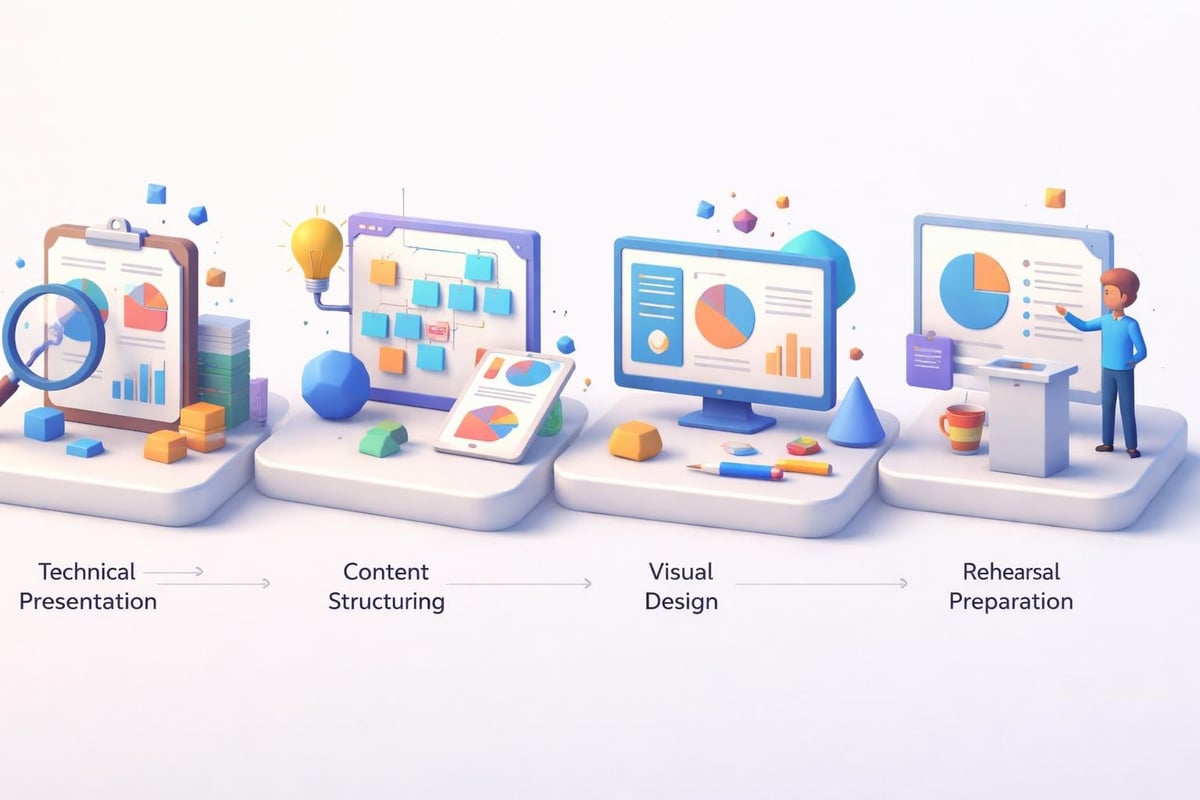
Technical presentation workflow

Template Design and Brand Consistency

Professional technical powerpoint presentations require consistent visual frameworks that reinforce credibility while maintaining brand identity. Templates establish visual coherence across presentations, particularly important for organizations delivering multiple technical presentations.

Essential Template Elements

Effective technical presentation templates include:

  • Master slide layouts for title slides, content slides, section breaks, and data visualization
  • Color palette definitions with primary, secondary, and accent colors
  • Typography specifications including font families, sizes, and weights for different content types
  • Grid systems ensuring consistent alignment and spacing
  • Logo placement maintaining brand visibility without dominating slides
  • Footer elements with slide numbers, dates, or confidentiality markers

Organizations in cybersecurity might explore specialized templates for technical sectors that address industry-specific requirements while maintaining visual appeal. Financial services firms require templates balancing regulatory compliance with sophisticated design.

Customization Without Chaos

While templates provide structure, technical presentations often require flexibility for unique content types. Build template variations that accommodate:

Full-width diagrams for system architectures requiring maximum space
Side-by-side comparisons for before/after scenarios or competitive analysis
Data-heavy layouts with increased chart areas and minimal text
Code display formats optimized for monospace fonts and syntax highlighting

Accessibility and Universal Design

Technical presentations must reach diverse audiences, including individuals with visual, auditory, or cognitive differences. Accessibility isn't just ethical consideration, it's practical necessity ensuring your technical message reaches all stakeholders.

Implementing Accessible Design

Create inclusive technical powerpoint presentations through these approaches:

  • Alt text for images: Describe charts, diagrams, and graphics for screen reader users
  • Sufficient color contrast: Maintain 4.5:1 ratio minimum for normal text
  • Multiple information channels: Don't rely solely on color to convey meaning
  • Readable fonts: Avoid decorative or script fonts for body content
  • Logical reading order: Structure content for sequential screen reader navigation

Following Old Dominion University's presentation guidelines, consistency in layout and design significantly enhances readability for all users, particularly those with cognitive processing differences.

Captions and Speaker Notes

Technical presentations benefit enormously from comprehensive speaker notes. These notes serve multiple purposes:

  1. Accessibility support for hearing-impaired audience members
  2. Presentation sharing allowing those who couldn't attend to follow your narrative
  3. Rehearsal tools helping presenters maintain consistent messaging
  4. Documentation creating permanent records of technical findings

Speaker notes should expand on slide content without duplicating it verbatim. Explain technical concepts, provide additional context, and include pronunciation guidance for specialized terminology.

Rehearsal and Delivery Preparation

Even the most brilliantly designed technical powerpoint presentation fails without effective delivery. Technical content demands extra preparation because complex information requires clear explanation and anticipation of technical questions.

Structured Practice Approaches

Effective technical presentation rehearsal includes:

Content mastery rehearsals focusing on explaining complex concepts clearly without reading slides. Practice translating technical jargon into accessible language for mixed audiences.

Timing rehearsals ensuring your presentation fits allocated time while allowing questions. Technical presentations frequently run long because presenters underestimate explanation time for complex concepts.

Technical rehearsals testing equipment, software demonstrations, and backup plans. Always have offline versions of cloud-based demonstrations and screenshots of critical system outputs.

Question anticipation preparing for likely technical challenges, methodology questions, or implementation concerns. Create backup slides addressing probable questions.

Integrating Live Demonstrations

Technical presentations often benefit from live demonstrations showing systems, software, or processes in action. However, live demonstrations carry inherent risks requiring careful management.

Demonstration Best Practices

Minimize live demonstration risks through preparation:

Risk Factor Mitigation Strategy
Network connectivity Prepare offline demonstration environments
Software bugs Test thoroughly, have recorded backup videos
Data sensitivity Use sanitized demo data, never production systems
Time constraints Set strict time limits, have skip-ahead options
Unexpected errors Prepare explanations, have screenshots as fallbacks

When executed successfully, live demonstrations provide compelling proof of technical capabilities. When they fail, they undermine credibility catastrophically. Always have backup materials ready.

Metadata and File Management

Professional technical presentations require attention to file-level details often overlooked but critical for distribution, version control, and document management.

File Organization Best Practices

Maintain professional standards through:

  • Descriptive filenames: "CompanyName_TechnicalPresentation_Topic_Date_v2.pptx"
  • Version control: Clear numbering systems tracking revisions
  • Metadata completion: Title, author, company, and description fields
  • File size optimization: Compressed images maintaining quality
  • Compatibility checking: Testing across PowerPoint versions and platforms

Technical presentations frequently get shared across organizations, uploaded to portals, or archived for future reference. Proper file management ensures your technical powerpoint presentation maintains professionalism throughout its lifecycle.

Collaborating on Technical Presentations

Technical presentations often require collaborative development involving subject matter experts, designers, and stakeholders. Efficient collaboration processes prevent version conflicts and ensure technical accuracy.

Collaborative Workflows

Establish clear collaboration protocols:

  1. Role definition: Separate content development, design implementation, and review responsibilities
  2. Version control systems: Use cloud platforms with version history tracking
  3. Review cycles: Schedule technical review, design review, and stakeholder approval stages
  4. Feedback consolidation: Designate single point of contact for incorporating changes
  5. Final approval process: Establish clear sign-off procedures before delivery

Modern presentation workflows increasingly involve tools like Figma for collaborative slide design, enabling real-time collaboration and design consistency across team members.

Industry-Specific Considerations

Different technical sectors require specialized approaches to presentation design and content organization. Financial services technical presentations differ significantly from software engineering or scientific research presentations.

Financial Services Technical Presentations

Financial technical presentations demand:

  • Regulatory compliance with disclosure requirements and risk warnings
  • Data precision with exact figures, proper rounding, and source citations
  • Security considerations protecting sensitive financial models and proprietary data
  • Investor focus balancing technical sophistication with business implications

Organizations serving financial sectors should explore specialized fintech presentation approaches that address industry-specific requirements.

Technology and Cybersecurity Presentations

Technology sector technical presentations prioritize:

  • Architecture clarity showing system designs without revealing security vulnerabilities
  • Performance metrics demonstrating scalability, reliability, and efficiency
  • Competitive positioning highlighting technical advantages over alternatives
  • Implementation roadmaps providing realistic deployment timelines

Companies in cybersecurity face unique challenges balancing technical depth with security consciousness. Cybersecurity pitch decks must demonstrate technical capabilities without exposing methodologies that could aid attackers.

Measuring Presentation Effectiveness

Professional technical presentations should include mechanisms for measuring effectiveness and gathering feedback for continuous improvement.

Feedback Collection Methods

Gather presentation feedback through:

  • Post-presentation surveys assessing clarity, technical depth, and visual effectiveness
  • Stakeholder interviews exploring decision-maker perspectives and concerns
  • Analytics tracking monitoring slide views and time spent on shared presentations
  • Question analysis identifying recurring confusion points requiring clarification
  • Outcome measurement tracking whether presentations achieved intended objectives

Systematic feedback collection transforms individual presentations into continuous improvement processes, refining both content and delivery over time.


Mastering the technical powerpoint presentation format requires balancing precision with accessibility, technical depth with visual clarity, and comprehensive coverage with focused messaging. By implementing structured content frameworks, thoughtful data visualization, accessible design principles, and rigorous preparation processes, technical presenters can transform complex information into compelling narratives that drive understanding and action. When you need expert support creating technical presentations that engage stakeholders while maintaining technical integrity, Prznt Perfect specializes in transforming complex financial and technology concepts into visually stunning presentations that resonate with diverse audiences. Our expertise in visual storytelling and technical communication ensures your critical insights receive the professional presentation they deserve.


News & Updates...

Master the art of creating a beautiful presentation PowerPoint with expert design tips, layout strategies, and visual techniques for 2026.

Master business design ppt creation with expert strategies for compelling presentations. Transform complex models into clear visuals in 2026.