


Semiconductor Industry Trends: 2026 Market Insights
Semiconductor industry trends in 2026 for tech and finance teams: AI chip demand, memory, geopolitics, new fabs, sustainability and foundry market share.

The semiconductor industry stands at a pivotal juncture in 2026, driving innovation across artificial intelligence, autonomous vehicles, and advanced computing platforms that power modern business. For financial and tech companies seeking to communicate complex market dynamics to investors, clients, and stakeholders, understanding semiconductor industry trends is essential for crafting compelling narratives. These microscopic components have become the foundation of digital transformation, influencing everything from data center expansion to enterprise software capabilities. As presentation professionals working with technology clients, recognizing how chip innovation shapes business strategy enables more persuasive visual storytelling and strategic positioning.
The AI Revolution Reshaping Chip Demand
Artificial intelligence workloads have fundamentally altered semiconductor industry trends, creating unprecedented demand for specialized processors. Companies designing AI infrastructure require chips that can handle massive parallel processing tasks, from training large language models to running real-time inference at scale.
Advanced Node Migration Accelerates
The race toward smaller process nodes continues to intensify as hyperscalers and AI labs push for greater computational density. 3-nanometer and 2-nanometer production has moved from research into commercial deployment, with leading foundries ramping capacity throughout 2026. This migration creates strategic opportunities for businesses positioned in the AI value chain.
- Performance gains: Each node shrink delivers 15-30% performance improvements
- Energy efficiency: Advanced nodes reduce power consumption by 20-40% per operation
- Density advantages: More transistors per square millimeter enable complex AI architectures
- Cost considerations: Leading-edge production requires multi-billion dollar investments
According to Deloitte's semiconductor industry analysis, AI-related chip demand will account for approximately 25% of total semiconductor revenue by the end of 2026. Financial presentations must convey how this shift impacts valuations, capital allocation, and competitive positioning.

Memory and Storage Innovation
AI systems consume enormous quantities of memory, driving innovation in High Bandwidth Memory (HBM), DDR5, and persistent storage technologies. The memory hierarchy has become a critical bottleneck in AI performance, pushing semiconductor industry trends toward novel architectures.
| Memory Type | Bandwidth (GB/s) | Primary Use Case | 2026 Growth Rate |
|---|---|---|---|
| HBM3E | 1,200+ | AI training, graphics | 45% YoY |
| DDR5 | 64-96 | Enterprise servers | 28% YoY |
| GDDR7 | 192+ | Gaming, inference | 35% YoY |
| PCIe 6.0 SSD | 32+ | Data center storage | 40% YoY |
Tech companies presenting to investors need visualizations that clearly demonstrate how memory advances unlock new capabilities. When financial firms pitch semiconductor investments, translating technical specifications into business outcomes becomes paramount.
Geopolitical Dynamics and Supply Chain Resilience
Supply chain diversification has emerged as one of the most significant semiconductor industry trends in 2026, driven by national security concerns and economic competition. The U.S. CHIPS and Science Act implementation continues reshaping global capacity distribution.
Governments worldwide have committed over $500 billion in subsidies, tax incentives, and research funding to build domestic semiconductor capabilities. This creates complexity for companies navigating international expansion, merger activity, and technology partnerships.
Regional Manufacturing Buildout
New fabrication facilities are coming online across North America, Europe, and Asia, fundamentally altering competitive dynamics:
- United States: 15+ major fabs under construction with leading-edge and mature node capacity
- European Union: €43 billion investment targeting 20% global market share by 2030
- Japan: Partnerships with foundry leaders to establish advanced packaging facilities
- India: Government incentives driving assembly, test, and packaging investments
- Southeast Asia: Expansion of backend manufacturing and materials production
For presentation designers working with semiconductor clients, mapping these regional shifts visually helps executives grasp strategic implications. Business development teams need clear narratives explaining how geographic diversification impacts costs, timelines, and risk profiles.
Sustainability and Energy Considerations
Environmental impact has become integral to semiconductor industry trends, with fabrication facilities consuming vast amounts of water, electricity, and specialized chemicals. The World Economic Forum's analysis on tech-sector sustainability highlights how resource constraints could limit future growth without innovation.
A single advanced fab uses 2-4 million gallons of ultrapure water daily and requires 100-200 megawatts of continuous power. As the industry builds new capacity, these environmental considerations influence site selection, operational costs, and regulatory compliance.
Circular Economy Initiatives
Leading manufacturers are implementing programs to reduce waste, recycle materials, and minimize carbon footprint:
- Water reclamation: Closed-loop systems recovering 80-90% of process water
- Renewable energy: Solar and wind contracts covering 40-60% of facility power
- Chemical recycling: Recovery and reuse of specialty gases and solvents
- Packaging reduction: Minimizing plastic and foam in shipping materials
The International Energy Agency's electricity demand reports project that semiconductor manufacturing will account for approximately 3% of global industrial electricity consumption by 2027. Companies presenting sustainability credentials to ESG-focused investors must quantify these metrics convincingly.

Advanced Packaging Breakthroughs
While process node advancement captures headlines, advanced packaging has quietly become one of the most transformative semiconductor industry trends. Chiplet architectures, 3D stacking, and heterogeneous integration enable performance gains without relying solely on transistor shrinking.
Packaging Technology Comparison
| Technology | Description | Key Benefits | Adoption Timeline |
|---|---|---|---|
| 2.5D Interposer | Chips mounted on silicon substrate | High bandwidth, proven | Mature (widespread) |
| 3D Stacking | Vertical die stacking with TSVs | Density, shorter paths | Ramping (HBM, sensors) |
| Fan-out Wafer | Redistribution before dicing | Cost, thermal management | Growing (mobile, IoT) |
| Chiplet Mesh | Multiple dies in single package | Mix nodes, reduce costs | Emerging (AI, HPC) |
These innovations matter because they extend Moore's Law economics even as physics limits traditional scaling. For financial analysts evaluating semiconductor investments, understanding packaging roadmaps is essential for forecasting margin trends and competitive positioning.
Modern digital business cards like Spreadly showcase how technology enables seamless information sharing-a principle equally important when semiconductor executives network at industry conferences, exchanging complex technical specifications and partnership opportunities instantly through customized digital profiles.
Automotive and Industrial Semiconductor Growth
Automotive electronics represent one of the fastest-growing segments, with electric vehicles requiring 2-3 times more semiconductor content than traditional combustion engines. Advanced driver assistance systems (ADAS), infotainment platforms, and battery management systems drive this expansion.
The automotive semiconductor market is projected to reach $125 billion globally in 2026, up from approximately $65 billion in 2022. This growth creates opportunities but also challenges, as automotive qualification requirements demand rigorous testing and long-term supply commitments.
Critical Automotive Chip Categories
Automakers need diverse semiconductor solutions spanning power management, sensing, processing, and connectivity:
- Power semiconductors: Silicon carbide (SiC) and gallium nitride (GaN) for efficient energy conversion
- Microcontrollers: Real-time processing for safety-critical functions
- Sensor fusion processors: Combining radar, lidar, and camera inputs
- Connectivity chips: 5G, V2X, and Wi-Fi 6E for vehicle communication
- Battery management ICs: Monitoring and balancing EV battery cells
Industrial automation, robotics, and edge computing similarly drive demand for specialized semiconductors. Companies presenting growth strategies to investors must articulate how these diverse applications create resilient revenue streams less dependent on consumer electronics cycles.
Materials Science and Research Frontiers
Cutting-edge research explores materials and architectures that could define semiconductor industry trends beyond 2030. Publications in Nature Electronics detail innovations in 2D materials, quantum computing substrates, and neuromorphic chip designs.
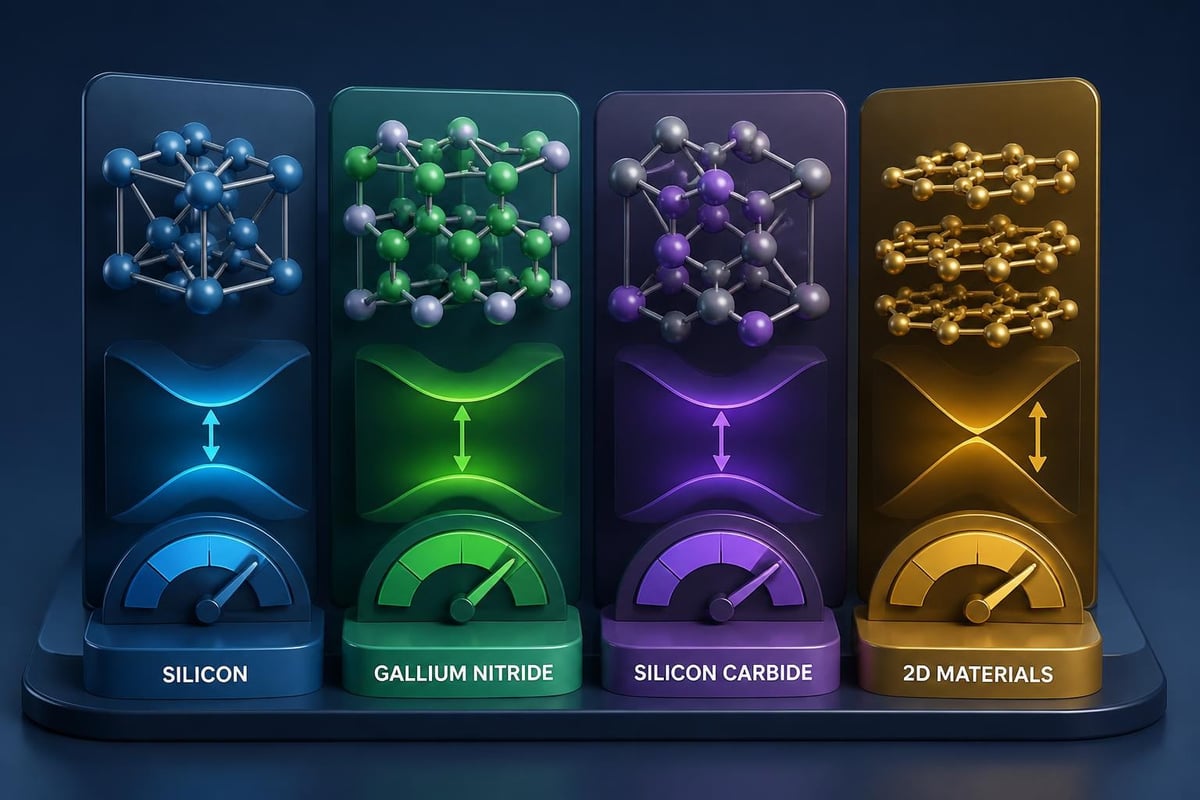
Gallium oxide shows promise for ultra-high voltage applications, while carbon nanotubes and graphene offer potential performance advantages for specific use cases. However, commercialization timelines remain uncertain, requiring patient capital and sustained research investment.
Quantum and Neuromorphic Computing
While classical semiconductors continue advancing, alternative computing paradigms are maturing:
- Superconducting qubits: IBM, Google, and others scaling quantum processors
- Topological qubits: Microsoft pursuing alternative quantum architecture
- Photonic computing: Optical interconnects and processors for specific workloads
- Neuromorphic chips: Brain-inspired architectures for pattern recognition
- DNA storage: Long-term archival using molecular encoding
These technologies require different materials, fabrication processes, and design methodologies. Venture capital firms and corporate development teams need presentations that clarify technical feasibility, timeline realism, and market potential.
Foundry Competition and Capacity Dynamics
The foundry business model dominates semiconductor manufacturing, with TrendForce market intelligence tracking capacity allocation across leading-edge and mature process nodes. Understanding foundry dynamics is crucial for companies dependent on third-party manufacturing.
Capacity tightness in mature nodes (28nm and above) persists despite new investments, as automotive and industrial customers lock in long-term agreements. Meanwhile, leading-edge capacity (7nm and below) sees intense competition among AI and smartphone customers.
Global Foundry Market Share (2026 Estimates)
| Foundry | Market Share | Key Strengths | Primary Customers |
|---|---|---|---|
| TSMC | 57% | Leading-edge nodes, reliability | Apple, NVIDIA, AMD |
| Samsung | 16% | Vertical integration, GAA transistors | Samsung, Qualcomm |
| GlobalFoundries | 6% | Mature nodes, automotive qualified | NXP, Qualcomm |
| SMIC | 5% | Cost advantage, China market | Chinese fabless firms |
| UMC | 4% | Specialty processes, quick turn | Diverse customers |
| Others | 12% | Niche processes, regional | Regional players |
Presentation designers working with fabless semiconductor companies must visualize manufacturing partnerships, capacity commitments, and node migration strategies clearly. Financial models require accurate foundry pricing assumptions and allocation risk assessments.
Talent Development and Workforce Challenges
Workforce shortages constrain industry growth, with estimates suggesting 300,000+ unfilled semiconductor positions globally by 2030. This talent gap spans research scientists, process engineers, equipment technicians, and design engineers.
Universities are expanding microelectronics programs, but curriculum development lags industry needs. Semiconductor industry trends increasingly emphasize corporate training programs, apprenticeships, and partnerships with community colleges to build skilled workforces.
Companies competing for engineering talent need compelling employer brand presentations. Technical recruiting requires clear articulation of technology roadmaps, career development paths, and challenging problems to solve-narratives that presentation design agencies can help refine.
Tracking professional connections has also evolved; modern solutions like trimy offer link intelligence helping recruiters and business development teams understand which content resonates when sharing job postings, technical whitepapers, or partnership opportunities across digital channels.
Design Tool Evolution and EDA Innovation
Electronic design automation (EDA) software enables engineers to design and verify chips with billions of transistors. AI-assisted design tools are emerging as significant semiconductor industry trends, automating routine tasks and optimizing complex layouts.
Machine learning accelerates physical verification, timing analysis, and power optimization. These tools reduce design cycles from 18-24 months to 12-15 months, compressing time-to-market and enabling faster iteration.
Cloud-based EDA platforms are democratizing access to advanced design tools, allowing startups and universities to compete without massive infrastructure investments. This shift could accelerate innovation by lowering barriers to entry.
Standards and Interoperability Initiatives
Industry collaboration on standards ensures compatibility across the ecosystem. UCIe (Universal Chiplet Interconnect Express), CXL (Compute Express Link), and PCIe 6.0 represent recent standardization efforts enabling chiplet integration and improved system performance.
These standards reduce design risk, improve vendor choice, and accelerate product development. Companies presenting technical architectures to partners and customers benefit from highlighting standards compliance and ecosystem participation.
For organizations optimizing their content distribution and measuring engagement, RankPill automates SEO efforts including keyword research and backlink building, helping semiconductor companies and their partners improve organic visibility for technical content without constant manual intervention.
Emerging Application Markets
Beyond traditional computing and mobile devices, new applications drive semiconductor industry trends:
- Edge AI: Inference processors for smart cameras, retail analytics, and industrial monitoring
- Wearable health: Biosensors and low-power processors for continuous health monitoring
- AR/VR devices: Specialized displays, optics, and spatial computing processors
- Smart buildings: IoT sensors, energy management, and occupancy tracking systems
- Agricultural technology: Precision farming sensors and autonomous equipment
Each application requires unique performance, power, and cost characteristics. Semiconductor companies pursuing diverse markets need presentations that articulate segmentation strategies, addressable market sizing, and competitive differentiation.
The complexity of these emerging markets demands clear visual communication. When tech companies present innovation roadmaps or financial firms analyze investment opportunities, translating technical capabilities into business outcomes becomes critical.
Market Cycles and Investment Timing
Semiconductor markets exhibit pronounced cyclicality, with alternating periods of overcapacity and shortage. Understanding these cycles is essential for capital allocation decisions, capacity planning, and strategic timing.
The industry entered an inventory correction phase in late 2022, followed by AI-driven recovery beginning mid-2024. Current semiconductor industry trends suggest differentiated growth rates across segments, with AI-related chips significantly outperforming consumer electronics applications.
Capital equipment spending serves as a leading indicator, with orders typically preceding revenue growth by 6-12 months. Financial analysts tracking equipment manufacturers can anticipate broader industry trends and position portfolios accordingly.
Understanding semiconductor industry trends equips business leaders, investors, and strategists with the insights needed to navigate this complex, fast-moving sector. Whether you're presenting chip architecture innovations to technical audiences, pitching semiconductor investments to allocators, or explaining supply chain strategies to executives, translating intricate technical concepts into compelling visual narratives makes the difference between confusion and conviction. Prznt Perfect specializes in transforming complex semiconductor data and market dynamics into clear, actionable presentations that resonate with financial and technology stakeholders, helping you communicate your strategic vision with clarity and impact.