Pitch Deck Design Agencies: A Strategic Investment Guide

Your pitch deck represents the first impression investors will have of your business, and in 2026's competitive fundraising environment, that first impression must be flawless. Pitch deck design agencies specialize in transforming complex business concepts into visually compelling narratives that capture investor attention and secure funding. These specialized firms combine design expertise with strategic storytelling to help financial and tech companies communicate their value proposition effectively. Understanding what these agencies offer and how to select the right partner can make the difference between a funded venture and a missed opportunity.

What Pitch Deck Design Agencies Actually Do

Pitch deck design agencies provide far more than aesthetic improvements to your slides. These specialized firms serve as strategic partners in shaping how your business story is told and received by investors.

The core function involves translating your business strategy into a visual narrative that resonates with venture capitalists, angel investors, and other funding sources. This process begins with understanding your business model, competitive advantages, and market opportunity. Agencies then craft a storyline that positions your company for investment success.

Strategic Consulting and Content Development

Professional agencies start by conducting discovery sessions to understand your business fundamentals. They analyze your:

  • Target market and addressable opportunity
  • Competitive differentiation and unique value proposition
  • Financial projections and unit economics
  • Go-to-market strategy and traction metrics
  • Team composition and relevant expertise

Through this analysis, agencies identify the strongest elements of your story and determine how to present them in sequence. Many firms provide strategic guidance on pitch deck structure that follows proven frameworks while maintaining uniqueness.

Pitch deck content strategy framework

Visual Design and Brand Integration

Once the narrative framework exists, agencies focus on visual execution. This involves creating custom graphics, data visualizations, and slide layouts that enhance comprehension while maintaining visual appeal.

The design process typically includes:

  1. Brand audit to ensure consistency with existing corporate identity
  2. Custom iconography development for unique visual language
  3. Data visualization that makes complex metrics immediately understandable
  4. Typography systems that improve readability and hierarchy
  5. Color palette selection aligned with brand and emotional impact

Professional designers understand how to balance sophistication with clarity. They know which design elements signal credibility to institutional investors versus those that appeal to consumer-focused VCs. According to research on visual design principles, visual excellence directly correlates with funding success rates.

Why Financial and Tech Companies Choose Design Agencies

The decision to partner with pitch deck design agencies stems from recognizing that fundraising success requires specialized expertise beyond what most internal teams possess.

Time Efficiency and Opportunity Cost

Building an effective pitch deck internally can consume hundreds of hours across multiple team members. Founders and executives must balance fundraising preparation with running their actual business operations.

External agencies compress this timeline dramatically. What might take an internal team six weeks to develop through trial and error, an experienced agency delivers in two weeks with higher quality results.

Approach Timeline Iterations Opportunity Cost
Internal Development 6-8 weeks 8-12 versions High (founder time)
Template-Based DIY 2-3 weeks 5-7 versions Medium (quality gaps)
Professional Agency 1.5-2 weeks 3-4 versions Low (efficient process)

Access to Specialized Expertise

Pitch deck design agencies employ professionals who create these presentations daily. Their teams include strategists who understand investor psychology, designers versed in PowerPoint design best practices, and consultants familiar with industry-specific expectations.

This concentrated expertise means agencies stay current on what works. They've analyzed hundreds of successful decks and understand subtle differences between Series A expectations versus Series B requirements. For companies preparing for Series B fundraising, this specialized knowledge proves invaluable.

Objective Perspective and Strategic Distance

Internal teams often struggle with message clarity because they're too close to the product. Agencies provide the outside perspective investors actually experience when reviewing your deck.

They identify assumptions that need explanation, jargon that creates barriers, and storyline gaps that internal teams overlook. This objective viewpoint helps refine messaging before investor meetings begin.

Evaluating Pitch Deck Design Agencies

Selecting the right agency partner requires methodical evaluation across multiple dimensions beyond just portfolio quality.

Portfolio Analysis and Industry Expertise

Review agency portfolios with specific criteria in mind. Look beyond aesthetic appeal to assess strategic thinking and storytelling capability.

Key evaluation questions:

  • Do portfolio examples demonstrate understanding of your industry's metrics?
  • Can you identify clear narrative progression through sample decks?
  • Does visual design enhance or distract from core messages?
  • Are data visualizations accurate and appropriately scaled?

Agencies serving financial and tech sectors should demonstrate familiarity with SaaS metrics, fintech regulations, or cybersecurity frameworks relevant to your business. Review their work in fintech pitch decks or cybersecurity presentations if those align with your industry.

Process Transparency and Collaboration Style

Understanding how an agency works proves as important as seeing what they've produced. Request detailed information about their process including:

  1. Discovery and strategy phase duration and format
  2. Number of design concepts presented initially
  3. Revision rounds included in standard engagements
  4. Typical timeline from kickoff to final delivery
  5. Communication frequency and stakeholder involvement

Some agencies operate with minimal client input, delivering finished decks based on initial briefings. Others involve clients throughout iterative development. Neither approach is inherently superior, but alignment with your preference matters significantly.

Agency selection criteria

Pricing Models and Value Assessment

Pitch deck design agencies employ various pricing structures that reflect different value propositions and service levels.

Pricing Model Typical Range Best For Considerations
Fixed Project Fee $5,000-$25,000 Standard pitch decks Clear scope definition required
Hourly Consulting $150-$400/hour Ongoing refinements Can exceed budget without controls
Retainer Packages $3,000-$15,000/month Multiple deliverables Requires sustained need
Equity-Based 0.1%-0.5% equity Early-stage startups Aligns incentives but dilutes ownership

Evaluate pricing relative to the potential funding you're seeking. Investing $15,000 in professional design for a $5 million raise represents 0.3% of target capital, typically yielding substantial returns through improved success rates and faster funding timelines. Common mistakes in budget allocation are outlined in this analysis of pitch deck design errors.

The Agency Engagement Process

Understanding what to expect during an agency engagement helps set realistic expectations and ensures productive collaboration.

Discovery and Strategic Foundation

The engagement typically begins with comprehensive discovery sessions where agencies gather information about your business, market, and fundraising goals. Prepare detailed materials including:

  • Current pitch deck or presentation materials
  • Business plan and financial models
  • Competitive analysis documentation
  • Previous investor feedback (if applicable)
  • Brand guidelines and visual assets

Agencies use this foundation to develop strategic recommendations about positioning, messaging hierarchy, and visual direction. This phase often reveals opportunities to strengthen your overall business narrative beyond just the deck itself.

Design Development and Iteration

Following strategic alignment, agencies move into active design production. This typically unfolds across multiple stages:

Initial concepts present 2-3 distinct visual directions for your consideration. These establish overall aesthetic, typography, color systems, and layout approaches without full content development.

Content integration applies the selected design direction across all slides, incorporating your specific data, metrics, and messaging. This stage reveals how the visual system performs with real content.

Refinement cycles address feedback, adjust pacing, and optimize individual slides for maximum impact. Professional agencies typically include 2-3 revision rounds, though complex projects may require additional iterations.

Understanding professional PowerPoint development processes helps clients provide effective feedback during these cycles.

Finalization and Delivery

Agencies deliver final presentations in multiple formats to support various use scenarios:

  • Editable source files (PowerPoint, Keynote, or Google Slides)
  • PDF versions for email distribution
  • Presentation mode files optimized for live delivery
  • Individual slide exports for social media or marketing use

Many agencies also provide presentation coaching or rehearsal support to help founders deliver their newly designed decks effectively. This ensures visual quality translates into actual presentation impact.

Design Principles That Separate Professional Agencies

Pitch deck design agencies distinguish themselves through mastery of specific design principles that directly impact investor perception and comprehension.

Visual Hierarchy and Information Flow

Professional designers create clear visual hierarchy that guides investor attention through each slide deliberately. This involves strategic use of:

  • Size variation to emphasize critical data points
  • Color contrast to distinguish primary from supporting information
  • Whitespace deployment to prevent cognitive overload
  • Directional cues that lead eyes through complex graphics

Research on pitch deck design principles demonstrates that clear visual hierarchy reduces investor cognitive load by up to 40%, improving message retention significantly.

Data Visualization Excellence

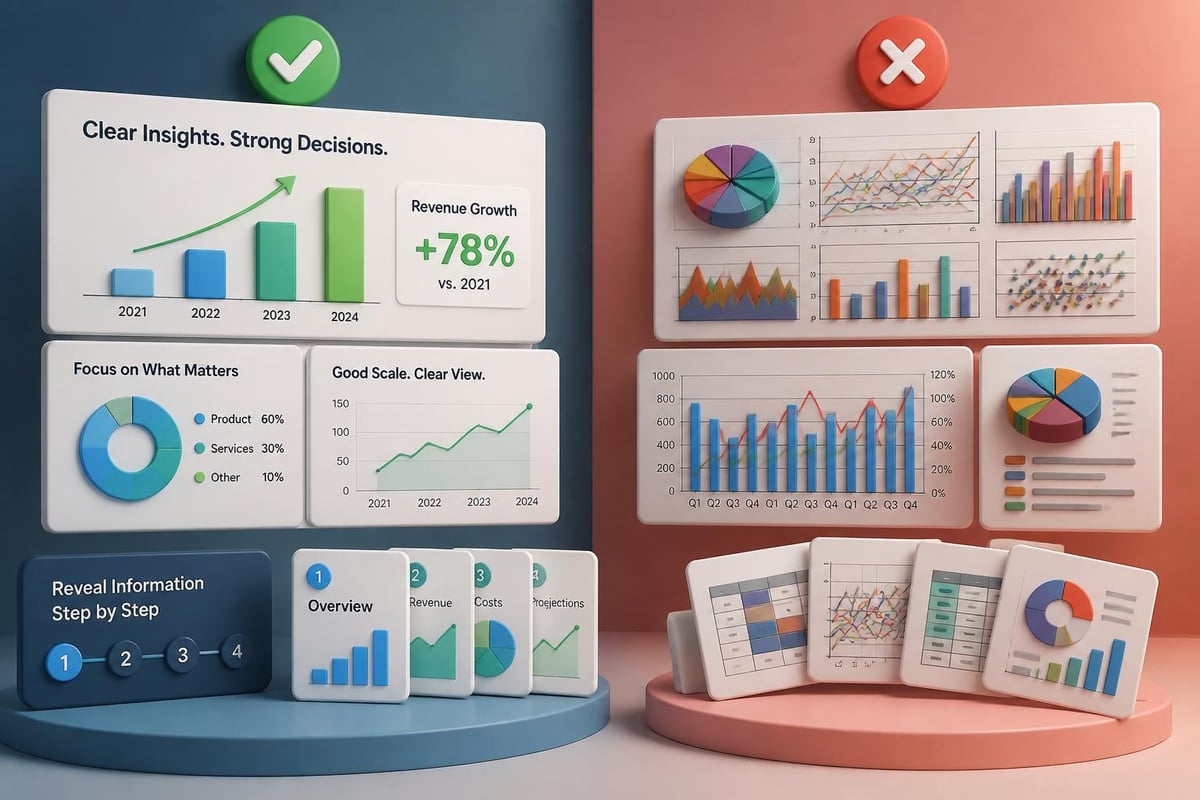
Financial and tech pitch decks contain substantial quantitative information that must be communicated clearly. Professional agencies transform raw data into visualizations that tell stories rather than just display numbers.

Effective approaches include:

  • Simplified chart types that prioritize clarity over complexity
  • Annotated graphs that highlight key inflection points
  • Comparative visualizations that contextualize your metrics
  • Progressive disclosure techniques for complex datasets

Agencies understand when to use bar charts versus line graphs, how to scale axes appropriately, and which metrics deserve visual emphasis versus text presentation. These technical decisions significantly impact investor comprehension and confidence.

Data visualization techniques

Consistency and Professional Polish

Attention to detail signals overall business competence to investors. Professional agencies ensure complete consistency across:

  1. Typography (font families, sizes, weights, spacing)
  2. Color application (primary, secondary, accent usage)
  3. Layout grids (alignment, margins, spacing systems)
  4. Visual elements (icons, dividers, backgrounds)
  5. Animation and transitions (if applicable)

This consistency extends beyond aesthetics into functional elements like slide numbering, footer information, and version control. Details like proper PPT layout design demonstrate professionalism that builds investor confidence.

Industry-Specific Considerations for Tech and Financial Firms

Different sectors require tailored approaches that reflect their unique investor expectations and communication challenges.

Fintech and Financial Services Requirements

Financial sector pitch decks must balance innovation storytelling with regulatory awareness and risk management. Agencies experienced in this space understand how to:

  • Present complex financial models with appropriate detail levels
  • Address regulatory compliance without defensive positioning
  • Demonstrate security and data protection capabilities
  • Communicate unit economics and customer acquisition costs clearly

Investors in financial services scrutinize operational details more intensely than in other sectors. Your deck must withstand this analysis while maintaining visual appeal. Guidelines for fintech presentations emphasize the importance of balancing technical credibility with accessible communication.

Technology and SaaS Presentation Strategies

Tech sector pitch decks face the challenge of explaining complex technical innovation to investors who may lack domain expertise. Successful agencies employ strategies including:

Layered technical explanation that provides high-level concepts upfront with optional detail for technical investors

Product demonstration integration through strategic screenshots, workflow diagrams, or UI examples

Market education that establishes problem significance before introducing your solution

Competitive positioning that differentiates on meaningful dimensions beyond feature lists

Technology companies benefit from agencies that understand how to visualize software architecture, API integrations, or technical infrastructure without overwhelming non-technical stakeholders.

Beyond the Initial Deck: Ongoing Design Support

Pitch deck design agencies increasingly offer extended services that support the full fundraising journey beyond initial deck creation.

Version Management and Updates

Fundraising campaigns evolve as you gather investor feedback, update financial projections, or adjust strategy. Agencies provide ongoing support through:

  • Quarterly refreshes incorporating new traction metrics
  • Investor-specific customization tailoring emphasis for different VC profiles
  • A/B testing variations to optimize message performance
  • Response to feedback addressing common investor questions

This ongoing relationship ensures your deck remains current and effective throughout extended fundraising timelines.

Multi-Format Adaptation

Modern fundraising requires presentation materials across multiple formats and contexts. Agencies help adapt your core deck into:

Format Purpose Key Adaptations
Email Teaser Initial outreach 3-5 slides, high-level only
Full Pitch Deck Formal meetings 12-18 slides, complete story
Data Room Deck Due diligence 25-40 slides, detailed appendix
Demo Day Format Time-constrained pitches 8-10 slides, visual-heavy
Board Updates Investor reporting Metric-focused, variance analysis

Each format requires different design optimization and content selection while maintaining brand consistency.

Presentation Coaching and Delivery Training

The best-designed deck fails if poorly delivered. Many agencies now include presentation coaching that covers:

  • Slide-by-slide narrative development
  • Handling difficult questions or objections
  • Timing and pacing optimization
  • Body language and stage presence
  • Virtual presentation best practices

This holistic approach ensures design quality translates into fundraising success through effective delivery.

Alternatives to Full-Service Agencies

While pitch deck design agencies offer comprehensive solutions, understanding alternative approaches helps make informed decisions about the right path for your situation.

Template-Based Solutions

For early-stage companies with limited budgets, high-quality templates provide starting points. Resources like Canva pitch deck templates offer structured frameworks at minimal cost.

Advantages: Low cost, immediate availability, simple customization

Limitations: Generic appearance, limited strategic guidance, requires internal design skill

Templates work best when combined with strong internal storytelling capabilities and basic design competence.

Freelance Designers

Individual designers offer middle-ground solutions between DIY templates and full agencies. Platforms like Upwork or Behance connect you with presentation specialists.

Advantages: Lower cost than agencies, personalized attention, flexible engagement

Limitations: Variable quality, limited strategic expertise, capacity constraints

Freelancers excel for companies with clear strategic direction needing execution support rather than comprehensive consulting.

Hybrid Approaches

Some companies successfully combine approaches, using agencies for initial deck creation while handling updates internally or through freelancers. This leverages agency expertise for foundational work while controlling ongoing costs.


Selecting the right pitch deck design partner significantly impacts your fundraising success and timeline efficiency. The investment in professional design expertise pays dividends through stronger investor engagement, faster funding cycles, and more favorable terms. Whether you're preparing for your first seed round or advancing to growth-stage financing, Prznt Perfect specializes in transforming complex financial and technical narratives into compelling visual stories that resonate with investors and drive results.

We offer free 30-min consultation on the presentation design audit
and hiring the right visual 
comms professional, let’s talk!
Shedule a call
Shedule a call
"I understand" goes a step further into the cognitive dance of persuasion. It's where the audience begins to see the connections between the facts, to grasp the nuances of the problem and the elegance of the solution.
  • This is some text inside of a div block.
    lay out the facts clearly and compellingly. Use data to establish the ground reality, but remember that facts alone are like the individual strands of a tapestry—necessary but not complete.
    lay out the facts clearly and compellingly. Use data to establish the ground reality, but remember that facts alone are like the individual strands of a tapestry—necessary but not complete.
  • This is some text inside of a div block.
    lay out the facts clearly and compellingly. Use data to establish the ground reality, but remember that facts alone are like the individual strands of a tapestry—necessary but not complete.

We offer free 30-min consultation on the presentation design audit

and hiring the right visual 
comms professional, let’s talk!

Shedule a call

"I understand" goes a step further into the cognitive dance of persuasion. It's where the audience begins to see the connections between the facts, to grasp the nuances of the problem and the elegance of the solution.

  • - 1 -
    Consistency at Scale:

    Biotech Market Trends 2024: Tailoring Your Pitch Deck to Current Industry Dynamics.

  • - 2 -
    Efficiency and Speed:

    The traditional process of manually updating presentations is not only slow but also prone to bottlenecks, especially when dealing with large volumes of slides. Automation dramatically accelerates this process, enabling designers to apply changes across hundreds of slides in the time it would take to manually update a single one. This efficiency is a game-changer for agencies working under tight deadlines or managing multiple projects simultaneously.

  • - 3 -
    Enhanced Creativity:

    With the burden of manual updates lifted, designers can allocate more time and energy to the creative aspects of presentation design. This freedom allows for deeper exploration of innovative design concepts, experimentation with new visual storytelling techniques, and the development of more engaging and interactive presentations. Automation doesn't stifle creativity; it amplifies it, enabling designers to push the boundaries of what's possible in corporate presentation design.

  • - 4 -
    Error Reduction:

    Manual updates are inherently prone to inconsistencies and mistakes, from misaligned logos to incorrect font sizes. These errors can detract from the professionalism of a presentation and, by extension, the corporate image. Automation minimizes these risks by ensuring that updates are applied uniformly and accurately across all slides, enhancing the overall quality and integrity of the presentation.

  • - 5 -
    Cost-Effectiveness:

    The time savings afforded by automation directly translate to cost savings for both the design agency and its clients. By reducing the hours spent on manual updates, agencies can optimize their workflows and resources, allowing them to take on more projects without compromising on quality. This efficiency can also make high-quality presentation design services more affordable and accessible to a broader range of businesses.

Pitch Deck Design Agencies: A Strategic Investment Guide
Discover how pitch deck design agencies transform startup presentations into investor-ready narratives. Expert insights for 2026 success.

Your pitch deck represents the first impression investors will have of your business, and in 2026's competitive fundraising environment, that first impression must be flawless. Pitch deck design agencies specialize in transforming complex business concepts into visually compelling narratives that capture investor attention and secure funding. These specialized firms combine design expertise with strategic storytelling to help financial and tech companies communicate their value proposition effectively. Understanding what these agencies offer and how to select the right partner can make the difference between a funded venture and a missed opportunity.

What Pitch Deck Design Agencies Actually Do

Pitch deck design agencies provide far more than aesthetic improvements to your slides. These specialized firms serve as strategic partners in shaping how your business story is told and received by investors.

The core function involves translating your business strategy into a visual narrative that resonates with venture capitalists, angel investors, and other funding sources. This process begins with understanding your business model, competitive advantages, and market opportunity. Agencies then craft a storyline that positions your company for investment success.

Strategic Consulting and Content Development

Professional agencies start by conducting discovery sessions to understand your business fundamentals. They analyze your:

  • Target market and addressable opportunity
  • Competitive differentiation and unique value proposition
  • Financial projections and unit economics
  • Go-to-market strategy and traction metrics
  • Team composition and relevant expertise

Through this analysis, agencies identify the strongest elements of your story and determine how to present them in sequence. Many firms provide strategic guidance on pitch deck structure that follows proven frameworks while maintaining uniqueness.

Pitch deck content strategy framework

Visual Design and Brand Integration

Once the narrative framework exists, agencies focus on visual execution. This involves creating custom graphics, data visualizations, and slide layouts that enhance comprehension while maintaining visual appeal.

The design process typically includes:

  1. Brand audit to ensure consistency with existing corporate identity
  2. Custom iconography development for unique visual language
  3. Data visualization that makes complex metrics immediately understandable
  4. Typography systems that improve readability and hierarchy
  5. Color palette selection aligned with brand and emotional impact

Professional designers understand how to balance sophistication with clarity. They know which design elements signal credibility to institutional investors versus those that appeal to consumer-focused VCs. According to research on visual design principles, visual excellence directly correlates with funding success rates.

Why Financial and Tech Companies Choose Design Agencies

The decision to partner with pitch deck design agencies stems from recognizing that fundraising success requires specialized expertise beyond what most internal teams possess.

Time Efficiency and Opportunity Cost

Building an effective pitch deck internally can consume hundreds of hours across multiple team members. Founders and executives must balance fundraising preparation with running their actual business operations.

External agencies compress this timeline dramatically. What might take an internal team six weeks to develop through trial and error, an experienced agency delivers in two weeks with higher quality results.

Approach Timeline Iterations Opportunity Cost
Internal Development 6-8 weeks 8-12 versions High (founder time)
Template-Based DIY 2-3 weeks 5-7 versions Medium (quality gaps)
Professional Agency 1.5-2 weeks 3-4 versions Low (efficient process)

Access to Specialized Expertise

Pitch deck design agencies employ professionals who create these presentations daily. Their teams include strategists who understand investor psychology, designers versed in PowerPoint design best practices, and consultants familiar with industry-specific expectations.

This concentrated expertise means agencies stay current on what works. They've analyzed hundreds of successful decks and understand subtle differences between Series A expectations versus Series B requirements. For companies preparing for Series B fundraising, this specialized knowledge proves invaluable.

Objective Perspective and Strategic Distance

Internal teams often struggle with message clarity because they're too close to the product. Agencies provide the outside perspective investors actually experience when reviewing your deck.

They identify assumptions that need explanation, jargon that creates barriers, and storyline gaps that internal teams overlook. This objective viewpoint helps refine messaging before investor meetings begin.

Evaluating Pitch Deck Design Agencies

Selecting the right agency partner requires methodical evaluation across multiple dimensions beyond just portfolio quality.

Portfolio Analysis and Industry Expertise

Review agency portfolios with specific criteria in mind. Look beyond aesthetic appeal to assess strategic thinking and storytelling capability.

Key evaluation questions:

  • Do portfolio examples demonstrate understanding of your industry's metrics?
  • Can you identify clear narrative progression through sample decks?
  • Does visual design enhance or distract from core messages?
  • Are data visualizations accurate and appropriately scaled?

Agencies serving financial and tech sectors should demonstrate familiarity with SaaS metrics, fintech regulations, or cybersecurity frameworks relevant to your business. Review their work in fintech pitch decks or cybersecurity presentations if those align with your industry.

Process Transparency and Collaboration Style

Understanding how an agency works proves as important as seeing what they've produced. Request detailed information about their process including:

  1. Discovery and strategy phase duration and format
  2. Number of design concepts presented initially
  3. Revision rounds included in standard engagements
  4. Typical timeline from kickoff to final delivery
  5. Communication frequency and stakeholder involvement

Some agencies operate with minimal client input, delivering finished decks based on initial briefings. Others involve clients throughout iterative development. Neither approach is inherently superior, but alignment with your preference matters significantly.

Agency selection criteria

Pricing Models and Value Assessment

Pitch deck design agencies employ various pricing structures that reflect different value propositions and service levels.

Pricing Model Typical Range Best For Considerations
Fixed Project Fee $5,000-$25,000 Standard pitch decks Clear scope definition required
Hourly Consulting $150-$400/hour Ongoing refinements Can exceed budget without controls
Retainer Packages $3,000-$15,000/month Multiple deliverables Requires sustained need
Equity-Based 0.1%-0.5% equity Early-stage startups Aligns incentives but dilutes ownership

Evaluate pricing relative to the potential funding you're seeking. Investing $15,000 in professional design for a $5 million raise represents 0.3% of target capital, typically yielding substantial returns through improved success rates and faster funding timelines. Common mistakes in budget allocation are outlined in this analysis of pitch deck design errors.

The Agency Engagement Process

Understanding what to expect during an agency engagement helps set realistic expectations and ensures productive collaboration.

Discovery and Strategic Foundation

The engagement typically begins with comprehensive discovery sessions where agencies gather information about your business, market, and fundraising goals. Prepare detailed materials including:

  • Current pitch deck or presentation materials
  • Business plan and financial models
  • Competitive analysis documentation
  • Previous investor feedback (if applicable)
  • Brand guidelines and visual assets

Agencies use this foundation to develop strategic recommendations about positioning, messaging hierarchy, and visual direction. This phase often reveals opportunities to strengthen your overall business narrative beyond just the deck itself.

Design Development and Iteration

Following strategic alignment, agencies move into active design production. This typically unfolds across multiple stages:

Initial concepts present 2-3 distinct visual directions for your consideration. These establish overall aesthetic, typography, color systems, and layout approaches without full content development.

Content integration applies the selected design direction across all slides, incorporating your specific data, metrics, and messaging. This stage reveals how the visual system performs with real content.

Refinement cycles address feedback, adjust pacing, and optimize individual slides for maximum impact. Professional agencies typically include 2-3 revision rounds, though complex projects may require additional iterations.

Understanding professional PowerPoint development processes helps clients provide effective feedback during these cycles.

Finalization and Delivery

Agencies deliver final presentations in multiple formats to support various use scenarios:

  • Editable source files (PowerPoint, Keynote, or Google Slides)
  • PDF versions for email distribution
  • Presentation mode files optimized for live delivery
  • Individual slide exports for social media or marketing use

Many agencies also provide presentation coaching or rehearsal support to help founders deliver their newly designed decks effectively. This ensures visual quality translates into actual presentation impact.

Design Principles That Separate Professional Agencies

Pitch deck design agencies distinguish themselves through mastery of specific design principles that directly impact investor perception and comprehension.

Visual Hierarchy and Information Flow

Professional designers create clear visual hierarchy that guides investor attention through each slide deliberately. This involves strategic use of:

  • Size variation to emphasize critical data points
  • Color contrast to distinguish primary from supporting information
  • Whitespace deployment to prevent cognitive overload
  • Directional cues that lead eyes through complex graphics

Research on pitch deck design principles demonstrates that clear visual hierarchy reduces investor cognitive load by up to 40%, improving message retention significantly.

Data Visualization Excellence

Financial and tech pitch decks contain substantial quantitative information that must be communicated clearly. Professional agencies transform raw data into visualizations that tell stories rather than just display numbers.

Effective approaches include:

  • Simplified chart types that prioritize clarity over complexity
  • Annotated graphs that highlight key inflection points
  • Comparative visualizations that contextualize your metrics
  • Progressive disclosure techniques for complex datasets

Agencies understand when to use bar charts versus line graphs, how to scale axes appropriately, and which metrics deserve visual emphasis versus text presentation. These technical decisions significantly impact investor comprehension and confidence.
Data visualization techniques

Consistency and Professional Polish

Attention to detail signals overall business competence to investors. Professional agencies ensure complete consistency across:

  1. Typography (font families, sizes, weights, spacing)
  2. Color application (primary, secondary, accent usage)
  3. Layout grids (alignment, margins, spacing systems)
  4. Visual elements (icons, dividers, backgrounds)
  5. Animation and transitions (if applicable)

This consistency extends beyond aesthetics into functional elements like slide numbering, footer information, and version control. Details like proper PPT layout design demonstrate professionalism that builds investor confidence.

Industry-Specific Considerations for Tech and Financial Firms

Different sectors require tailored approaches that reflect their unique investor expectations and communication challenges.

Fintech and Financial Services Requirements

Financial sector pitch decks must balance innovation storytelling with regulatory awareness and risk management. Agencies experienced in this space understand how to:

  • Present complex financial models with appropriate detail levels
  • Address regulatory compliance without defensive positioning
  • Demonstrate security and data protection capabilities
  • Communicate unit economics and customer acquisition costs clearly

Investors in financial services scrutinize operational details more intensely than in other sectors. Your deck must withstand this analysis while maintaining visual appeal. Guidelines for fintech presentations emphasize the importance of balancing technical credibility with accessible communication.

Technology and SaaS Presentation Strategies

Tech sector pitch decks face the challenge of explaining complex technical innovation to investors who may lack domain expertise. Successful agencies employ strategies including:

Layered technical explanation that provides high-level concepts upfront with optional detail for technical investors

Product demonstration integration through strategic screenshots, workflow diagrams, or UI examples

Market education that establishes problem significance before introducing your solution

Competitive positioning that differentiates on meaningful dimensions beyond feature lists

Technology companies benefit from agencies that understand how to visualize software architecture, API integrations, or technical infrastructure without overwhelming non-technical stakeholders.

Beyond the Initial Deck: Ongoing Design Support

Pitch deck design agencies increasingly offer extended services that support the full fundraising journey beyond initial deck creation.

Version Management and Updates

Fundraising campaigns evolve as you gather investor feedback, update financial projections, or adjust strategy. Agencies provide ongoing support through:

  • Quarterly refreshes incorporating new traction metrics
  • Investor-specific customization tailoring emphasis for different VC profiles
  • A/B testing variations to optimize message performance
  • Response to feedback addressing common investor questions

This ongoing relationship ensures your deck remains current and effective throughout extended fundraising timelines.

Multi-Format Adaptation

Modern fundraising requires presentation materials across multiple formats and contexts. Agencies help adapt your core deck into:

Format Purpose Key Adaptations
Email Teaser Initial outreach 3-5 slides, high-level only
Full Pitch Deck Formal meetings 12-18 slides, complete story
Data Room Deck Due diligence 25-40 slides, detailed appendix
Demo Day Format Time-constrained pitches 8-10 slides, visual-heavy
Board Updates Investor reporting Metric-focused, variance analysis

Each format requires different design optimization and content selection while maintaining brand consistency.

Presentation Coaching and Delivery Training

The best-designed deck fails if poorly delivered. Many agencies now include presentation coaching that covers:

  • Slide-by-slide narrative development
  • Handling difficult questions or objections
  • Timing and pacing optimization
  • Body language and stage presence
  • Virtual presentation best practices

This holistic approach ensures design quality translates into fundraising success through effective delivery.

Alternatives to Full-Service Agencies

While pitch deck design agencies offer comprehensive solutions, understanding alternative approaches helps make informed decisions about the right path for your situation.

Template-Based Solutions

For early-stage companies with limited budgets, high-quality templates provide starting points. Resources like Canva pitch deck templates offer structured frameworks at minimal cost.

Advantages: Low cost, immediate availability, simple customization

Limitations: Generic appearance, limited strategic guidance, requires internal design skill

Templates work best when combined with strong internal storytelling capabilities and basic design competence.

Freelance Designers

Individual designers offer middle-ground solutions between DIY templates and full agencies. Platforms like Upwork or Behance connect you with presentation specialists.

Advantages: Lower cost than agencies, personalized attention, flexible engagement

Limitations: Variable quality, limited strategic expertise, capacity constraints

Freelancers excel for companies with clear strategic direction needing execution support rather than comprehensive consulting.

Hybrid Approaches

Some companies successfully combine approaches, using agencies for initial deck creation while handling updates internally or through freelancers. This leverages agency expertise for foundational work while controlling ongoing costs.


Selecting the right pitch deck design partner significantly impacts your fundraising success and timeline efficiency. The investment in professional design expertise pays dividends through stronger investor engagement, faster funding cycles, and more favorable terms. Whether you're preparing for your first seed round or advancing to growth-stage financing, Prznt Perfect specializes in transforming complex financial and technical narratives into compelling visual stories that resonate with investors and drive results.

News & Updates...

Learn proven strategies to beautify slides for financial and tech presentations. Expert tips on design, layout, and visual storytelling.

Discover how 24-hour pitch deck services deliver professional presentations under tight deadlines. Expert insights for fast turnarounds.