Cybersecurity Presentation Design: Best Practices Guide

Communicating cybersecurity concepts effectively requires more than technical expertise. It demands presentation design that translates complex security frameworks, threat landscapes, and compliance requirements into visual narratives that resonate with diverse audiences. Whether you're presenting to C-suite executives, technical teams, or board members, cybersecurity presentation design bridges the gap between intricate security concepts and actionable business insights. Organizations that master this intersection create presentations that not only inform but also drive strategic decision-making and security investment.

The Unique Challenges of Cybersecurity Presentations

Cybersecurity professionals face distinct presentation challenges that set their communication needs apart from other technical fields. Security teams must balance technical accuracy with accessibility, ensuring stakeholders understand both the severity of threats and the value of proposed solutions.

Translating Technical Complexity

The fundamental challenge in cybersecurity presentation design lies in making abstract threats tangible. Attack vectors, zero-day vulnerabilities, and encryption protocols require visual interpretation that maintains accuracy while remaining comprehensible to non-technical audiences.

Key translation strategies include:

  • Converting network diagrams into simplified flow charts that highlight risk points
  • Replacing jargon-heavy terminology with business-impact language
  • Using progressive disclosure to layer technical details for different audience segments
  • Creating visual hierarchies that prioritize business consequences over technical mechanisms

Security professionals often struggle with the delicate balance between showcasing expertise and overwhelming their audience. Strategies for delivering engaging cybersecurity presentations emphasize the importance of audience-centric content that addresses specific concerns rather than comprehensive security encyclopedias.

Cybersecurity data visualization

Compliance and Confidentiality Constraints

Cybersecurity presentations operate under unique constraints related to information sensitivity and regulatory compliance. Design decisions must account for what can be displayed, shared, and distributed across different security clearance levels.

Organizations implementing secure by design principles understand that presentation security extends beyond content to encompass file handling, version control, and distribution protocols. This approach ensures that the presentation itself doesn't become a security vulnerability.

Design Consideration Standard Presentation Cybersecurity Presentation
Data Sensitivity Moderate screening Rigorous classification review
Distribution Control Open sharing Role-based access controls
Version Management Basic tracking Audit trail requirements
Third-party Elements Liberal use of stock images Vetted, compliant assets only

Visual Strategy for Security Narratives

Effective cybersecurity presentation design requires a purposeful visual strategy that supports security messaging while maintaining professional credibility. The visual language you choose directly impacts how audiences perceive both the threats you present and the solutions you propose.

Color Psychology in Security Communications

Color choices in cybersecurity presentations carry psychological weight that extends beyond aesthetics. Traditional security presentations often default to red-dominated color schemes that emphasize danger, but this approach can create alarm fatigue and undermine constructive dialogue.

Strategic color application includes:

  1. Risk gradient systems that use color intensity to communicate threat severity levels
  2. Status indicators that provide at-a-glance security posture assessments
  3. Attention direction that guides audiences to critical decision points
  4. Brand consistency that maintains organizational identity while addressing security themes

Professional presentation design services understand that effective PPT layout design creates visual breathing room that prevents cognitive overload. This principle proves especially critical in cybersecurity contexts where information density can quickly overwhelm audiences.

Data Visualization for Threat Intelligence

Cybersecurity generates massive data sets that require thoughtful visualization to extract meaningful insights. Raw security logs, incident reports, and vulnerability scans become actionable intelligence only when properly visualized.

Cybersecurity managers benefit from presentation tips that emphasize clarity over complexity, particularly when presenting metrics to executive audiences who need decision-enabling information rather than technical deep dives.

Effective visualization approaches:

  • Timeline visualizations showing attack progression and response actions
  • Heat maps identifying vulnerable systems or high-risk user behaviors
  • Trend analysis demonstrating security posture improvements over time
  • Comparative dashboards benchmarking organizational security against industry standards

The transformation of security data into visual stories requires understanding both the technical nuances and the business context. This intersection defines successful cybersecurity presentation design.

Audience Segmentation and Message Tailoring

Different stakeholders require fundamentally different approaches to cybersecurity communication. The presentation that resonates with your security operations team will likely miss the mark with board members focused on business risk and regulatory compliance.

Executive-Level Security Presentations

C-suite audiences prioritize business impact over technical implementation. Cybersecurity presentation design for executives emphasizes financial risk, competitive positioning, and regulatory exposure rather than technical vulnerability details.

Executive presentations should lead with business outcomes:

  • Revenue protection through customer data security
  • Reputation preservation and brand trust maintenance
  • Regulatory compliance and penalty avoidance
  • Competitive advantage through security differentiation

These audiences respond to company presentation approaches that position security as a business enabler rather than a cost center. The design aesthetic should reflect boardroom sophistication while maintaining accessibility.

Technical Team Communications

Security engineers and IT professionals require presentations that demonstrate technical depth while still benefiting from strong visual organization. These audiences appreciate detailed architecture diagrams, code snippets, and implementation specifics that would overwhelm executive viewers.

Cybersecurity audience segmentation

Technical cybersecurity presentation design balances thoroughness with usability:

  1. Detailed system architecture with clear security boundaries
  2. Specific vulnerability remediation steps with technical specifications
  3. Configuration examples and policy implementation guidance
  4. Integration requirements with existing security infrastructure

The visual approach for technical audiences can embrace greater complexity, utilizing detailed diagrams and technical schematics that support implementation discussions. However, even technical presentations benefit from clear information hierarchy and purposeful design.

Building Persuasive Security Investment Cases

One of the most critical applications of cybersecurity presentation design involves securing budget approval for security initiatives. These presentations must translate technical requirements into compelling business cases that justify resource allocation.

Quantifying Security Value

Security leaders often struggle to demonstrate return on investment for preventative measures. Unlike revenue-generating initiatives with clear metrics, security investments prevent negative outcomes that are difficult to quantify.

Effective value demonstration strategies:

  • Breach cost modeling showing potential financial impact of security incidents
  • Compliance cost avoidance quantifying penalties prevented through proper controls
  • Operational efficiency gains from streamlined security processes
  • Insurance premium reductions achieved through improved security posture

Organizations working on cybersecurity pitch decks understand that visual storytelling transforms abstract security concepts into tangible business value propositions. This approach proves essential when competing for limited resources against revenue-focused initiatives.

Investment Justification Element Weak Approach Strong Approach
Risk Quantification "Significant security gap" "$2.4M potential breach cost based on industry benchmarks"
Solution Impact "Improves security posture" "Reduces detection time from 196 days to 24 hours"
Timeline "As soon as possible" "90-day implementation with staged rollout"
Success Metrics "Better protection" "25% reduction in security incidents within 6 months"

Competitive Intelligence in Security Presentations

Demonstrating how organizational security compares to industry peers provides powerful context for investment requests. Cybersecurity presentation design should incorporate competitive benchmarking that positions security initiatives within broader market trends.

This comparative approach addresses the question executives always ask: "How do we stack up against competitors?" Visual presentation of competitive positioning creates urgency while providing cover for budget approvals.

Design Systems for Security Consistency

Establishing consistent design patterns across security communications builds recognition and trust while streamlining presentation development. Organizations that invest in cybersecurity presentation design systems create reusable frameworks that maintain quality while reducing production time.

Template Architecture for Security Content

Purpose-built templates address recurring cybersecurity presentation scenarios without requiring custom design for each instance. Professional PowerPoint approaches emphasize template systems that balance flexibility with brand consistency.

Core template categories include:

  • Monthly security briefing templates for recurring stakeholder updates
  • Incident response presentation frameworks for crisis communications
  • Training and awareness session templates for employee education
  • Audit and compliance review templates for regulatory interactions

Template systems prove particularly valuable for distributed security teams where multiple presenters need to maintain consistent quality and messaging. The investment in template development pays ongoing dividends through efficiency and professionalism.

Icon Libraries and Visual Assets

Cybersecurity concepts benefit from standardized visual representation that builds recognition over time. Developing curated icon libraries for common security concepts ensures consistency while accelerating presentation development.

Standard visual assets should cover:

  1. Threat actor categories and attack types
  2. Security control classifications and defensive measures
  3. Compliance frameworks and regulatory requirements
  4. Security tool categories and technology stacks

Organizations can enhance their visual communication by partnering with specialists in product design who understand how consistent visual systems support complex technical narratives.

Accessibility and Inclusive Design Principles

Cybersecurity presentations must reach diverse audiences with varying abilities and learning preferences. Designing for accessibility ensures critical security messages reach everyone who needs them while demonstrating organizational commitment to inclusion.

Compliance with Accessibility Standards

Best practices for creating accessible presentations extend beyond legal compliance to ensure effective communication with all stakeholders. Cybersecurity presentation design that ignores accessibility potentially excludes decision-makers from critical security discussions.

Essential accessibility elements:

  • Sufficient color contrast ratios for text readability
  • Alternative text descriptions for all images and diagrams
  • Logical reading order for screen reader compatibility
  • Caption support for video and multimedia elements
  • Keyboard navigation support for interactive elements

These considerations prove particularly important in security contexts where urgent communications must reach all stakeholders regardless of individual abilities or circumstances.

Multi-Modal Content Delivery

Different audiences process information through different modalities. Effective cybersecurity presentation design incorporates multiple information channels that reinforce key messages through visual, textual, and narrative approaches.

This layered communication strategy ensures that whether your audience prefers reading detailed specifications, viewing visual diagrams, or listening to verbal explanations, they receive the critical security information they need to make informed decisions.

Accessible cybersecurity design

Interactive and Gamified Security Training

Traditional security awareness training often fails to engage audiences or drive behavioral change. Modern cybersecurity presentation design incorporates interactive elements and gamification strategies that transform passive presentations into active learning experiences.

Serious Games for Security Education

Research into cybersecurity awareness through interactive learning demonstrates the effectiveness of game-based approaches for complex security concepts. These methodologies translate readily into presentation contexts where engagement drives retention.

Interactive presentation elements include scenario-based decision trees where audiences choose responses to simulated security incidents, revealing consequences of different actions. This approach builds intuitive understanding of security principles that survives long after the presentation concludes.

Organizations exploring innovative training approaches can learn from card-based teaching methods that break complex topics into digestible, interactive components. These principles apply equally to presentation design where modular content supports flexible delivery.

Engagement Metrics and Effectiveness Measurement

Moving beyond passive slide delivery, modern cybersecurity presentation design incorporates mechanisms for measuring audience engagement and comprehension. Real-time polling, knowledge checks, and interactive scenarios provide immediate feedback on message effectiveness.

This data-driven approach enables continuous improvement of security communications, identifying which visual approaches, message framing, and content structures resonate most effectively with different audiences.

Integration with Broader Marketing Communications

Cybersecurity presentations rarely exist in isolation. They form part of broader marketing and communication strategies that span sales enablement, thought leadership, and brand positioning. Effective cybersecurity presentation design aligns with organizational communication frameworks while addressing security-specific requirements.

Sales Enablement for Security Solutions

Organizations selling cybersecurity solutions require presentations that balance technical credibility with persuasive storytelling. Cybersecurity sales approaches recognize that prospects need both confidence in technical capabilities and clarity on business value.

Sales-focused cybersecurity presentation design emphasizes proof points and case studies that demonstrate real-world effectiveness. This evidence-based approach overcomes skepticism while building trust through demonstrated results.

Marketing agencies specializing in strategic branding and digital marketing understand how cybersecurity messaging integrates with broader brand narratives. Security communications that align with organizational positioning create coherent market presence across all touchpoints.

Thought Leadership and Industry Positioning

Security executives increasingly use presentations to establish thought leadership and influence industry conversations. Conference presentations, webinar content, and analyst briefings require sophisticated cybersecurity presentation design that balances expertise demonstration with audience value delivery.

Thought leadership presentations should provide genuine insights rather than thinly veiled product pitches. This audience-first approach builds credibility and positions organizations as trusted advisors rather than mere vendors.

Leveraging Multimedia and Motion Graphics

Static slides represent just one dimension of modern presentation capabilities. Cybersecurity presentation design increasingly incorporates video, animation, and motion graphics that bring abstract security concepts to life through dynamic visualization.

Video Integration for Complex Concepts

Certain cybersecurity concepts benefit enormously from video explanation. Attack progression sequences, network traffic analysis, and incident response procedures become dramatically clearer when presented through animation rather than static diagrams.

Organizations can enhance their presentation impact by partnering with audiovisual production specialists who understand how to translate technical concepts into engaging video content. These multimedia elements transform presentations from information delivery vehicles into memorable experiences.

Effective video applications include:

  • Animated attack scenario walkthroughs showing progression and impact
  • Screen capture demonstrations of security tool functionality
  • Interview segments with security leaders providing context and credibility
  • Data visualization animations revealing patterns in security metrics

The investment in video production pays dividends through increased engagement and improved message retention, particularly for complex security concepts that resist static visualization.

Animation for Process Visualization

Motion graphics excel at demonstrating security processes and workflows. Authentication sequences, encryption operations, and threat detection pipelines become dramatically more comprehensible when presented through purposeful animation rather than static process diagrams.

Animation directs audience attention precisely where you need it, revealing information progressively and preventing cognitive overload. This controlled information flow proves particularly valuable when presenting to mixed audiences with varying technical sophistication.

Remote Presentation Optimization

The shift toward remote and hybrid work models requires cybersecurity presentation design optimized for virtual delivery. Presentations that work brilliantly in physical conference rooms may fail completely in video conference environments without appropriate adaptation.

Virtual-First Design Considerations

Remote presentation success depends on design decisions that account for small screens, variable internet connectivity, and limited presenter control over viewing environments. Georgetown University's presentation design guidance emphasizes readability and clarity as fundamental principles that prove especially critical in remote contexts.

Virtual presentation optimization includes:

  1. Larger fonts sized for laptop screens rather than projectors
  2. Higher contrast ratios accounting for variable display quality
  3. Simplified layouts reducing visual complexity for bandwidth constraints
  4. Strategic use of presenter notes supporting virtual delivery
  5. Export formats optimized for screen sharing platforms

Organizations exploring presentation outsourcing services should ensure providers understand virtual delivery requirements and design accordingly. The technical requirements for effective remote presentation differ substantially from traditional in-person delivery.

Engagement Strategies for Virtual Audiences

Maintaining audience attention proves challenging in remote environments where distractions abound and engagement signals remain hidden. Cybersecurity presentation design for virtual delivery must incorporate active engagement mechanisms that keep audiences focused and participating.

Interactive polls, chat-based questions, and breakout discussions transform passive viewing into active participation. These engagement tools provide presenters with real-time feedback on comprehension while maintaining audience attention through varied interaction modes.

Remote presentations also benefit from shorter, more focused segments rather than extended lectures. Cybersecurity content delivered in 15-20 minute modules with discussion breaks maintains attention more effectively than hour-long monologues regardless of visual quality.

Emerging Technologies in Security Presentations

Cybersecurity presentation design continues evolving alongside broader technological advancement. Organizations that embrace emerging presentation technologies gain competitive advantages through more effective security communication.

Artificial Intelligence and Automated Design

AI-powered design tools increasingly automate routine presentation development tasks, freeing security professionals to focus on content strategy and message refinement. These technologies analyze content and suggest visual treatments, layout improvements, and design enhancements.

Organizations implementing remote CMO services often leverage AI-driven presentation tools as part of comprehensive digital strategies. These technologies democratize professional design quality while accelerating production timelines.

However, automated tools work best when guided by experienced designers who understand both cybersecurity content requirements and visual communication principles. The most effective approach combines AI efficiency with human expertise and strategic oversight.

Interactive Data Dashboards

Modern presentation platforms support embedded interactive dashboards that allow audiences to explore security data during presentations. Rather than static charts showing predetermined views, interactive dashboards enable audience-driven data investigation.

This capability proves particularly valuable for technical audiences who want to drill into specific metrics or explore alternative data views. Interactive elements transform presentations from one-way broadcasts into collaborative analytical sessions.

Creating Presentation Systems at Scale

Large organizations require systematic approaches to cybersecurity presentation design that maintain quality across distributed teams while enabling rapid response to emerging threats and evolving requirements.

Centralized Design Resources

Establishing centralized presentation design resources ensures consistent quality while providing efficiency through reusable components and standardized processes. These resources typically include template libraries, asset repositories, and design guidelines specific to cybersecurity communications.

Organizations can develop internal capabilities or partner with specialists providing sales pitch deck services and broader presentation support. The right approach depends on presentation volume, internal design capabilities, and strategic importance of presentation quality.

Training and Enablement Programs

Even the best design systems fail without proper training on effective use. Organizations investing in cybersecurity presentation design should develop corresponding enablement programs that teach security professionals how to leverage available resources effectively.

Training programs should cover both design principles and practical tool usage, ensuring security teams can create professional presentations independently while knowing when to escalate complex requirements to specialized design resources.


Mastering cybersecurity presentation design transforms security communications from technical documentation into persuasive business narratives that drive decision-making and action. By combining visual sophistication with security expertise, organizations create presentations that resonate with diverse audiences while maintaining technical credibility. Whether you're building security awareness programs, pitching budget requests, or establishing thought leadership, professional presentation design amplifies your message and accelerates your objectives. Prznt Perfect specializes in transforming complex cybersecurity concepts into compelling visual stories that engage stakeholders and drive results, bringing specialized expertise in both presentation design and security industry knowledge to every project.

We offer free 30-min consultation on the presentation design audit
and hiring the right visual 
comms professional, let’s talk!
Shedule a call
Shedule a call
"I understand" goes a step further into the cognitive dance of persuasion. It's where the audience begins to see the connections between the facts, to grasp the nuances of the problem and the elegance of the solution.
  • This is some text inside of a div block.
    lay out the facts clearly and compellingly. Use data to establish the ground reality, but remember that facts alone are like the individual strands of a tapestry—necessary but not complete.
    lay out the facts clearly and compellingly. Use data to establish the ground reality, but remember that facts alone are like the individual strands of a tapestry—necessary but not complete.
  • This is some text inside of a div block.
    lay out the facts clearly and compellingly. Use data to establish the ground reality, but remember that facts alone are like the individual strands of a tapestry—necessary but not complete.

We offer free 30-min consultation on the presentation design audit

and hiring the right visual 
comms professional, let’s talk!

Shedule a call

"I understand" goes a step further into the cognitive dance of persuasion. It's where the audience begins to see the connections between the facts, to grasp the nuances of the problem and the elegance of the solution.

  • - 1 -
    Consistency at Scale:

    Biotech Market Trends 2024: Tailoring Your Pitch Deck to Current Industry Dynamics.

  • - 2 -
    Efficiency and Speed:

    The traditional process of manually updating presentations is not only slow but also prone to bottlenecks, especially when dealing with large volumes of slides. Automation dramatically accelerates this process, enabling designers to apply changes across hundreds of slides in the time it would take to manually update a single one. This efficiency is a game-changer for agencies working under tight deadlines or managing multiple projects simultaneously.

  • - 3 -
    Enhanced Creativity:

    With the burden of manual updates lifted, designers can allocate more time and energy to the creative aspects of presentation design. This freedom allows for deeper exploration of innovative design concepts, experimentation with new visual storytelling techniques, and the development of more engaging and interactive presentations. Automation doesn't stifle creativity; it amplifies it, enabling designers to push the boundaries of what's possible in corporate presentation design.

  • - 4 -
    Error Reduction:

    Manual updates are inherently prone to inconsistencies and mistakes, from misaligned logos to incorrect font sizes. These errors can detract from the professionalism of a presentation and, by extension, the corporate image. Automation minimizes these risks by ensuring that updates are applied uniformly and accurately across all slides, enhancing the overall quality and integrity of the presentation.

  • - 5 -
    Cost-Effectiveness:

    The time savings afforded by automation directly translate to cost savings for both the design agency and its clients. By reducing the hours spent on manual updates, agencies can optimize their workflows and resources, allowing them to take on more projects without compromising on quality. This efficiency can also make high-quality presentation design services more affordable and accessible to a broader range of businesses.

Cybersecurity Presentation Design: Best Practices Guide
Master cybersecurity presentation design with proven strategies for creating compelling, secure, and impactful presentations that engage audiences.

Communicating cybersecurity concepts effectively requires more than technical expertise. It demands presentation design that translates complex security frameworks, threat landscapes, and compliance requirements into visual narratives that resonate with diverse audiences. Whether you're presenting to C-suite executives, technical teams, or board members, cybersecurity presentation design bridges the gap between intricate security concepts and actionable business insights. Organizations that master this intersection create presentations that not only inform but also drive strategic decision-making and security investment.

The Unique Challenges of Cybersecurity Presentations

Cybersecurity professionals face distinct presentation challenges that set their communication needs apart from other technical fields. Security teams must balance technical accuracy with accessibility, ensuring stakeholders understand both the severity of threats and the value of proposed solutions.

Translating Technical Complexity

The fundamental challenge in cybersecurity presentation design lies in making abstract threats tangible. Attack vectors, zero-day vulnerabilities, and encryption protocols require visual interpretation that maintains accuracy while remaining comprehensible to non-technical audiences.

Key translation strategies include:

  • Converting network diagrams into simplified flow charts that highlight risk points
  • Replacing jargon-heavy terminology with business-impact language
  • Using progressive disclosure to layer technical details for different audience segments
  • Creating visual hierarchies that prioritize business consequences over technical mechanisms

Security professionals often struggle with the delicate balance between showcasing expertise and overwhelming their audience. Strategies for delivering engaging cybersecurity presentations emphasize the importance of audience-centric content that addresses specific concerns rather than comprehensive security encyclopedias.

Cybersecurity data visualization

Compliance and Confidentiality Constraints

Cybersecurity presentations operate under unique constraints related to information sensitivity and regulatory compliance. Design decisions must account for what can be displayed, shared, and distributed across different security clearance levels.

Organizations implementing secure by design principles understand that presentation security extends beyond content to encompass file handling, version control, and distribution protocols. This approach ensures that the presentation itself doesn't become a security vulnerability.

Design Consideration Standard Presentation Cybersecurity Presentation
Data Sensitivity Moderate screening Rigorous classification review
Distribution Control Open sharing Role-based access controls
Version Management Basic tracking Audit trail requirements
Third-party Elements Liberal use of stock images Vetted, compliant assets only

Visual Strategy for Security Narratives

Effective cybersecurity presentation design requires a purposeful visual strategy that supports security messaging while maintaining professional credibility. The visual language you choose directly impacts how audiences perceive both the threats you present and the solutions you propose.

Color Psychology in Security Communications

Color choices in cybersecurity presentations carry psychological weight that extends beyond aesthetics. Traditional security presentations often default to red-dominated color schemes that emphasize danger, but this approach can create alarm fatigue and undermine constructive dialogue.

Strategic color application includes:

  1. Risk gradient systems that use color intensity to communicate threat severity levels
  2. Status indicators that provide at-a-glance security posture assessments
  3. Attention direction that guides audiences to critical decision points
  4. Brand consistency that maintains organizational identity while addressing security themes

Professional presentation design services understand that effective PPT layout design creates visual breathing room that prevents cognitive overload. This principle proves especially critical in cybersecurity contexts where information density can quickly overwhelm audiences.

Data Visualization for Threat Intelligence

Cybersecurity generates massive data sets that require thoughtful visualization to extract meaningful insights. Raw security logs, incident reports, and vulnerability scans become actionable intelligence only when properly visualized.

Cybersecurity managers benefit from presentation tips that emphasize clarity over complexity, particularly when presenting metrics to executive audiences who need decision-enabling information rather than technical deep dives.

Effective visualization approaches:

  • Timeline visualizations showing attack progression and response actions
  • Heat maps identifying vulnerable systems or high-risk user behaviors
  • Trend analysis demonstrating security posture improvements over time
  • Comparative dashboards benchmarking organizational security against industry standards

The transformation of security data into visual stories requires understanding both the technical nuances and the business context. This intersection defines successful cybersecurity presentation design.

Audience Segmentation and Message Tailoring

Different stakeholders require fundamentally different approaches to cybersecurity communication. The presentation that resonates with your security operations team will likely miss the mark with board members focused on business risk and regulatory compliance.

Executive-Level Security Presentations

C-suite audiences prioritize business impact over technical implementation. Cybersecurity presentation design for executives emphasizes financial risk, competitive positioning, and regulatory exposure rather than technical vulnerability details.

Executive presentations should lead with business outcomes:

  • Revenue protection through customer data security
  • Reputation preservation and brand trust maintenance
  • Regulatory compliance and penalty avoidance
  • Competitive advantage through security differentiation

These audiences respond to company presentation approaches that position security as a business enabler rather than a cost center. The design aesthetic should reflect boardroom sophistication while maintaining accessibility.

Technical Team Communications

Security engineers and IT professionals require presentations that demonstrate technical depth while still benefiting from strong visual organization. These audiences appreciate detailed architecture diagrams, code snippets, and implementation specifics that would overwhelm executive viewers.

Cybersecurity audience segmentation

Technical cybersecurity presentation design balances thoroughness with usability:

  1. Detailed system architecture with clear security boundaries
  2. Specific vulnerability remediation steps with technical specifications
  3. Configuration examples and policy implementation guidance
  4. Integration requirements with existing security infrastructure

The visual approach for technical audiences can embrace greater complexity, utilizing detailed diagrams and technical schematics that support implementation discussions. However, even technical presentations benefit from clear information hierarchy and purposeful design.

Building Persuasive Security Investment Cases

One of the most critical applications of cybersecurity presentation design involves securing budget approval for security initiatives. These presentations must translate technical requirements into compelling business cases that justify resource allocation.

Quantifying Security Value

Security leaders often struggle to demonstrate return on investment for preventative measures. Unlike revenue-generating initiatives with clear metrics, security investments prevent negative outcomes that are difficult to quantify.

Effective value demonstration strategies:

  • Breach cost modeling showing potential financial impact of security incidents
  • Compliance cost avoidance quantifying penalties prevented through proper controls
  • Operational efficiency gains from streamlined security processes
  • Insurance premium reductions achieved through improved security posture

Organizations working on cybersecurity pitch decks understand that visual storytelling transforms abstract security concepts into tangible business value propositions. This approach proves essential when competing for limited resources against revenue-focused initiatives.

Investment Justification Element Weak Approach Strong Approach
Risk Quantification "Significant security gap" "$2.4M potential breach cost based on industry benchmarks"
Solution Impact "Improves security posture" "Reduces detection time from 196 days to 24 hours"
Timeline "As soon as possible" "90-day implementation with staged rollout"
Success Metrics "Better protection" "25% reduction in security incidents within 6 months"

Competitive Intelligence in Security Presentations

Demonstrating how organizational security compares to industry peers provides powerful context for investment requests. Cybersecurity presentation design should incorporate competitive benchmarking that positions security initiatives within broader market trends.

This comparative approach addresses the question executives always ask: "How do we stack up against competitors?" Visual presentation of competitive positioning creates urgency while providing cover for budget approvals.

Design Systems for Security Consistency

Establishing consistent design patterns across security communications builds recognition and trust while streamlining presentation development. Organizations that invest in cybersecurity presentation design systems create reusable frameworks that maintain quality while reducing production time.

Template Architecture for Security Content

Purpose-built templates address recurring cybersecurity presentation scenarios without requiring custom design for each instance. Professional PowerPoint approaches emphasize template systems that balance flexibility with brand consistency.

Core template categories include:

  • Monthly security briefing templates for recurring stakeholder updates
  • Incident response presentation frameworks for crisis communications
  • Training and awareness session templates for employee education
  • Audit and compliance review templates for regulatory interactions

Template systems prove particularly valuable for distributed security teams where multiple presenters need to maintain consistent quality and messaging. The investment in template development pays ongoing dividends through efficiency and professionalism.

Icon Libraries and Visual Assets

Cybersecurity concepts benefit from standardized visual representation that builds recognition over time. Developing curated icon libraries for common security concepts ensures consistency while accelerating presentation development.

Standard visual assets should cover:

  1. Threat actor categories and attack types
  2. Security control classifications and defensive measures
  3. Compliance frameworks and regulatory requirements
  4. Security tool categories and technology stacks

Organizations can enhance their visual communication by partnering with specialists in product design who understand how consistent visual systems support complex technical narratives.

Accessibility and Inclusive Design Principles

Cybersecurity presentations must reach diverse audiences with varying abilities and learning preferences. Designing for accessibility ensures critical security messages reach everyone who needs them while demonstrating organizational commitment to inclusion.

Compliance with Accessibility Standards

Best practices for creating accessible presentations extend beyond legal compliance to ensure effective communication with all stakeholders. Cybersecurity presentation design that ignores accessibility potentially excludes decision-makers from critical security discussions.

Essential accessibility elements:

  • Sufficient color contrast ratios for text readability
  • Alternative text descriptions for all images and diagrams
  • Logical reading order for screen reader compatibility
  • Caption support for video and multimedia elements
  • Keyboard navigation support for interactive elements

These considerations prove particularly important in security contexts where urgent communications must reach all stakeholders regardless of individual abilities or circumstances.

Multi-Modal Content Delivery

Different audiences process information through different modalities. Effective cybersecurity presentation design incorporates multiple information channels that reinforce key messages through visual, textual, and narrative approaches.

This layered communication strategy ensures that whether your audience prefers reading detailed specifications, viewing visual diagrams, or listening to verbal explanations, they receive the critical security information they need to make informed decisions.
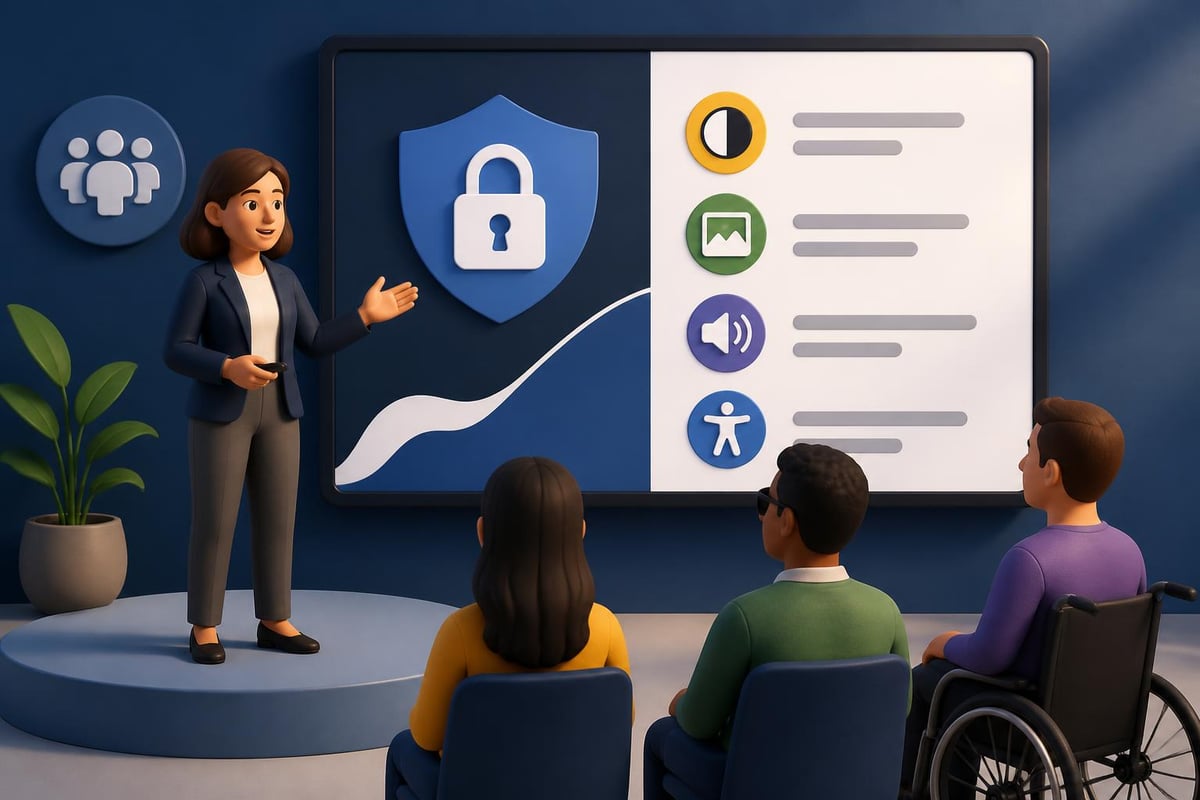
Accessible cybersecurity design

Interactive and Gamified Security Training

Traditional security awareness training often fails to engage audiences or drive behavioral change. Modern cybersecurity presentation design incorporates interactive elements and gamification strategies that transform passive presentations into active learning experiences.

Serious Games for Security Education

Research into cybersecurity awareness through interactive learning demonstrates the effectiveness of game-based approaches for complex security concepts. These methodologies translate readily into presentation contexts where engagement drives retention.

Interactive presentation elements include scenario-based decision trees where audiences choose responses to simulated security incidents, revealing consequences of different actions. This approach builds intuitive understanding of security principles that survives long after the presentation concludes.

Organizations exploring innovative training approaches can learn from card-based teaching methods that break complex topics into digestible, interactive components. These principles apply equally to presentation design where modular content supports flexible delivery.

Engagement Metrics and Effectiveness Measurement

Moving beyond passive slide delivery, modern cybersecurity presentation design incorporates mechanisms for measuring audience engagement and comprehension. Real-time polling, knowledge checks, and interactive scenarios provide immediate feedback on message effectiveness.

This data-driven approach enables continuous improvement of security communications, identifying which visual approaches, message framing, and content structures resonate most effectively with different audiences.

Integration with Broader Marketing Communications

Cybersecurity presentations rarely exist in isolation. They form part of broader marketing and communication strategies that span sales enablement, thought leadership, and brand positioning. Effective cybersecurity presentation design aligns with organizational communication frameworks while addressing security-specific requirements.

Sales Enablement for Security Solutions

Organizations selling cybersecurity solutions require presentations that balance technical credibility with persuasive storytelling. Cybersecurity sales approaches recognize that prospects need both confidence in technical capabilities and clarity on business value.

Sales-focused cybersecurity presentation design emphasizes proof points and case studies that demonstrate real-world effectiveness. This evidence-based approach overcomes skepticism while building trust through demonstrated results.

Marketing agencies specializing in strategic branding and digital marketing understand how cybersecurity messaging integrates with broader brand narratives. Security communications that align with organizational positioning create coherent market presence across all touchpoints.

Thought Leadership and Industry Positioning

Security executives increasingly use presentations to establish thought leadership and influence industry conversations. Conference presentations, webinar content, and analyst briefings require sophisticated cybersecurity presentation design that balances expertise demonstration with audience value delivery.

Thought leadership presentations should provide genuine insights rather than thinly veiled product pitches. This audience-first approach builds credibility and positions organizations as trusted advisors rather than mere vendors.

Leveraging Multimedia and Motion Graphics

Static slides represent just one dimension of modern presentation capabilities. Cybersecurity presentation design increasingly incorporates video, animation, and motion graphics that bring abstract security concepts to life through dynamic visualization.

Video Integration for Complex Concepts

Certain cybersecurity concepts benefit enormously from video explanation. Attack progression sequences, network traffic analysis, and incident response procedures become dramatically clearer when presented through animation rather than static diagrams.

Organizations can enhance their presentation impact by partnering with audiovisual production specialists who understand how to translate technical concepts into engaging video content. These multimedia elements transform presentations from information delivery vehicles into memorable experiences.

Effective video applications include:

  • Animated attack scenario walkthroughs showing progression and impact
  • Screen capture demonstrations of security tool functionality
  • Interview segments with security leaders providing context and credibility
  • Data visualization animations revealing patterns in security metrics

The investment in video production pays dividends through increased engagement and improved message retention, particularly for complex security concepts that resist static visualization.

Animation for Process Visualization

Motion graphics excel at demonstrating security processes and workflows. Authentication sequences, encryption operations, and threat detection pipelines become dramatically more comprehensible when presented through purposeful animation rather than static process diagrams.

Animation directs audience attention precisely where you need it, revealing information progressively and preventing cognitive overload. This controlled information flow proves particularly valuable when presenting to mixed audiences with varying technical sophistication.

Remote Presentation Optimization

The shift toward remote and hybrid work models requires cybersecurity presentation design optimized for virtual delivery. Presentations that work brilliantly in physical conference rooms may fail completely in video conference environments without appropriate adaptation.

Virtual-First Design Considerations

Remote presentation success depends on design decisions that account for small screens, variable internet connectivity, and limited presenter control over viewing environments. Georgetown University's presentation design guidance emphasizes readability and clarity as fundamental principles that prove especially critical in remote contexts.

Virtual presentation optimization includes:

  1. Larger fonts sized for laptop screens rather than projectors
  2. Higher contrast ratios accounting for variable display quality
  3. Simplified layouts reducing visual complexity for bandwidth constraints
  4. Strategic use of presenter notes supporting virtual delivery
  5. Export formats optimized for screen sharing platforms

Organizations exploring presentation outsourcing services should ensure providers understand virtual delivery requirements and design accordingly. The technical requirements for effective remote presentation differ substantially from traditional in-person delivery.

Engagement Strategies for Virtual Audiences

Maintaining audience attention proves challenging in remote environments where distractions abound and engagement signals remain hidden. Cybersecurity presentation design for virtual delivery must incorporate active engagement mechanisms that keep audiences focused and participating.

Interactive polls, chat-based questions, and breakout discussions transform passive viewing into active participation. These engagement tools provide presenters with real-time feedback on comprehension while maintaining audience attention through varied interaction modes.

Remote presentations also benefit from shorter, more focused segments rather than extended lectures. Cybersecurity content delivered in 15-20 minute modules with discussion breaks maintains attention more effectively than hour-long monologues regardless of visual quality.

Emerging Technologies in Security Presentations

Cybersecurity presentation design continues evolving alongside broader technological advancement. Organizations that embrace emerging presentation technologies gain competitive advantages through more effective security communication.

Artificial Intelligence and Automated Design

AI-powered design tools increasingly automate routine presentation development tasks, freeing security professionals to focus on content strategy and message refinement. These technologies analyze content and suggest visual treatments, layout improvements, and design enhancements.

Organizations implementing remote CMO services often leverage AI-driven presentation tools as part of comprehensive digital strategies. These technologies democratize professional design quality while accelerating production timelines.

However, automated tools work best when guided by experienced designers who understand both cybersecurity content requirements and visual communication principles. The most effective approach combines AI efficiency with human expertise and strategic oversight.

Interactive Data Dashboards

Modern presentation platforms support embedded interactive dashboards that allow audiences to explore security data during presentations. Rather than static charts showing predetermined views, interactive dashboards enable audience-driven data investigation.

This capability proves particularly valuable for technical audiences who want to drill into specific metrics or explore alternative data views. Interactive elements transform presentations from one-way broadcasts into collaborative analytical sessions.

Creating Presentation Systems at Scale

Large organizations require systematic approaches to cybersecurity presentation design that maintain quality across distributed teams while enabling rapid response to emerging threats and evolving requirements.

Centralized Design Resources

Establishing centralized presentation design resources ensures consistent quality while providing efficiency through reusable components and standardized processes. These resources typically include template libraries, asset repositories, and design guidelines specific to cybersecurity communications.

Organizations can develop internal capabilities or partner with specialists providing sales pitch deck services and broader presentation support. The right approach depends on presentation volume, internal design capabilities, and strategic importance of presentation quality.

Training and Enablement Programs

Even the best design systems fail without proper training on effective use. Organizations investing in cybersecurity presentation design should develop corresponding enablement programs that teach security professionals how to leverage available resources effectively.

Training programs should cover both design principles and practical tool usage, ensuring security teams can create professional presentations independently while knowing when to escalate complex requirements to specialized design resources.


Mastering cybersecurity presentation design transforms security communications from technical documentation into persuasive business narratives that drive decision-making and action. By combining visual sophistication with security expertise, organizations create presentations that resonate with diverse audiences while maintaining technical credibility. Whether you're building security awareness programs, pitching budget requests, or establishing thought leadership, professional presentation design amplifies your message and accelerates your objectives. Prznt Perfect specializes in transforming complex cybersecurity concepts into compelling visual stories that engage stakeholders and drive results, bringing specialized expertise in both presentation design and security industry knowledge to every project.
News & Updates...

Master deep tech presentation design with proven strategies for communicating complex innovations. Expert tips for pitch decks that resonate with investors.

Master technical storytelling to transform complex data into compelling narratives. Learn frameworks, techniques, and best practices for 2026.