Cyber Startup Logo and Visual Identity Design Guide

The cybersecurity industry presents unique challenges for startups trying to establish their visual presence. Unlike consumer brands that can rely on whimsy or approachability, cyber startups must convey technical expertise, trustworthiness, and sophisticated protection capabilities through every visual touchpoint. Building a compelling cyber startup logo and visual identity design system requires balancing cutting-edge aesthetics with the credibility that enterprise buyers demand, all while differentiating from competitors in an increasingly crowded market.

Strategic Foundation for Cybersecurity Brand Identity

Before sketching a single logo concept, successful cyber startups invest in strategic research and positioning. Visual identity is not decoration-it communicates your company's core promise to security-conscious buyers who scrutinize every detail.

Understanding Your Audience's Trust Triggers

B2B cybersecurity buyers approach vendor selection with heightened skepticism. According to research on trust and credibility in user experience, professional design quality directly influences perceived reliability and competence. Your visual identity must immediately signal that your startup operates at enterprise standards.

When creating presentations for cybersecurity pitch decks, the visual consistency between your logo, color system, and supporting graphics becomes a critical trust signal. Investors and enterprise buyers notice mismatched fonts, inconsistent color usage, and amateur design choices that undermine your technical credibility.

Key audience considerations for cyber startup logos include:

  • Chief Information Security Officers (CISOs) evaluating multiple vendors simultaneously
  • Venture capital firms comparing dozens of cybersecurity pitches monthly
  • Technical decision-makers who value precision and attention to detail
  • Compliance officers seeking partners with professional governance
  • Channel partners who need brandable, professional marketing assets
Cybersecurity buyer evaluation criteria

Competitive Differentiation in a Crowded Sector

The cybersecurity market contains thousands of startups, many with similar value propositions around threat detection, endpoint protection, or data security. Your cyber startup logo and visual identity design must create instant differentiation without sacrificing industry credibility.

A 2024 Harvard Business Review analysis of 597 logos found that distinctive visual systems improved brand recall by 73% while maintaining perceived trustworthiness. For cyber startups, this means avoiding generic shield symbols, lock icons, and predictable blue color schemes that make your brand invisible in the market.

Visual Elements That Build Cybersecurity Credibility

Effective cyber startup visual identities balance multiple competing demands: appearing innovative yet stable, technical yet accessible, powerful yet precise. Each design element contributes to this complex positioning.

Logo Architecture and Symbol Selection

The logo serves as the cornerstone of your entire visual system. For cybersecurity companies, logo design requires particular attention to scalability, versatility, and meaning.

Logo Type Strengths for Cyber Startups Considerations
Wordmark Strong for new names requiring recognition; projects confidence and directness Requires distinctive typography; less memorable without repetition
Abstract Symbol Conveys sophisticated technology; differentiates from generic security icons Meaning must be immediately intuitive; avoid overly complex geometry
Letter Mark Professional, scalable, works across all applications Less distinctive in crowded market; typography becomes critical
Combination Mark Balances recognition with flexibility; symbol reinforces name Requires careful balance; can feel cluttered if poorly executed

When creating a logo for trademark protection, the USPTO guidelines on designing marks for registration emphasize distinctiveness and non-generic imagery. Avoid purely descriptive terms or common security symbols that cannot be protected legally.

Color Psychology for Trust and Technology

Color selection in cyber startup logo and visual identity design carries substantial strategic weight. Academic research on color and sentiment in marketing demonstrates that color palettes directly influence emotional response, brand perception, and purchase intent.

Strategic color approaches for cybersecurity brands:

  1. Deep Blues and Purples: Signal trust, stability, and technical sophistication without appearing conservative or dated
  2. Accent Neons: Small doses of bright cyan, electric green, or magenta suggest innovation and cutting-edge capability
  3. Neutrals as Foundation: Charcoal, slate, and pure black create professional gravitas and emphasize content over decoration
  4. Avoid Common Traps: Red (too alarming), bright green (consumer-focused), primary blue alone (generic bank aesthetic)

The Radware brand guidelines demonstrate how an established cybersecurity company balances bold red with sophisticated grays to convey both urgency and enterprise credibility. Their system shows the governance required to maintain consistency across global teams.

Typography That Conveys Technical Authority

Font selection communicates as powerfully as color or symbol. Modern geometric sans-serifs (such as Inter, Manrope, or custom variants) project precision and contemporary thinking. Heavy weights work well for headlines and key messaging, while lighter weights maintain readability in documentation.

Avoid:

  • Script or handwritten fonts (undermine technical credibility)
  • Condensed fonts for body copy (reduce readability)
  • Trendy display fonts that will feel dated within 18 months
  • More than two font families in your core system

Building a Comprehensive Visual Identity System

A logo alone does not constitute a complete brand identity. Cyber startups require documented systems that ensure consistency across investor presentations, product interfaces, marketing websites, and sales collateral.

Design System Components for Scalability

The OPSWAT design system case study illustrates how cybersecurity companies with complex product portfolios maintain visual coherence. Their approach combines flexible grid systems, component libraries, and strict governance to scale across 30+ products while maintaining brand recognition.

Essential elements of your visual identity system:

  • Logo variations (primary, reversed, monochrome, minimum size specifications)
  • Color palette (primary, secondary, accent, neutral scales with hex, RGB, CMYK values)
  • Typography scale (heading hierarchy, body text, captions, UI text)
  • Iconography style (line weight, corner radius, perspective, metaphor approach)
  • Photography guidelines (subject matter, color treatment, composition rules)
  • Data visualization standards (chart types, color usage, labeling conventions)
  • Layout grids and spacing systems (margins, padding, vertical rhythm)
Cybersecurity visual identity components

Application Across Critical Touchpoints

Your cyber startup logo and visual identity design must perform flawlessly across diverse contexts. A system that looks striking on your website but fails in a technology presentation or investor pitch deck creates inconsistency that damages credibility.

Critical application contexts:

  1. Investor Materials: Pitch decks, executive summaries, and financial projections where visual sophistication signals operational maturity
  2. Product Interfaces: Dashboard headers, login screens, and navigation where consistency builds trust in your technical execution
  3. Sales Collateral: One-pagers, case studies, and comparison charts where professional design elevates perceived value
  4. Digital Presence: Website, social media, and email signatures where first impressions form instantly
  5. Conference Materials: Booth graphics, presentation templates, and promotional items where you compete for attention

The W3C brand standards provide excellent guidance on creating accessible, web-facing visual language that maintains integrity across digital platforms-particularly relevant for SaaS cybersecurity products.

Strategic Implementation for Startup Success

Creating visual assets is only half the challenge. Successful cyber startups establish governance processes that protect brand consistency while enabling rapid execution.

Building Internal Brand Guidelines

Document every aspect of your visual identity in a central brand guide accessible to all team members, contractors, and partners. Include:

  • Clear usage rules with visual examples of correct and incorrect applications
  • Template files for common formats (presentations, one-pagers, social graphics)
  • Approval workflows specifying who can modify core brand elements
  • Update protocols for evolving your system as the company scales

Research on B2B startup brand identity and its association with brand relevance emphasizes that startups with documented visual standards achieve higher brand recognition and perceived trustworthiness among enterprise buyers-critical factors in cybersecurity sales cycles.

Partnering with Design Specialists

Many successful cyber startups recognize that visual identity requires specialized expertise beyond their core team's capabilities. Professional agencies bring strategic perspective, technical execution skills, and efficiency that accelerates time-to-market.

When selecting design partners, prioritize those with experience in B2B technology and financial services. Prznt Perfect specializes in creating visually compelling presentations and brand materials for tech startups, transforming complex technical concepts into clear, credible visual narratives that resonate with investors and enterprise buyers.

In-House Approach Agency Partnership Hybrid Model
Lower upfront cost Higher initial investment Moderate investment
Slower execution Rapid professional delivery Balanced timeline
Learning curve on brand strategy Immediate strategic expertise Guided internal capability building
Risk of amateur execution Consistent professional quality Quality with internal ownership
Best for: Companies with design talent Best for: Fast-scaling startups Best for: Long-term brand development

Maintaining Consistency Through Growth

As your startup expands from seed stage through Series A and beyond, maintaining visual consistency becomes exponentially more challenging. New team members, international offices, partner relationships, and product launches all create pressure points where brand dilution occurs.

Governance strategies for scaling startups:

  1. Designate a brand steward responsible for reviewing high-visibility materials
  2. Invest in template systems that make correct usage the path of least resistance
  3. Conduct quarterly brand audits identifying inconsistencies across touchpoints
  4. Build feedback loops where teams report challenges applying brand standards
  5. Budget for periodic brand refreshes that modernize without abandoning recognition
Brand consistency framework

Practical Execution Steps for Launch

Translating strategic planning into tangible visual assets requires methodical execution across multiple workstreams. Successful cyber startups approach identity development as a structured project with clear milestones and deliverables.

Phase 1: Discovery and Strategy (2-3 weeks)

Begin with comprehensive research into your competitive landscape, target audience preferences, and strategic positioning. Interview key stakeholders about brand aspirations, conduct competitive visual audits, and define success metrics for your identity system.

Deliverables: Positioning statement, audience profiles, competitive analysis, visual direction boards showing three distinct aesthetic approaches

Phase 2: Concept Development (2-3 weeks)

Develop multiple logo directions exploring different visual strategies. Present concepts with rationale explaining how each approach serves strategic objectives. Gather structured feedback focusing on strategic fit rather than personal preference.

Many startups make the mistake of designing in isolation. Instead, test concepts with trusted advisors, potential customers, and investors to validate that your visual approach resonates with target audiences. The process mirrors best practices in presentation design for technology companies, where audience testing reveals what communicates effectively versus what confuses.

Deliverables: Three logo concepts with variants, initial color exploration, typography recommendations, application mockups

Phase 3: Refinement and System Building (3-4 weeks)

Once a strategic direction is selected, refine every detail while building out the complete visual system. This phase requires meticulous attention to technical specifications, file formats, and usage scenarios.

Deliverables: Final logo files (vector, raster, multiple formats), complete color system, typography license and files, icon library (minimum 50 icons), pattern or texture library, photography direction with examples

Phase 4: Application and Launch (2-3 weeks)

Apply your new identity across all priority touchpoints, starting with highest-visibility materials. Update your website, create investor presentation templates, design sales collateral, and establish social media presence with consistent visual language.

Create launch momentum by revealing your new identity through coordinated communications. Announce to your email list, update all profiles simultaneously, and brief partners on the changes to ensure consistent external presentation.

Deliverables: Website redesign, presentation template library, sales collateral suite, social media assets, email signature templates, brand guidelines document

Measuring Identity Effectiveness

Track specific metrics that indicate whether your cyber startup logo and visual identity design achieves strategic objectives:

  • Brand recognition: Percentage of target audience who correctly identify your logo in under three seconds
  • Perceived differentiation: Survey data on how prospects distinguish your brand from competitors
  • Conversion impact: Changes in pitch-to-meeting conversion rates with updated materials
  • Asset efficiency: Time required to produce on-brand materials (should decrease with robust templates)
  • Consistency scores: Quarterly audits measuring adherence to brand standards across touchpoints

Integration with Broader Marketing Strategy

Visual identity does not exist in isolation. Your logo, colors, and typography must integrate seamlessly with messaging, content strategy, and go-to-market approach.

Aligning Visual and Verbal Identity

The most effective cyber startup brands maintain tight alignment between what they say and how they look. If your messaging emphasizes "invisible protection that just works," your visual identity should feel effortless and refined rather than aggressive and complicated.

Document your brand voice alongside visual standards, specifying tone, vocabulary, and messaging principles that reinforce visual positioning. When creating sales pitch decks for cybersecurity, ensure verbal claims about sophistication or innovation align with visual evidence of those qualities.

Content Marketing Visual Consistency

Blog posts, white papers, webinars, and social content all require visual templates that maintain brand consistency while optimizing for each channel's specific requirements. Develop content templates that balance brand expression with platform best practices.

Channel-specific considerations:

  • LinkedIn: Professional imagery, data visualizations using brand colors, consistent post templates
  • Twitter/X: High-contrast graphics optimized for mobile viewing, animated logo variations
  • Blog: Featured image templates, pull quote styling, embedded media treatments
  • Video: Lower-third graphics, intro/outro sequences, branded backgrounds for interviews

Building a distinctive, credible cyber startup logo and visual identity design system requires strategic thinking, creative excellence, and disciplined execution. Your visual identity must immediately communicate technical sophistication and trustworthiness while differentiating your startup in a crowded market. When your brand system aligns with your strategic positioning and maintains consistency across all touchpoints, it becomes a powerful asset that accelerates sales cycles, attracts investment, and builds long-term enterprise relationships. Prznt Perfect helps cybersecurity and technology startups transform complex technical concepts into visually compelling brand systems and presentations that resonate with investors and enterprise buyers, ensuring your visual communications match the sophistication of your technology.

We offer free 30-min consultation on the presentation design audit
and hiring the right visual 
comms professional, let’s talk!
Shedule a call
Shedule a call
"I understand" goes a step further into the cognitive dance of persuasion. It's where the audience begins to see the connections between the facts, to grasp the nuances of the problem and the elegance of the solution.
  • This is some text inside of a div block.
    lay out the facts clearly and compellingly. Use data to establish the ground reality, but remember that facts alone are like the individual strands of a tapestry—necessary but not complete.
    lay out the facts clearly and compellingly. Use data to establish the ground reality, but remember that facts alone are like the individual strands of a tapestry—necessary but not complete.
  • This is some text inside of a div block.
    lay out the facts clearly and compellingly. Use data to establish the ground reality, but remember that facts alone are like the individual strands of a tapestry—necessary but not complete.

We offer free 30-min consultation on the presentation design audit

and hiring the right visual 
comms professional, let’s talk!

Shedule a call

"I understand" goes a step further into the cognitive dance of persuasion. It's where the audience begins to see the connections between the facts, to grasp the nuances of the problem and the elegance of the solution.

  • - 1 -
    Consistency at Scale:

    Biotech Market Trends 2024: Tailoring Your Pitch Deck to Current Industry Dynamics.

  • - 2 -
    Efficiency and Speed:

    The traditional process of manually updating presentations is not only slow but also prone to bottlenecks, especially when dealing with large volumes of slides. Automation dramatically accelerates this process, enabling designers to apply changes across hundreds of slides in the time it would take to manually update a single one. This efficiency is a game-changer for agencies working under tight deadlines or managing multiple projects simultaneously.

  • - 3 -
    Enhanced Creativity:

    With the burden of manual updates lifted, designers can allocate more time and energy to the creative aspects of presentation design. This freedom allows for deeper exploration of innovative design concepts, experimentation with new visual storytelling techniques, and the development of more engaging and interactive presentations. Automation doesn't stifle creativity; it amplifies it, enabling designers to push the boundaries of what's possible in corporate presentation design.

  • - 4 -
    Error Reduction:

    Manual updates are inherently prone to inconsistencies and mistakes, from misaligned logos to incorrect font sizes. These errors can detract from the professionalism of a presentation and, by extension, the corporate image. Automation minimizes these risks by ensuring that updates are applied uniformly and accurately across all slides, enhancing the overall quality and integrity of the presentation.

  • - 5 -
    Cost-Effectiveness:

    The time savings afforded by automation directly translate to cost savings for both the design agency and its clients. By reducing the hours spent on manual updates, agencies can optimize their workflows and resources, allowing them to take on more projects without compromising on quality. This efficiency can also make high-quality presentation design services more affordable and accessible to a broader range of businesses.

Cyber Startup Logo and Visual Identity Design Guide
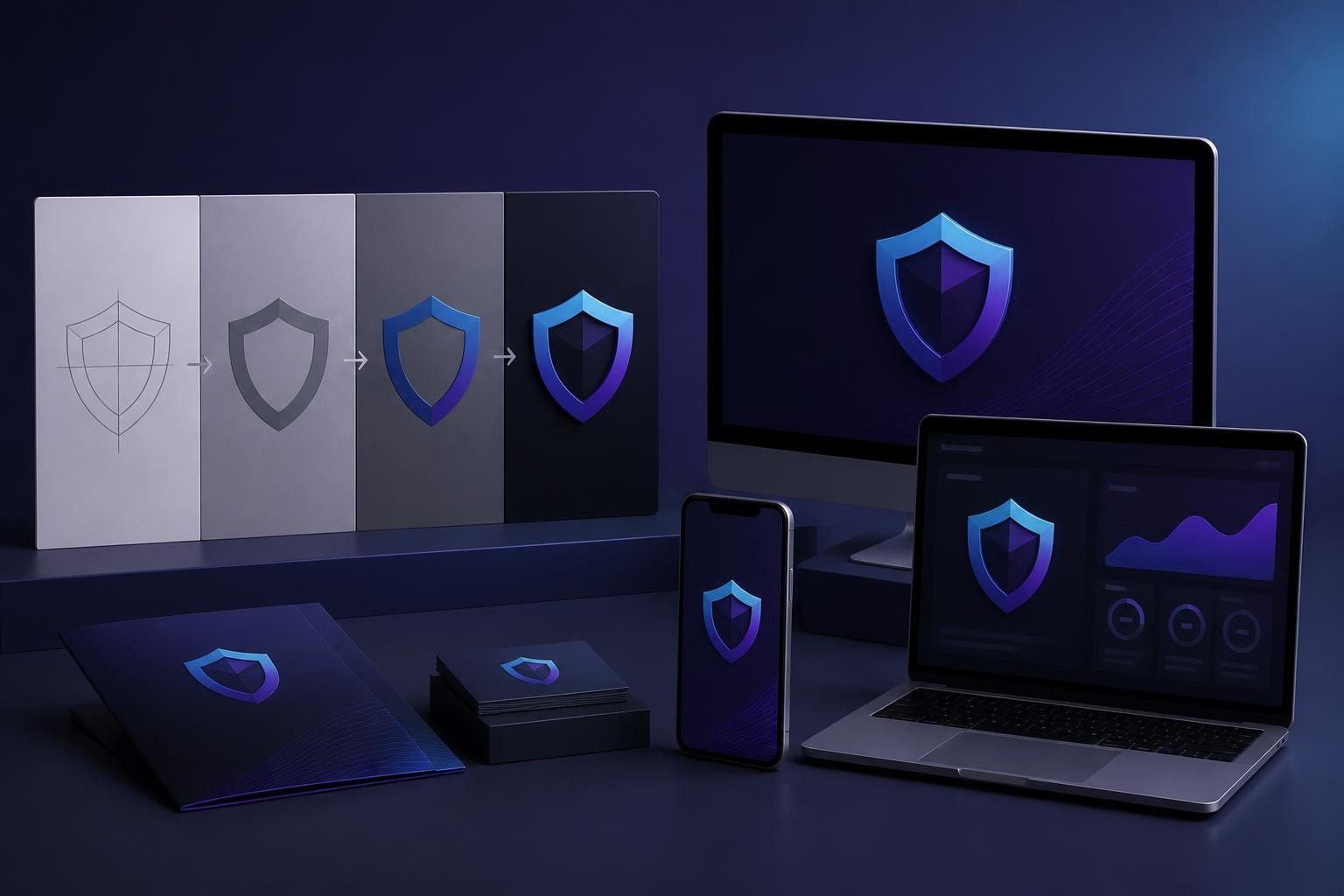
Master cyber startup logo and visual identity design. Learn research-backed strategies for building trust, recognition, and credibility in 2026.

The cybersecurity industry presents unique challenges for startups trying to establish their visual presence. Unlike consumer brands that can rely on whimsy or approachability, cyber startups must convey technical expertise, trustworthiness, and sophisticated protection capabilities through every visual touchpoint. Building a compelling cyber startup logo and visual identity design system requires balancing cutting-edge aesthetics with the credibility that enterprise buyers demand, all while differentiating from competitors in an increasingly crowded market.

Strategic Foundation for Cybersecurity Brand Identity

Before sketching a single logo concept, successful cyber startups invest in strategic research and positioning. Visual identity is not decoration-it communicates your company's core promise to security-conscious buyers who scrutinize every detail.

Understanding Your Audience's Trust Triggers

B2B cybersecurity buyers approach vendor selection with heightened skepticism. According to research on trust and credibility in user experience, professional design quality directly influences perceived reliability and competence. Your visual identity must immediately signal that your startup operates at enterprise standards.

When creating presentations for cybersecurity pitch decks, the visual consistency between your logo, color system, and supporting graphics becomes a critical trust signal. Investors and enterprise buyers notice mismatched fonts, inconsistent color usage, and amateur design choices that undermine your technical credibility.

Key audience considerations for cyber startup logos include:

  • Chief Information Security Officers (CISOs) evaluating multiple vendors simultaneously
  • Venture capital firms comparing dozens of cybersecurity pitches monthly
  • Technical decision-makers who value precision and attention to detail
  • Compliance officers seeking partners with professional governance
  • Channel partners who need brandable, professional marketing assets

Cybersecurity buyer evaluation criteria

Competitive Differentiation in a Crowded Sector

The cybersecurity market contains thousands of startups, many with similar value propositions around threat detection, endpoint protection, or data security. Your cyber startup logo and visual identity design must create instant differentiation without sacrificing industry credibility.

A 2024 Harvard Business Review analysis of 597 logos found that distinctive visual systems improved brand recall by 73% while maintaining perceived trustworthiness. For cyber startups, this means avoiding generic shield symbols, lock icons, and predictable blue color schemes that make your brand invisible in the market.

Visual Elements That Build Cybersecurity Credibility

Effective cyber startup visual identities balance multiple competing demands: appearing innovative yet stable, technical yet accessible, powerful yet precise. Each design element contributes to this complex positioning.

Logo Architecture and Symbol Selection

The logo serves as the cornerstone of your entire visual system. For cybersecurity companies, logo design requires particular attention to scalability, versatility, and meaning.

Logo Type Strengths for Cyber Startups Considerations
Wordmark Strong for new names requiring recognition; projects confidence and directness Requires distinctive typography; less memorable without repetition
Abstract Symbol Conveys sophisticated technology; differentiates from generic security icons Meaning must be immediately intuitive; avoid overly complex geometry
Letter Mark Professional, scalable, works across all applications Less distinctive in crowded market; typography becomes critical
Combination Mark Balances recognition with flexibility; symbol reinforces name Requires careful balance; can feel cluttered if poorly executed

When creating a logo for trademark protection, the USPTO guidelines on designing marks for registration emphasize distinctiveness and non-generic imagery. Avoid purely descriptive terms or common security symbols that cannot be protected legally.

Color Psychology for Trust and Technology

Color selection in cyber startup logo and visual identity design carries substantial strategic weight. Academic research on color and sentiment in marketing demonstrates that color palettes directly influence emotional response, brand perception, and purchase intent.

Strategic color approaches for cybersecurity brands:

  1. Deep Blues and Purples: Signal trust, stability, and technical sophistication without appearing conservative or dated
  2. Accent Neons: Small doses of bright cyan, electric green, or magenta suggest innovation and cutting-edge capability
  3. Neutrals as Foundation: Charcoal, slate, and pure black create professional gravitas and emphasize content over decoration
  4. Avoid Common Traps: Red (too alarming), bright green (consumer-focused), primary blue alone (generic bank aesthetic)

The Radware brand guidelines demonstrate how an established cybersecurity company balances bold red with sophisticated grays to convey both urgency and enterprise credibility. Their system shows the governance required to maintain consistency across global teams.

Typography That Conveys Technical Authority

Font selection communicates as powerfully as color or symbol. Modern geometric sans-serifs (such as Inter, Manrope, or custom variants) project precision and contemporary thinking. Heavy weights work well for headlines and key messaging, while lighter weights maintain readability in documentation.

Avoid:

  • Script or handwritten fonts (undermine technical credibility)
  • Condensed fonts for body copy (reduce readability)
  • Trendy display fonts that will feel dated within 18 months
  • More than two font families in your core system

Building a Comprehensive Visual Identity System

A logo alone does not constitute a complete brand identity. Cyber startups require documented systems that ensure consistency across investor presentations, product interfaces, marketing websites, and sales collateral.

Design System Components for Scalability

The OPSWAT design system case study illustrates how cybersecurity companies with complex product portfolios maintain visual coherence. Their approach combines flexible grid systems, component libraries, and strict governance to scale across 30+ products while maintaining brand recognition.

Essential elements of your visual identity system:

  • Logo variations (primary, reversed, monochrome, minimum size specifications)
  • Color palette (primary, secondary, accent, neutral scales with hex, RGB, CMYK values)
  • Typography scale (heading hierarchy, body text, captions, UI text)
  • Iconography style (line weight, corner radius, perspective, metaphor approach)
  • Photography guidelines (subject matter, color treatment, composition rules)
  • Data visualization standards (chart types, color usage, labeling conventions)
  • Layout grids and spacing systems (margins, padding, vertical rhythm)
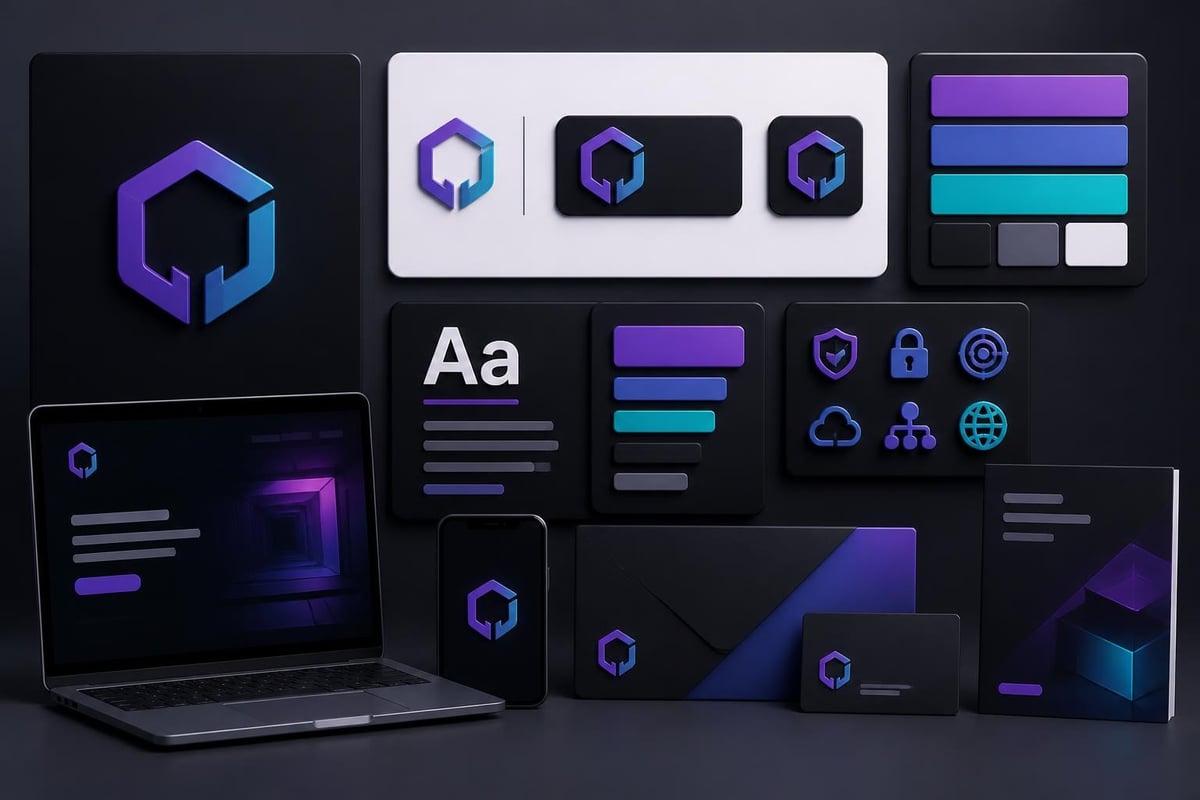
Cybersecurity visual identity components

Application Across Critical Touchpoints

Your cyber startup logo and visual identity design must perform flawlessly across diverse contexts. A system that looks striking on your website but fails in a technology presentation or investor pitch deck creates inconsistency that damages credibility.

Critical application contexts:

  1. Investor Materials: Pitch decks, executive summaries, and financial projections where visual sophistication signals operational maturity
  2. Product Interfaces: Dashboard headers, login screens, and navigation where consistency builds trust in your technical execution
  3. Sales Collateral: One-pagers, case studies, and comparison charts where professional design elevates perceived value
  4. Digital Presence: Website, social media, and email signatures where first impressions form instantly
  5. Conference Materials: Booth graphics, presentation templates, and promotional items where you compete for attention

The W3C brand standards provide excellent guidance on creating accessible, web-facing visual language that maintains integrity across digital platforms-particularly relevant for SaaS cybersecurity products.

Strategic Implementation for Startup Success

Creating visual assets is only half the challenge. Successful cyber startups establish governance processes that protect brand consistency while enabling rapid execution.

Building Internal Brand Guidelines

Document every aspect of your visual identity in a central brand guide accessible to all team members, contractors, and partners. Include:

  • Clear usage rules with visual examples of correct and incorrect applications
  • Template files for common formats (presentations, one-pagers, social graphics)
  • Approval workflows specifying who can modify core brand elements
  • Update protocols for evolving your system as the company scales

Research on B2B startup brand identity and its association with brand relevance emphasizes that startups with documented visual standards achieve higher brand recognition and perceived trustworthiness among enterprise buyers-critical factors in cybersecurity sales cycles.

Partnering with Design Specialists

Many successful cyber startups recognize that visual identity requires specialized expertise beyond their core team's capabilities. Professional agencies bring strategic perspective, technical execution skills, and efficiency that accelerates time-to-market.

When selecting design partners, prioritize those with experience in B2B technology and financial services. Prznt Perfect specializes in creating visually compelling presentations and brand materials for tech startups, transforming complex technical concepts into clear, credible visual narratives that resonate with investors and enterprise buyers.

In-House Approach Agency Partnership Hybrid Model
Lower upfront cost Higher initial investment Moderate investment
Slower execution Rapid professional delivery Balanced timeline
Learning curve on brand strategy Immediate strategic expertise Guided internal capability building
Risk of amateur execution Consistent professional quality Quality with internal ownership
Best for: Companies with design talent Best for: Fast-scaling startups Best for: Long-term brand development

Maintaining Consistency Through Growth

As your startup expands from seed stage through Series A and beyond, maintaining visual consistency becomes exponentially more challenging. New team members, international offices, partner relationships, and product launches all create pressure points where brand dilution occurs.

Governance strategies for scaling startups:

  1. Designate a brand steward responsible for reviewing high-visibility materials
  2. Invest in template systems that make correct usage the path of least resistance
  3. Conduct quarterly brand audits identifying inconsistencies across touchpoints
  4. Build feedback loops where teams report challenges applying brand standards
  5. Budget for periodic brand refreshes that modernize without abandoning recognition

Brand consistency framework

Practical Execution Steps for Launch

Translating strategic planning into tangible visual assets requires methodical execution across multiple workstreams. Successful cyber startups approach identity development as a structured project with clear milestones and deliverables.

Phase 1: Discovery and Strategy (2-3 weeks)

Begin with comprehensive research into your competitive landscape, target audience preferences, and strategic positioning. Interview key stakeholders about brand aspirations, conduct competitive visual audits, and define success metrics for your identity system.

Deliverables: Positioning statement, audience profiles, competitive analysis, visual direction boards showing three distinct aesthetic approaches

Phase 2: Concept Development (2-3 weeks)

Develop multiple logo directions exploring different visual strategies. Present concepts with rationale explaining how each approach serves strategic objectives. Gather structured feedback focusing on strategic fit rather than personal preference.

Many startups make the mistake of designing in isolation. Instead, test concepts with trusted advisors, potential customers, and investors to validate that your visual approach resonates with target audiences. The process mirrors best practices in presentation design for technology companies, where audience testing reveals what communicates effectively versus what confuses.

Deliverables: Three logo concepts with variants, initial color exploration, typography recommendations, application mockups

Phase 3: Refinement and System Building (3-4 weeks)

Once a strategic direction is selected, refine every detail while building out the complete visual system. This phase requires meticulous attention to technical specifications, file formats, and usage scenarios.

Deliverables: Final logo files (vector, raster, multiple formats), complete color system, typography license and files, icon library (minimum 50 icons), pattern or texture library, photography direction with examples

Phase 4: Application and Launch (2-3 weeks)

Apply your new identity across all priority touchpoints, starting with highest-visibility materials. Update your website, create investor presentation templates, design sales collateral, and establish social media presence with consistent visual language.

Create launch momentum by revealing your new identity through coordinated communications. Announce to your email list, update all profiles simultaneously, and brief partners on the changes to ensure consistent external presentation.

Deliverables: Website redesign, presentation template library, sales collateral suite, social media assets, email signature templates, brand guidelines document

Measuring Identity Effectiveness

Track specific metrics that indicate whether your cyber startup logo and visual identity design achieves strategic objectives:

  • Brand recognition: Percentage of target audience who correctly identify your logo in under three seconds
  • Perceived differentiation: Survey data on how prospects distinguish your brand from competitors
  • Conversion impact: Changes in pitch-to-meeting conversion rates with updated materials
  • Asset efficiency: Time required to produce on-brand materials (should decrease with robust templates)
  • Consistency scores: Quarterly audits measuring adherence to brand standards across touchpoints

Integration with Broader Marketing Strategy

Visual identity does not exist in isolation. Your logo, colors, and typography must integrate seamlessly with messaging, content strategy, and go-to-market approach.

Aligning Visual and Verbal Identity

The most effective cyber startup brands maintain tight alignment between what they say and how they look. If your messaging emphasizes "invisible protection that just works," your visual identity should feel effortless and refined rather than aggressive and complicated.

Document your brand voice alongside visual standards, specifying tone, vocabulary, and messaging principles that reinforce visual positioning. When creating sales pitch decks for cybersecurity, ensure verbal claims about sophistication or innovation align with visual evidence of those qualities.

Content Marketing Visual Consistency

Blog posts, white papers, webinars, and social content all require visual templates that maintain brand consistency while optimizing for each channel's specific requirements. Develop content templates that balance brand expression with platform best practices.

Channel-specific considerations:

  • LinkedIn: Professional imagery, data visualizations using brand colors, consistent post templates
  • Twitter/X: High-contrast graphics optimized for mobile viewing, animated logo variations
  • Blog: Featured image templates, pull quote styling, embedded media treatments
  • Video: Lower-third graphics, intro/outro sequences, branded backgrounds for interviews

Building a distinctive, credible cyber startup logo and visual identity design system requires strategic thinking, creative excellence, and disciplined execution. Your visual identity must immediately communicate technical sophistication and trustworthiness while differentiating your startup in a crowded market. When your brand system aligns with your strategic positioning and maintains consistency across all touchpoints, it becomes a powerful asset that accelerates sales cycles, attracts investment, and builds long-term enterprise relationships. Prznt Perfect helps cybersecurity and technology startups transform complex technical concepts into visually compelling brand systems and presentations that resonate with investors and enterprise buyers, ensuring your visual communications match the sophistication of your technology.
News & Updates...

Build a winning investor readiness kit for cybersecurity startup fundraising. Learn what to include, how to package it, and how to stand out.

Learn how zero trust product one-pager design services transform complex cybersecurity concepts into compelling visual assets for stakeholders.