Concept Visualization: Turning Ideas Into Visual Impact

In the competitive landscape of financial and tech presentations, success often hinges on one critical capability: transforming abstract concepts into visual narratives that stakeholders can immediately grasp. Concept visualization serves as the bridge between complex ideas and audience comprehension, enabling presenters to communicate value propositions, technical architectures, and strategic visions with clarity and impact. For businesses competing for investor attention or client approval, mastering concept visualization techniques represents more than a design skill-it's a strategic advantage that determines whether your message resonates or gets lost in translation.

Understanding Concept Visualization in Business Communication

Concept visualization is the systematic process of converting abstract ideas, relationships, and strategies into visual formats that enhance understanding and retention. Unlike simple graphics or decorative elements, effective concept visualization creates a deliberate visual language that maps directly to your business logic and audience needs.

The approach differs fundamentally from traditional presentation design. While conventional slides may illustrate data or support talking points, concept visualization actively structures information architecture before visual execution begins. This distinction matters significantly in high-stakes environments where professional PowerPoint presentation design can determine funding outcomes or contract decisions.

Why Financial and Tech Sectors Demand Superior Visualization

Financial services and technology companies face unique communication challenges that make concept visualization essential:

  • Complexity burden: These industries deal with layered technical systems, regulatory frameworks, and intricate business models that resist simple explanation
  • Diverse audiences: Presentations must simultaneously serve technical teams, executive leadership, investors, and clients with varying expertise levels
  • Trust requirements: Visual clarity signals competence and builds confidence in your organization's capabilities
  • Competitive pressure: Decision-makers evaluate multiple proposals rapidly, favoring those that communicate value most efficiently

When presenting blockchain infrastructure, algorithmic trading strategies, or SaaS platform architectures, you cannot rely on verbal explanation alone. Your audience needs visual frameworks that organize information hierarchically and reveal relationships intuitively.

Financial and tech presentation challenges

Core Techniques for Effective Concept Visualization

Process Diagrams and Flow Visualization

Process diagrams transform sequential operations and workflows into visual pathways that audiences can follow naturally. For financial technology companies, these visualizations might map transaction flows, compliance checkpoints, or user journeys through digital platforms.

Effective process visualization requires deliberate choices about direction, hierarchy, and decision points. The strongest diagrams eliminate ambiguity by clearly indicating:

  1. Entry and exit points that frame the complete process scope
  2. Decision nodes where paths diverge based on conditions or user choices
  3. Critical dependencies between steps that must occur in sequence
  4. Parallel operations that can execute simultaneously
  5. Feedback loops where processes iterate or self-correct

Research on visualization effectiveness demonstrates that matching visualization style to concept type significantly impacts comprehension. Sequential processes demand linear visual logic, while interconnected systems require networked representations.

Metaphorical Visualization Strategies

Metaphorical visualization leverages familiar concepts to explain unfamiliar systems. When describing complex cybersecurity architectures, comparing network layers to building security (perimeter, rooms, vaults) creates immediate conceptual anchors for non-technical audiences.

The power of metaphorical visualization lies in cognitive efficiency. Rather than building understanding from foundational principles, metaphors activate existing mental models and map new information onto established frameworks. This technique proves particularly valuable in company presentation scenarios where time constraints prevent comprehensive technical education.

However, metaphors require careful selection to avoid misleading simplification. The metaphor must accurately represent the concept's essential characteristics while remaining accessible to your specific audience's background knowledge.

Spatial and Hierarchical Organization

Spatial positioning communicates relationships without requiring explicit labels or connectors. Placing related concepts in proximity suggests association, while distance implies independence or contrast. Hierarchical arrangements-whether top-down, center-radiating, or layered-instantly communicate reporting structures, priority levels, or dependency chains.

Visualization Type Best Used For Common Applications Key Advantage
Flowcharts Sequential processes User journeys, transaction flows Clarity in steps
Network diagrams Interconnected systems API architectures, organizational structures Relationship mapping
Matrix layouts Comparative analysis Feature comparisons, prioritization frameworks Multi-dimensional evaluation
Timeline visualizations Temporal progression Roadmaps, project phases, historical context Chronological clarity
Layered diagrams Stacked architectures Software stacks, security models Depth representation

For tech businesses developing data visualization presentation materials, understanding these fundamental structures enables strategic choice rather than default template application.

Applying Concept Visualization to Pitch Decks and Investor Presentations

Investor presentations demand concept visualization at multiple levels. Your overall narrative arc requires conceptual structure-problem, solution, market opportunity, competitive advantage, execution plan. Within each section, individual concepts need visual translation that supports rapid comprehension.

Visualizing Business Models and Revenue Streams

Business model visualization must communicate value creation, capture, and delivery in integrated frameworks. Traditional text descriptions of revenue streams, customer segments, and value propositions fail to convey the systemic nature of business design.

Effective approaches include:

  • Value chain diagrams showing how your product or service adds value at each stage from raw inputs to customer delivery
  • Ecosystem maps positioning your company within larger industry networks and partner relationships
  • Revenue architecture visualizations that break down income sources, pricing models, and customer lifetime value calculation
  • Unit economics visual breakdowns that make profitability mechanisms transparent and credible

Investors evaluate hundreds of opportunities annually. Biotech pitch deck insights reveal that clarity in business model visualization directly correlates with funding success, as it demonstrates strategic thinking beyond product features.

Business model visualization components

Technical Architecture and System Design Visualization

Technology companies must balance technical credibility with accessibility when visualizing system architectures. Your presentation might address both technical evaluators who scrutinize implementation details and business stakeholders who focus on capabilities and outcomes.

Layered visualization approaches solve this challenge by presenting architecture at multiple abstraction levels. Executive summaries show high-level component relationships and data flows, while appendix slides provide detailed technical specifications for due diligence reviewers.

Consider employing concept mapping techniques to organize complex technical relationships before committing to specific visual formats. This preliminary step ensures your visualization accurately represents system logic rather than imposing arbitrary graphic structures.

Market Positioning and Competitive Landscape

Visual positioning frameworks communicate market dynamics more effectively than bullet-point competitor lists. Two-by-two matrices, radar charts, and positioning maps enable audiences to grasp competitive differentiation at a glance.

When designing competitive visualizations:

  • Select axes that genuinely differentiate offerings rather than creating artificial distinctions
  • Position your company honestly while highlighting strategic advantages
  • Include enough competitors to establish market context without overwhelming the visual
  • Consider dynamic factors like market trajectory and emerging challengers
  • Support visual positioning with quantitative metrics where possible

The strategic importance of visual storytelling in these contexts extends beyond aesthetics to fundamental persuasion mechanics. Investors must quickly identify why your position represents opportunity rather than risk.

Advanced Concept Visualization for Complex Data and Analytics

Financial and tech businesses increasingly compete on analytical sophistication. Translating statistical models, algorithmic outputs, and predictive analytics into accessible visualizations requires balancing precision with comprehension.

Transforming Statistical Concepts Into Visual Insights

Statistical significance, confidence intervals, correlation versus causation-these concepts underpin data-driven decision making but resist intuitive explanation. Effective visualization strategies include:

  1. Visual annotation that highlights specific data points and explains their significance within context
  2. Comparative frameworks showing actual versus projected performance or current versus historical trends
  3. Progressive disclosure revealing analytical complexity in stages rather than overwhelming audiences immediately
  4. Simplified representations of complex models focusing on inputs, outputs, and reliability rather than mathematical mechanics

For organizations offering presentation outsourcing services, mastering these techniques enables consistent quality across diverse analytical content types.

Visualizing Uncertainty and Risk

Risk communication presents unique visualization challenges. Stakeholders need realistic understanding of probability distributions, scenario ranges, and sensitivity factors without becoming paralyzed by uncertainty.

Effective approaches balance transparency with actionability:

  • Scenario comparison showing best-case, expected, and worst-case outcomes side by side
  • Sensitivity analysis visualization revealing which variables most significantly impact outcomes
  • Confidence bands on projections that honestly communicate forecast reliability
  • Decision trees mapping choices, probabilities, and potential outcomes systematically

These visualizations prove particularly critical in financial services where regulatory compliance and fiduciary responsibility demand documented risk disclosure.

Integrating Concept Visualization Into Design Systems and Brand Frameworks

Consistency amplifies impact. When concept visualization aligns with established brand guidelines and design systems, each presentation reinforces organizational identity while maintaining functional clarity.

Developing Visual Languages for Recurring Concepts

Organizations benefit from standardizing how they visualize frequently recurring concepts. Customer journey stages, product development phases, organizational values, or technology stack components appear across multiple presentations and communication contexts.

Creating a visual vocabulary for these elements ensures:

  • Recognition efficiency where audiences familiar with your previous materials quickly orient to new content
  • Production speed as design teams leverage established components rather than creating custom solutions repeatedly
  • Quality consistency that maintains professional standards across departments and presenters
  • Brand reinforcement where distinctive visual approaches become associated with your organization

When partnering with specialists who understand your industry context, such as agencies experienced in creating fintech pitch decks, you gain access to battle-tested visual frameworks adapted to your specific needs.

Balancing Innovation and Familiarity

While consistency matters, concept visualization must also evolve with changing content requirements and audience expectations. The challenge lies in innovating within established frameworks rather than abandoning effective approaches for novelty.

Strategic innovation focuses on:

  • Adapting proven visualization types to new concept categories
  • Incorporating emerging interaction capabilities while maintaining static presentation fallbacks
  • Testing alternative approaches in lower-stakes contexts before deployment in critical presentations
  • Gathering audience feedback on visualization effectiveness and adjusting accordingly

This balanced approach ensures your visual communication remains fresh and engaging without sacrificing the clarity that drives business outcomes.

Visual design system components

Implementation Strategies and Production Workflows

Effective concept visualization requires systematic approaches rather than ad hoc creative effort. Organizations achieving consistent quality typically implement structured workflows that separate conceptual development from visual execution.

The Concept-First Development Process

Beginning with visual design before clarifying conceptual structure produces attractive slides that fail to communicate effectively. Superior workflows reverse this sequence:

Phase Activities Deliverable Success Criteria
Concept mapping Identify core ideas, relationships, hierarchies Wireframe sketches, structural outlines Logical flow, complete coverage
Audience analysis Define knowledge levels, priorities, constraints Audience profile, key messages Aligned expectations
Visualization selection Match concept types to appropriate visual formats Format specifications Optimal comprehension
Visual execution Apply design systems, refine aesthetics Draft slides Brand consistency, clarity
Review and refinement Test comprehension, gather feedback Final presentation Validated effectiveness

This systematic approach prevents the common pitfall of retrofitting concepts into visually appealing but structurally inappropriate templates. The best presentation templates support conceptual clarity rather than dictating content structure.

Leveraging Specialized Expertise

Complex concept visualization often exceeds internal capabilities, particularly when organizations face high-stakes opportunities requiring exceptional quality. Strategic use of external expertise accelerates delivery while elevating outcomes.

When evaluating presentation design partners, prioritize those demonstrating:

  • Deep understanding of your industry's conceptual challenges and communication norms
  • Portfolio evidence of transforming complex ideas into accessible visuals
  • Collaborative processes that engage subject matter experts in conceptual development
  • Proven track records with comparable organizations and presentation contexts
  • Systematic approaches rather than purely artistic or intuitive methods

Professional agencies bring perspective beyond individual project needs, identifying opportunities to build reusable frameworks that serve multiple future applications.

Measuring Concept Visualization Effectiveness

Strategic organizations treat concept visualization as measurable capability rather than subjective preference. While aesthetic appeal matters, effectiveness ultimately depends on audience comprehension, engagement, and action.

Quantitative and Qualitative Assessment Methods

Evaluation approaches range from formal research methodologies to practical feedback collection:

  • Comprehension testing where sample audience members explain concepts after viewing visualizations
  • Eye tracking studies revealing which visual elements attract attention and in what sequence
  • A/B comparison presenting alternative visualization approaches to comparable audiences and measuring outcomes
  • Stakeholder interviews gathering qualitative feedback on clarity, credibility, and persuasiveness
  • Outcome tracking correlating presentation approaches with business results (deals closed, funding secured, approvals obtained)

For businesses regularly creating high-stakes presentations, systematic measurement builds organizational capability over time. Patterns emerge revealing which visualization strategies work best for specific concept types and audience segments.

Continuous Improvement Frameworks

Treating concept visualization as an evolving discipline rather than fixed skill set enables organizations to stay ahead of rising audience expectations and competitive standards. Improvement strategies include:

  1. Maintaining swipe files of exceptional visualization examples from diverse sources
  2. Conducting regular team reviews analyzing what worked well in recent presentations
  3. Investing in ongoing training as visualization tools and techniques advance
  4. Building relationships with external experts who bring fresh perspectives
  5. Experimenting with emerging technologies like interactive visualization and dynamic data integration

Organizations committed to excellence in visual communication create competitive advantages that compound over time as capabilities mature and reputations strengthen.

Technology and Tools Supporting Concept Visualization

While conceptual thinking matters most, appropriate tools accelerate execution and expand creative possibilities. The presentation design technology landscape offers options ranging from general-purpose platforms to specialized visualization applications.

Platform Selection Considerations

PowerPoint remains dominant in business contexts due to universal compatibility and organizational familiarity. However, modern alternatives offer capabilities that may better serve specific visualization needs:

  • Presentation software (PowerPoint, Keynote, Google Slides) providing comprehensive design control and broad compatibility
  • Diagramming tools (Lucidchart, draw.io, Visio) optimized for technical architecture and process visualization
  • Data visualization platforms (Tableau, Power BI) enabling dynamic exploration of analytical content
  • Interactive presentation tools (Prezi, Beautiful.ai) supporting non-linear navigation and engaging transitions
  • Collaborative design platforms (Figma, Canva) facilitating team contribution and maintaining design consistency

Strategic selection depends on audience expectations, technical requirements, collaboration needs, and internal capabilities. Many organizations maintain proficiency across multiple platforms, choosing tools based on specific project contexts.

Emerging Capabilities and Future Directions

Artificial intelligence, real-time data integration, and interactive visualization continue advancing what's possible in presentation design. Forward-thinking organizations monitor these developments while maintaining focus on fundamental communication effectiveness.

Promising capabilities include automated layout optimization, intelligent color scheme generation based on brand guidelines, and natural language processing that suggests visualization types based on content analysis. However, technology should enhance rather than replace strategic thinking about how concepts map to visual representations.

When complex projects demand specialized capabilities-such as incorporating aerial perspectives or unique visual assets-partnerships with specialists like Extreme Aerial Productions can provide the distinctive visual elements that elevate presentations above standard business graphics.


Mastering concept visualization transforms how financial and tech businesses communicate complex ideas, turning abstract strategies into compelling visual narratives that drive stakeholder action. The systematic approaches outlined here-from selecting appropriate visualization types to implementing structured development workflows-enable organizations to consistently deliver presentations that inform, persuade, and inspire. When your business needs to translate intricate concepts into presentations that secure funding, close deals, or align teams, Prznt Perfect brings specialized expertise in transforming complexity into clarity through strategic visual design.

We offer free 30-min consultation on the presentation design audit
and hiring the right visual 
comms professional, let’s talk!
Shedule a call
Shedule a call
"I understand" goes a step further into the cognitive dance of persuasion. It's where the audience begins to see the connections between the facts, to grasp the nuances of the problem and the elegance of the solution.
  • This is some text inside of a div block.
    lay out the facts clearly and compellingly. Use data to establish the ground reality, but remember that facts alone are like the individual strands of a tapestry—necessary but not complete.
    lay out the facts clearly and compellingly. Use data to establish the ground reality, but remember that facts alone are like the individual strands of a tapestry—necessary but not complete.
  • This is some text inside of a div block.
    lay out the facts clearly and compellingly. Use data to establish the ground reality, but remember that facts alone are like the individual strands of a tapestry—necessary but not complete.

We offer free 30-min consultation on the presentation design audit

and hiring the right visual 
comms professional, let’s talk!

Shedule a call

"I understand" goes a step further into the cognitive dance of persuasion. It's where the audience begins to see the connections between the facts, to grasp the nuances of the problem and the elegance of the solution.

  • - 1 -
    Consistency at Scale:

    Biotech Market Trends 2024: Tailoring Your Pitch Deck to Current Industry Dynamics.

  • - 2 -
    Efficiency and Speed:

    The traditional process of manually updating presentations is not only slow but also prone to bottlenecks, especially when dealing with large volumes of slides. Automation dramatically accelerates this process, enabling designers to apply changes across hundreds of slides in the time it would take to manually update a single one. This efficiency is a game-changer for agencies working under tight deadlines or managing multiple projects simultaneously.

  • - 3 -
    Enhanced Creativity:

    With the burden of manual updates lifted, designers can allocate more time and energy to the creative aspects of presentation design. This freedom allows for deeper exploration of innovative design concepts, experimentation with new visual storytelling techniques, and the development of more engaging and interactive presentations. Automation doesn't stifle creativity; it amplifies it, enabling designers to push the boundaries of what's possible in corporate presentation design.

  • - 4 -
    Error Reduction:

    Manual updates are inherently prone to inconsistencies and mistakes, from misaligned logos to incorrect font sizes. These errors can detract from the professionalism of a presentation and, by extension, the corporate image. Automation minimizes these risks by ensuring that updates are applied uniformly and accurately across all slides, enhancing the overall quality and integrity of the presentation.

  • - 5 -
    Cost-Effectiveness:

    The time savings afforded by automation directly translate to cost savings for both the design agency and its clients. By reducing the hours spent on manual updates, agencies can optimize their workflows and resources, allowing them to take on more projects without compromising on quality. This efficiency can also make high-quality presentation design services more affordable and accessible to a broader range of businesses.

Concept Visualization: Turning Ideas Into Visual Impact

Discover how concept visualization transforms abstract ideas into compelling visuals for presentations. Expert techniques for financial and tech businesses.

In the competitive landscape of financial and tech presentations, success often hinges on one critical capability: transforming abstract concepts into visual narratives that stakeholders can immediately grasp. Concept visualization serves as the bridge between complex ideas and audience comprehension, enabling presenters to communicate value propositions, technical architectures, and strategic visions with clarity and impact. For businesses competing for investor attention or client approval, mastering concept visualization techniques represents more than a design skill-it's a strategic advantage that determines whether your message resonates or gets lost in translation.

Understanding Concept Visualization in Business Communication

Concept visualization is the systematic process of converting abstract ideas, relationships, and strategies into visual formats that enhance understanding and retention. Unlike simple graphics or decorative elements, effective concept visualization creates a deliberate visual language that maps directly to your business logic and audience needs.

The approach differs fundamentally from traditional presentation design. While conventional slides may illustrate data or support talking points, concept visualization actively structures information architecture before visual execution begins. This distinction matters significantly in high-stakes environments where professional PowerPoint presentation design can determine funding outcomes or contract decisions.

Why Financial and Tech Sectors Demand Superior Visualization

Financial services and technology companies face unique communication challenges that make concept visualization essential:

  • Complexity burden: These industries deal with layered technical systems, regulatory frameworks, and intricate business models that resist simple explanation
  • Diverse audiences: Presentations must simultaneously serve technical teams, executive leadership, investors, and clients with varying expertise levels
  • Trust requirements: Visual clarity signals competence and builds confidence in your organization's capabilities
  • Competitive pressure: Decision-makers evaluate multiple proposals rapidly, favoring those that communicate value most efficiently

When presenting blockchain infrastructure, algorithmic trading strategies, or SaaS platform architectures, you cannot rely on verbal explanation alone. Your audience needs visual frameworks that organize information hierarchically and reveal relationships intuitively.

Financial and tech presentation challenges

Core Techniques for Effective Concept Visualization

Process Diagrams and Flow Visualization

Process diagrams transform sequential operations and workflows into visual pathways that audiences can follow naturally. For financial technology companies, these visualizations might map transaction flows, compliance checkpoints, or user journeys through digital platforms.

Effective process visualization requires deliberate choices about direction, hierarchy, and decision points. The strongest diagrams eliminate ambiguity by clearly indicating:

  1. Entry and exit points that frame the complete process scope
  2. Decision nodes where paths diverge based on conditions or user choices
  3. Critical dependencies between steps that must occur in sequence
  4. Parallel operations that can execute simultaneously
  5. Feedback loops where processes iterate or self-correct

Research on visualization effectiveness demonstrates that matching visualization style to concept type significantly impacts comprehension. Sequential processes demand linear visual logic, while interconnected systems require networked representations.

Metaphorical Visualization Strategies

Metaphorical visualization leverages familiar concepts to explain unfamiliar systems. When describing complex cybersecurity architectures, comparing network layers to building security (perimeter, rooms, vaults) creates immediate conceptual anchors for non-technical audiences.

The power of metaphorical visualization lies in cognitive efficiency. Rather than building understanding from foundational principles, metaphors activate existing mental models and map new information onto established frameworks. This technique proves particularly valuable in company presentation scenarios where time constraints prevent comprehensive technical education.

However, metaphors require careful selection to avoid misleading simplification. The metaphor must accurately represent the concept's essential characteristics while remaining accessible to your specific audience's background knowledge.

Spatial and Hierarchical Organization

Spatial positioning communicates relationships without requiring explicit labels or connectors. Placing related concepts in proximity suggests association, while distance implies independence or contrast. Hierarchical arrangements-whether top-down, center-radiating, or layered-instantly communicate reporting structures, priority levels, or dependency chains.

Visualization Type Best Used For Common Applications Key Advantage
Flowcharts Sequential processes User journeys, transaction flows Clarity in steps
Network diagrams Interconnected systems API architectures, organizational structures Relationship mapping
Matrix layouts Comparative analysis Feature comparisons, prioritization frameworks Multi-dimensional evaluation
Timeline visualizations Temporal progression Roadmaps, project phases, historical context Chronological clarity
Layered diagrams Stacked architectures Software stacks, security models Depth representation

For tech businesses developing data visualization presentation materials, understanding these fundamental structures enables strategic choice rather than default template application.

Applying Concept Visualization to Pitch Decks and Investor Presentations

Investor presentations demand concept visualization at multiple levels. Your overall narrative arc requires conceptual structure-problem, solution, market opportunity, competitive advantage, execution plan. Within each section, individual concepts need visual translation that supports rapid comprehension.

Visualizing Business Models and Revenue Streams

Business model visualization must communicate value creation, capture, and delivery in integrated frameworks. Traditional text descriptions of revenue streams, customer segments, and value propositions fail to convey the systemic nature of business design.

Effective approaches include:

  • Value chain diagrams showing how your product or service adds value at each stage from raw inputs to customer delivery
  • Ecosystem maps positioning your company within larger industry networks and partner relationships
  • Revenue architecture visualizations that break down income sources, pricing models, and customer lifetime value calculation
  • Unit economics visual breakdowns that make profitability mechanisms transparent and credible

Investors evaluate hundreds of opportunities annually. Biotech pitch deck insights reveal that clarity in business model visualization directly correlates with funding success, as it demonstrates strategic thinking beyond product features.
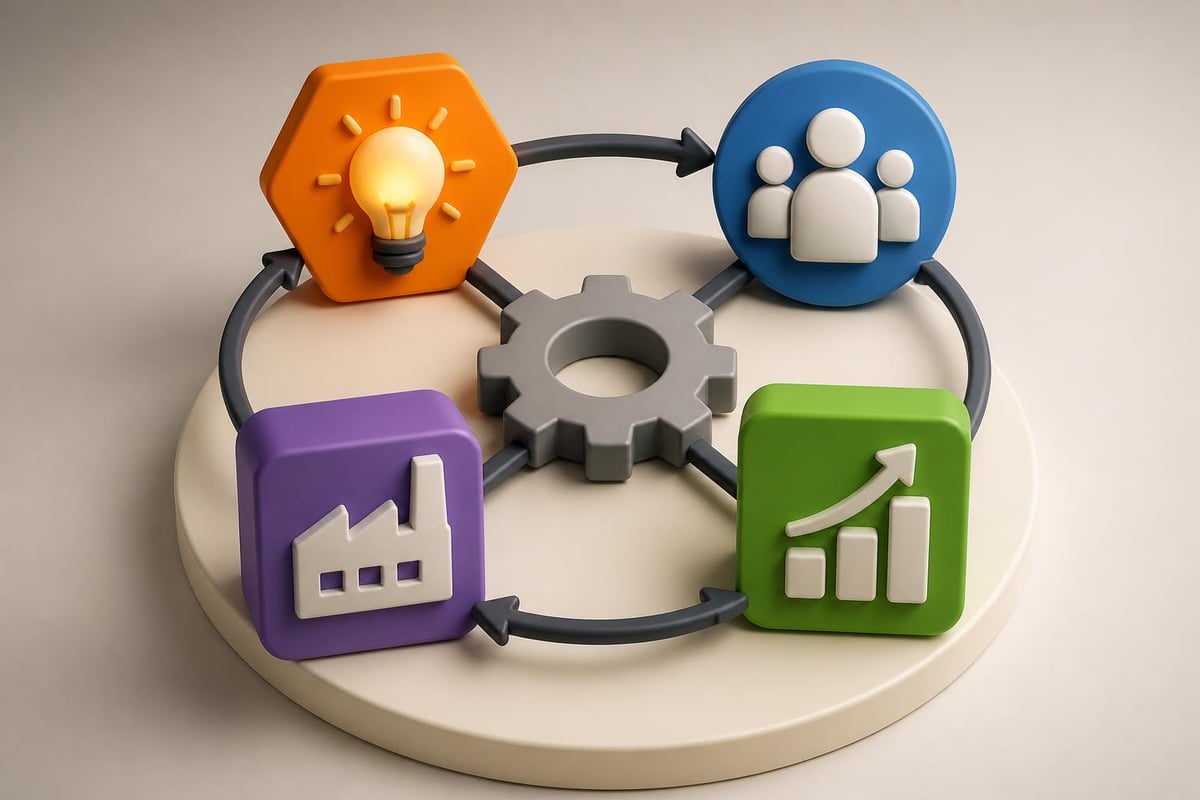
Business model visualization components

Technical Architecture and System Design Visualization

Technology companies must balance technical credibility with accessibility when visualizing system architectures. Your presentation might address both technical evaluators who scrutinize implementation details and business stakeholders who focus on capabilities and outcomes.

Layered visualization approaches solve this challenge by presenting architecture at multiple abstraction levels. Executive summaries show high-level component relationships and data flows, while appendix slides provide detailed technical specifications for due diligence reviewers.

Consider employing concept mapping techniques to organize complex technical relationships before committing to specific visual formats. This preliminary step ensures your visualization accurately represents system logic rather than imposing arbitrary graphic structures.

Market Positioning and Competitive Landscape

Visual positioning frameworks communicate market dynamics more effectively than bullet-point competitor lists. Two-by-two matrices, radar charts, and positioning maps enable audiences to grasp competitive differentiation at a glance.

When designing competitive visualizations:

  • Select axes that genuinely differentiate offerings rather than creating artificial distinctions
  • Position your company honestly while highlighting strategic advantages
  • Include enough competitors to establish market context without overwhelming the visual
  • Consider dynamic factors like market trajectory and emerging challengers
  • Support visual positioning with quantitative metrics where possible

The strategic importance of visual storytelling in these contexts extends beyond aesthetics to fundamental persuasion mechanics. Investors must quickly identify why your position represents opportunity rather than risk.

Advanced Concept Visualization for Complex Data and Analytics

Financial and tech businesses increasingly compete on analytical sophistication. Translating statistical models, algorithmic outputs, and predictive analytics into accessible visualizations requires balancing precision with comprehension.

Transforming Statistical Concepts Into Visual Insights

Statistical significance, confidence intervals, correlation versus causation-these concepts underpin data-driven decision making but resist intuitive explanation. Effective visualization strategies include:

  1. Visual annotation that highlights specific data points and explains their significance within context
  2. Comparative frameworks showing actual versus projected performance or current versus historical trends
  3. Progressive disclosure revealing analytical complexity in stages rather than overwhelming audiences immediately
  4. Simplified representations of complex models focusing on inputs, outputs, and reliability rather than mathematical mechanics

For organizations offering presentation outsourcing services, mastering these techniques enables consistent quality across diverse analytical content types.

Visualizing Uncertainty and Risk

Risk communication presents unique visualization challenges. Stakeholders need realistic understanding of probability distributions, scenario ranges, and sensitivity factors without becoming paralyzed by uncertainty.

Effective approaches balance transparency with actionability:

  • Scenario comparison showing best-case, expected, and worst-case outcomes side by side
  • Sensitivity analysis visualization revealing which variables most significantly impact outcomes
  • Confidence bands on projections that honestly communicate forecast reliability
  • Decision trees mapping choices, probabilities, and potential outcomes systematically

These visualizations prove particularly critical in financial services where regulatory compliance and fiduciary responsibility demand documented risk disclosure.

Integrating Concept Visualization Into Design Systems and Brand Frameworks

Consistency amplifies impact. When concept visualization aligns with established brand guidelines and design systems, each presentation reinforces organizational identity while maintaining functional clarity.

Developing Visual Languages for Recurring Concepts

Organizations benefit from standardizing how they visualize frequently recurring concepts. Customer journey stages, product development phases, organizational values, or technology stack components appear across multiple presentations and communication contexts.

Creating a visual vocabulary for these elements ensures:

  • Recognition efficiency where audiences familiar with your previous materials quickly orient to new content
  • Production speed as design teams leverage established components rather than creating custom solutions repeatedly
  • Quality consistency that maintains professional standards across departments and presenters
  • Brand reinforcement where distinctive visual approaches become associated with your organization

When partnering with specialists who understand your industry context, such as agencies experienced in creating fintech pitch decks, you gain access to battle-tested visual frameworks adapted to your specific needs.

Balancing Innovation and Familiarity

While consistency matters, concept visualization must also evolve with changing content requirements and audience expectations. The challenge lies in innovating within established frameworks rather than abandoning effective approaches for novelty.

Strategic innovation focuses on:

  • Adapting proven visualization types to new concept categories
  • Incorporating emerging interaction capabilities while maintaining static presentation fallbacks
  • Testing alternative approaches in lower-stakes contexts before deployment in critical presentations
  • Gathering audience feedback on visualization effectiveness and adjusting accordingly

This balanced approach ensures your visual communication remains fresh and engaging without sacrificing the clarity that drives business outcomes.

Visual design system components

Implementation Strategies and Production Workflows

Effective concept visualization requires systematic approaches rather than ad hoc creative effort. Organizations achieving consistent quality typically implement structured workflows that separate conceptual development from visual execution.

The Concept-First Development Process

Beginning with visual design before clarifying conceptual structure produces attractive slides that fail to communicate effectively. Superior workflows reverse this sequence:

Phase Activities Deliverable Success Criteria
Concept mapping Identify core ideas, relationships, hierarchies Wireframe sketches, structural outlines Logical flow, complete coverage
Audience analysis Define knowledge levels, priorities, constraints Audience profile, key messages Aligned expectations
Visualization selection Match concept types to appropriate visual formats Format specifications Optimal comprehension
Visual execution Apply design systems, refine aesthetics Draft slides Brand consistency, clarity
Review and refinement Test comprehension, gather feedback Final presentation Validated effectiveness

This systematic approach prevents the common pitfall of retrofitting concepts into visually appealing but structurally inappropriate templates. The best presentation templates support conceptual clarity rather than dictating content structure.

Leveraging Specialized Expertise

Complex concept visualization often exceeds internal capabilities, particularly when organizations face high-stakes opportunities requiring exceptional quality. Strategic use of external expertise accelerates delivery while elevating outcomes.

When evaluating presentation design partners, prioritize those demonstrating:

  • Deep understanding of your industry's conceptual challenges and communication norms
  • Portfolio evidence of transforming complex ideas into accessible visuals
  • Collaborative processes that engage subject matter experts in conceptual development
  • Proven track records with comparable organizations and presentation contexts
  • Systematic approaches rather than purely artistic or intuitive methods

Professional agencies bring perspective beyond individual project needs, identifying opportunities to build reusable frameworks that serve multiple future applications.

Measuring Concept Visualization Effectiveness

Strategic organizations treat concept visualization as measurable capability rather than subjective preference. While aesthetic appeal matters, effectiveness ultimately depends on audience comprehension, engagement, and action.

Quantitative and Qualitative Assessment Methods

Evaluation approaches range from formal research methodologies to practical feedback collection:

  • Comprehension testing where sample audience members explain concepts after viewing visualizations
  • Eye tracking studies revealing which visual elements attract attention and in what sequence
  • A/B comparison presenting alternative visualization approaches to comparable audiences and measuring outcomes
  • Stakeholder interviews gathering qualitative feedback on clarity, credibility, and persuasiveness
  • Outcome tracking correlating presentation approaches with business results (deals closed, funding secured, approvals obtained)

For businesses regularly creating high-stakes presentations, systematic measurement builds organizational capability over time. Patterns emerge revealing which visualization strategies work best for specific concept types and audience segments.

Continuous Improvement Frameworks

Treating concept visualization as an evolving discipline rather than fixed skill set enables organizations to stay ahead of rising audience expectations and competitive standards. Improvement strategies include:

  1. Maintaining swipe files of exceptional visualization examples from diverse sources
  2. Conducting regular team reviews analyzing what worked well in recent presentations
  3. Investing in ongoing training as visualization tools and techniques advance
  4. Building relationships with external experts who bring fresh perspectives
  5. Experimenting with emerging technologies like interactive visualization and dynamic data integration

Organizations committed to excellence in visual communication create competitive advantages that compound over time as capabilities mature and reputations strengthen.

Technology and Tools Supporting Concept Visualization

While conceptual thinking matters most, appropriate tools accelerate execution and expand creative possibilities. The presentation design technology landscape offers options ranging from general-purpose platforms to specialized visualization applications.

Platform Selection Considerations

PowerPoint remains dominant in business contexts due to universal compatibility and organizational familiarity. However, modern alternatives offer capabilities that may better serve specific visualization needs:

  • Presentation software (PowerPoint, Keynote, Google Slides) providing comprehensive design control and broad compatibility
  • Diagramming tools (Lucidchart, draw.io, Visio) optimized for technical architecture and process visualization
  • Data visualization platforms (Tableau, Power BI) enabling dynamic exploration of analytical content
  • Interactive presentation tools (Prezi, Beautiful.ai) supporting non-linear navigation and engaging transitions
  • Collaborative design platforms (Figma, Canva) facilitating team contribution and maintaining design consistency

Strategic selection depends on audience expectations, technical requirements, collaboration needs, and internal capabilities. Many organizations maintain proficiency across multiple platforms, choosing tools based on specific project contexts.

Emerging Capabilities and Future Directions

Artificial intelligence, real-time data integration, and interactive visualization continue advancing what's possible in presentation design. Forward-thinking organizations monitor these developments while maintaining focus on fundamental communication effectiveness.

Promising capabilities include automated layout optimization, intelligent color scheme generation based on brand guidelines, and natural language processing that suggests visualization types based on content analysis. However, technology should enhance rather than replace strategic thinking about how concepts map to visual representations.

When complex projects demand specialized capabilities-such as incorporating aerial perspectives or unique visual assets-partnerships with specialists like Extreme Aerial Productions can provide the distinctive visual elements that elevate presentations above standard business graphics.


Mastering concept visualization transforms how financial and tech businesses communicate complex ideas, turning abstract strategies into compelling visual narratives that drive stakeholder action. The systematic approaches outlined here-from selecting appropriate visualization types to implementing structured development workflows-enable organizations to consistently deliver presentations that inform, persuade, and inspire. When your business needs to translate intricate concepts into presentations that secure funding, close deals, or align teams, Prznt Perfect brings specialized expertise in transforming complexity into clarity through strategic visual design.

News & Updates...

Master data-heavy presentation design with proven strategies for transforming complex numbers into compelling visual narratives that engage audiences.

Master complex systems visualization to transform intricate data into compelling business narratives. Expert strategies for financial and tech presentations.