Semiconductor Pitch Deck Design Agency Guide 2026

The semiconductor industry stands at the intersection of unprecedented opportunity and complexity. With global chip demand surging driven by artificial intelligence, edge computing, and advanced packaging technologies, semiconductor startups and established players alike face intense competition for venture capital and strategic partnerships. A specialized semiconductor pitch deck design agency bridges the gap between technical innovation and investor comprehension, transforming intricate process nodes, wafer fabrication details, and supply chain strategies into compelling visual narratives that secure funding and market confidence.

Why Semiconductor Companies Need Specialized Pitch Deck Design

The semiconductor sector presents unique communication challenges that generic presentation templates cannot address. Technical founders must explain nanometer-scale manufacturing processes, quantum effects, and multi-billion-dollar fab investments to audiences ranging from venture capitalists to strategic acquirers. A semiconductor pitch deck design agency brings domain expertise that ensures accuracy while maintaining accessibility.

The Technical Translation Challenge

Semiconductor innovations involve concepts like extreme ultraviolet lithography, chiplet architectures, and heterogeneous integration that require visual simplification without sacrificing credibility. Professional designers understand how to create diagrams that accurately represent process flows, die layouts, and performance benchmarks while remaining legible to non-engineers. This balance proves critical when presenting to investor committees where only some members possess deep technical backgrounds.

The MIT Martin Trust Center emphasizes storytelling structure as essential for venture pitches, particularly when translating complex technical concepts into investor-friendly narratives. This principle applies doubly to semiconductor ventures where the technology gap between founders and funders often spans multiple disciplines.

Key technical elements requiring expert visualization:

  • Process node comparisons and roadmaps
  • Wafer yield curves and manufacturing efficiency
  • Power-performance-area (PPA) trade-offs
  • Supply chain resilience and geographic diversification
  • Intellectual property landscapes and patent portfolios
Semiconductor process flow visualization

Essential Components of a Semiconductor Pitch Deck

A comprehensive semiconductor pitch deck requires significantly more technical depth than typical startup presentations. Investors in this capital-intensive sector scrutinize manufacturing feasibility, IP strategy, and market positioning with exceptional rigor. Working with a semiconductor pitch deck design agency ensures each component receives appropriate emphasis and clarity.

Market Opportunity and Industry Context

The semiconductor market landscape shifts rapidly with geopolitical factors, supply chain realignments, and technology inflection points. According to KPMG's Global Semiconductor Industry Outlook, key demand drivers including AI acceleration, high-bandwidth memory, and automotive electrification create distinct opportunity segments. Your pitch deck must position your innovation within these macro trends using data visualization that demonstrates market sizing, growth projections, and competitive differentiation.

Market Slide Component Information to Include Design Approach
Total Addressable Market Segmented by application (AI, automotive, IoT, etc.) Tiered bubble charts or sankey diagrams
Growth Trajectory 5-10 year projections with key inflection points Clean line graphs with milestone annotations
Competitive Landscape Direct competitors, adjacent solutions, technology comparison Matrix positioning or capability heat maps
Market Entry Strategy Target customers, partnership approach, go-to-market timeline Phased roadmap with decision gates

Technology and IP Differentiation

Your core technology represents the heart of any semiconductor pitch. Whether you've developed novel materials, innovative architectures, or manufacturing process improvements, the presentation must convey both technical merit and commercial viability. A semiconductor pitch deck design agency structures these slides to emphasize patentability, defensibility, and performance advantages.

The WIPO IP strategy checklist provides authoritative guidance on patent portfolios and trade secret protection, elements that semiconductor investors scrutinize intensely given the sector's reliance on intellectual property moats.

Consider how biotech companies approach technical pitch decks with similar complexity challenges. The same principles of progressive disclosure and layered information apply: start with high-level benefit statements, then provide supporting technical evidence for investors who want deeper validation.

Manufacturing and Operations Strategy

Semiconductor ventures require clear articulation of how products will reach production. Whether you're pursuing a fabless model, partnering with foundries, or building captive manufacturing capacity, investors need confidence in your operational roadmap. Professional design agencies create process flow diagrams, capacity scaling charts, and supply chain visualizations that demonstrate manufacturing feasibility.

Critical operational elements to visualize:

  1. Fabrication strategy (fabless, fab-lite, or integrated manufacturing)
  2. Foundry partnerships and capacity allocation
  3. Yield improvement trajectory and quality metrics
  4. Testing, assembly, and packaging approach
  5. Supply chain redundancy and geographic risk mitigation

The capital intensity of semiconductor manufacturing makes these operational slides among the most scrutinized in your deck. Design choices should emphasize risk mitigation, scalability, and realistic timelines rather than overly optimistic projections.

Design Principles for Technical Data Presentation

Semiconductor pitch decks contain more quantitative data than most startup presentations. Performance benchmarks, process parameters, and financial projections require visualization approaches that maintain credibility while remaining accessible. Following systematic guidance for data visualization quality ensures your technical charts communicate effectively without overwhelming audiences.

Creating Effective Technical Figures

Scientific and engineering data demands particular attention to accuracy and clarity. Guidance on designing effective scientific figures emphasizes reducing visual clutter, choosing appropriate chart types, and ensuring accessibility. These principles prove invaluable when presenting wafer maps, performance curves, or reliability data.

Best practices for semiconductor data visualization include:

  • Use logarithmic scales appropriately for performance metrics spanning orders of magnitude
  • Annotate charts with context (industry standards, competitor benchmarks, theoretical limits)
  • Employ consistent color schemes that align with your brand while maintaining readability
  • Include error bars or confidence intervals for experimental results
  • Clearly label axes with units and provide legends for multi-series data

Avoid common pitfalls like 3D charts that distort data perception, excessive decimal precision that suggests false accuracy, or unlabeled axes that force audiences to guess at meaning. Professional design agencies understand these nuances and apply them consistently across your entire presentation.

Data visualization comparison

Visual Storytelling for Complex Semiconductor Innovations

Beyond data presentation, semiconductor pitch decks must weave technical elements into a cohesive narrative arc. A semiconductor pitch deck design agency structures your story to build momentum from problem identification through solution validation to market capture strategy. This narrative approach helps investors follow your logic even when individual technical details exceed their expertise.

Building the Narrative Arc

The most effective semiconductor pitches follow a clear progression: establish the market problem or opportunity, introduce your technical innovation as the solution, validate performance through data, demonstrate IP protection and competitive moats, outline the path to commercialization, and present the investment proposition. Each section should build naturally on preceding content while maintaining visual consistency.

Working with professional presentation design services ensures this narrative flow through intentional slide sequencing, visual transitions, and information hierarchy. Unlike template-based approaches, custom design allows each slide to serve its specific role in advancing your overall argument.

Consider how information flows between slides. A market opportunity slide should logically lead into your technology solution. Performance benchmarks should connect to competitive differentiation. Manufacturing strategy should support your financial projections. Professional designers create visual threads linking these elements through consistent use of color, iconography, and layout patterns.

Balancing Technical Depth with Accessibility

One challenge unique to semiconductor pitches involves calibrating technical detail for mixed audiences. Some investors bring deep semiconductor expertise while others evaluate primarily business fundamentals and team capabilities. Your pitch deck must serve both groups without alienating either.

A semiconductor pitch deck design agency addresses this through layered information architecture. Main slides present high-level conclusions and business implications. Supporting appendix slides provide technical specifications, detailed methodologies, and additional validation data. This structure allows presenters to adapt depth during live pitches while ensuring comprehensive information exists for due diligence review.

Audience Segment Primary Focus Areas Design Emphasis
Technical Investors Process innovation, performance metrics, IP strength Detailed diagrams, benchmark data, patent landscapes
Business Investors Market size, competitive positioning, revenue model Market segmentation, go-to-market strategy, financial projections
Strategic Partners Integration potential, supply chain fit, technology roadmap Ecosystem diagrams, partnership models, development timelines
Board Members Risk mitigation, capital efficiency, exit scenarios Milestone tracking, burn rate analysis, comparable transactions

Addressing Industry-Specific Investor Concerns

Semiconductor investors evaluate opportunities through frameworks shaped by industry-specific risks and success factors. Your pitch deck must proactively address concerns around capital intensity, technology risk, market timing, and competitive dynamics. A semiconductor pitch deck design agency familiar with investor due diligence processes structures presentations to build confidence across these dimensions.

Capital Requirements and Use of Funds

Semiconductor ventures typically require substantial funding for product development, manufacturing scale-up, and market entry. Investors scrutinize how capital will be deployed and what milestones each funding increment achieves. Clear visualization of funding rounds, capital allocation, and value creation stages builds confidence in your financial planning.

Create waterfall charts showing how investment translates into product development phases, capacity expansion, and revenue generation. Include sensitivity analyses demonstrating how key assumptions impact capital requirements and timeline to positive cash flow. Professional design makes these financial projections digestible while maintaining necessary detail.

Technology Risk and Validation

Given semiconductor development costs and timelines, investors need evidence that your technology works and can scale. Validation slides should present test results, prototype performance, customer pilots, or foundry partnerships that de-risk technical execution. Visualization choices should emphasize data quality, reproducibility, and relevance to production conditions.

When presenting simulation results, clarify modeling assumptions and validation against physical measurements. For prototype data, distinguish between laboratory demonstrations and real-world operating conditions. Investors appreciate transparency about remaining technical challenges and your mitigation strategies.

Technology validation roadmap

Competitive Differentiation in a Crowded Market

The semiconductor landscape includes established giants with enormous resources alongside innovative startups pursuing disruptive approaches. Your pitch deck must articulate not just what you do differently, but why those differences create sustainable competitive advantages. A semiconductor pitch deck design agency helps visualize positioning that resonates with investors who evaluate hundreds of opportunities annually.

Creating Effective Competitive Matrices

Simple competitive matrices often oversimplify complex technology trade-offs. Instead, consider multi-dimensional visualizations that capture the nuances of semiconductor competition. Show how your approach balances performance, power efficiency, cost, and time-to-market across different application segments. Use radar charts, capability heat maps, or scenario-based comparisons that demonstrate your solution's sweet spot.

Avoid the common mistake of making competitive slides that show you winning on every dimension. Investors recognize real trade-offs exist and appreciate honest positioning that acknowledges where competitors excel while emphasizing your differentiated advantages.

Effective competitive analysis elements:

  • Technology generation comparisons with clear performance metrics
  • Cost structure analysis across different manufacturing approaches
  • Time-to-market advantages from novel design or process innovations
  • IP freedom-to-operate analysis showing your patent position
  • Ecosystem compatibility and integration advantages

Working with a Specialized Design Agency

The decision to engage a semiconductor pitch deck design agency versus using templates or internal resources significantly impacts both presentation quality and fundraising outcomes. Professional agencies bring not just design capabilities but strategic perspective on what resonates with semiconductor investors.

What to Expect from Professional Services

A comprehensive engagement begins with strategic consultation to understand your technology, market position, and fundraising objectives. Designers then develop visual frameworks that support your narrative while ensuring technical accuracy. Iterative refinement incorporates feedback from your team and, when possible, friendly investors who can validate messaging effectiveness.

Professional agencies typically deliver presentation files optimized for both live pitching and asynchronous review. This includes speaker notes, animation sequences for complex builds, and properly formatted appendix sections. Many also provide derivative assets like executive summaries, teaser decks, and data room materials that maintain visual consistency across your fundraising package.

Unlike generic PowerPoint templates, custom semiconductor pitch decks account for your specific technology, competitive landscape, and target investor profile. This customization proves particularly valuable when your innovation doesn't fit standard categories or when market dynamics require nuanced positioning.

Evaluating Agency Expertise

Not all presentation design firms understand semiconductor industry dynamics. When selecting a semiconductor pitch deck design agency, evaluate their portfolio for relevant technical complexity, examine their process for ensuring accuracy, and assess their familiarity with investor expectations in capital-intensive industries.

Ask about their experience with similar technologies or business models. Review case studies that demonstrate successful outcomes. Inquire about their collaboration process and how they incorporate technical review to prevent errors that could undermine credibility. The right agency partner becomes an extension of your team, contributing strategic insights alongside design execution.

Measuring Pitch Deck Effectiveness

A well-designed semiconductor pitch deck should generate measurable results in investor engagement, meeting requests, and advancement through due diligence stages. Track metrics that indicate whether your presentation achieves its objectives and identify opportunities for refinement based on actual investor interactions.

Key Performance Indicators

Monitor how investors respond at different stages of the fundraising process. Initial email open rates and meeting conversion indicate whether your teaser deck generates interest. Follow-up meeting requests suggest your main pitch presentation effectively communicates opportunity. Due diligence progression reflects whether technical and business content withstands detailed scrutiny.

Fundraising Stage Relevant Metrics Success Indicators
Initial Outreach Email open rate, meeting request rate >30% open rate, >10% meeting conversion
First Meeting Presentation completion, Q&A engagement, follow-up requests Full presentation viewed, technical questions, additional materials requested
Due Diligence Reference calls, technical validation, term sheet timing Investor-initiated reference calls, detailed technical review, term sheet within 4-6 weeks
Closing Competitive interest, valuation support, investor value-add Multiple term sheets, valuation at or above expectations, strategic investors engaged

Gather qualitative feedback through post-meeting debriefs with your team. Which slides generated most questions? Where did you lose audience attention? What objections surfaced repeatedly? A semiconductor pitch deck design agency can help refine presentations based on this real-world feedback, continuously improving effectiveness.

Integration with Broader Marketing Strategy

Your pitch deck represents one element within a comprehensive investor communication strategy. Professional agencies ensure visual and narrative consistency across pitch presentations, website content, technical white papers, conference presentations, and media materials. This cohesion reinforces your brand positioning and makes all touchpoints mutually reinforcing.

Consider how your pitch deck visual language can extend into product roadmap presentations for customers, partnership discussions with foundries or IP vendors, and recruiting materials for technical talent. Investing in professional design creates reusable visual frameworks and brand assets that deliver value far beyond a single fundraising round.

When exploring hiring your first graphic designer versus engaging agencies, consider both immediate presentation needs and longer-term visual communication requirements. Agencies offer breadth of expertise and capacity surge for intensive projects, while in-house designers provide ongoing support and deep company knowledge. Many semiconductor companies use hybrid approaches, engaging specialized agencies for high-stakes pitch decks while building internal capabilities for day-to-day materials.


Semiconductor ventures face unique challenges in communicating complex technical innovations to investors who control access to the substantial capital required for success in this industry. A specialized semiconductor pitch deck design agency transforms technical depth into accessible narratives, data-heavy content into clear visualizations, and promising innovations into compelling investment opportunities. Whether you're pursuing Series A funding for a novel chip architecture or preparing strategic partnership discussions around advanced packaging technologies, Prznt Perfect delivers the visual storytelling expertise and technical understanding that helps semiconductor companies secure the resources they need to scale.

We offer free 30-min consultation on the presentation design audit
and hiring the right visual 
comms professional, let’s talk!
Shedule a call
Shedule a call
"I understand" goes a step further into the cognitive dance of persuasion. It's where the audience begins to see the connections between the facts, to grasp the nuances of the problem and the elegance of the solution.
  • This is some text inside of a div block.
    lay out the facts clearly and compellingly. Use data to establish the ground reality, but remember that facts alone are like the individual strands of a tapestry—necessary but not complete.
    lay out the facts clearly and compellingly. Use data to establish the ground reality, but remember that facts alone are like the individual strands of a tapestry—necessary but not complete.
  • This is some text inside of a div block.
    lay out the facts clearly and compellingly. Use data to establish the ground reality, but remember that facts alone are like the individual strands of a tapestry—necessary but not complete.

We offer free 30-min consultation on the presentation design audit

and hiring the right visual 
comms professional, let’s talk!

Shedule a call

"I understand" goes a step further into the cognitive dance of persuasion. It's where the audience begins to see the connections between the facts, to grasp the nuances of the problem and the elegance of the solution.

  • - 1 -
    Consistency at Scale:

    Biotech Market Trends 2024: Tailoring Your Pitch Deck to Current Industry Dynamics.

  • - 2 -
    Efficiency and Speed:

    The traditional process of manually updating presentations is not only slow but also prone to bottlenecks, especially when dealing with large volumes of slides. Automation dramatically accelerates this process, enabling designers to apply changes across hundreds of slides in the time it would take to manually update a single one. This efficiency is a game-changer for agencies working under tight deadlines or managing multiple projects simultaneously.

  • - 3 -
    Enhanced Creativity:

    With the burden of manual updates lifted, designers can allocate more time and energy to the creative aspects of presentation design. This freedom allows for deeper exploration of innovative design concepts, experimentation with new visual storytelling techniques, and the development of more engaging and interactive presentations. Automation doesn't stifle creativity; it amplifies it, enabling designers to push the boundaries of what's possible in corporate presentation design.

  • - 4 -
    Error Reduction:

    Manual updates are inherently prone to inconsistencies and mistakes, from misaligned logos to incorrect font sizes. These errors can detract from the professionalism of a presentation and, by extension, the corporate image. Automation minimizes these risks by ensuring that updates are applied uniformly and accurately across all slides, enhancing the overall quality and integrity of the presentation.

  • - 5 -
    Cost-Effectiveness:

    The time savings afforded by automation directly translate to cost savings for both the design agency and its clients. By reducing the hours spent on manual updates, agencies can optimize their workflows and resources, allowing them to take on more projects without compromising on quality. This efficiency can also make high-quality presentation design services more affordable and accessible to a broader range of businesses.

Semiconductor Pitch Deck Design Agency Guide 2026

Expert insights on semiconductor pitch deck design agency services. Learn how specialized presentation design transforms complex chip technology into investor-ready narratives.

The semiconductor industry stands at the intersection of unprecedented opportunity and complexity. With global chip demand surging driven by artificial intelligence, edge computing, and advanced packaging technologies, semiconductor startups and established players alike face intense competition for venture capital and strategic partnerships. A specialized semiconductor pitch deck design agency bridges the gap between technical innovation and investor comprehension, transforming intricate process nodes, wafer fabrication details, and supply chain strategies into compelling visual narratives that secure funding and market confidence.

Why Semiconductor Companies Need Specialized Pitch Deck Design

The semiconductor sector presents unique communication challenges that generic presentation templates cannot address. Technical founders must explain nanometer-scale manufacturing processes, quantum effects, and multi-billion-dollar fab investments to audiences ranging from venture capitalists to strategic acquirers. A semiconductor pitch deck design agency brings domain expertise that ensures accuracy while maintaining accessibility.

The Technical Translation Challenge

Semiconductor innovations involve concepts like extreme ultraviolet lithography, chiplet architectures, and heterogeneous integration that require visual simplification without sacrificing credibility. Professional designers understand how to create diagrams that accurately represent process flows, die layouts, and performance benchmarks while remaining legible to non-engineers. This balance proves critical when presenting to investor committees where only some members possess deep technical backgrounds.

The MIT Martin Trust Center emphasizes storytelling structure as essential for venture pitches, particularly when translating complex technical concepts into investor-friendly narratives. This principle applies doubly to semiconductor ventures where the technology gap between founders and funders often spans multiple disciplines.

Key technical elements requiring expert visualization:

  • Process node comparisons and roadmaps
  • Wafer yield curves and manufacturing efficiency
  • Power-performance-area (PPA) trade-offs
  • Supply chain resilience and geographic diversification
  • Intellectual property landscapes and patent portfolios

Semiconductor process flow visualization

Essential Components of a Semiconductor Pitch Deck

A comprehensive semiconductor pitch deck requires significantly more technical depth than typical startup presentations. Investors in this capital-intensive sector scrutinize manufacturing feasibility, IP strategy, and market positioning with exceptional rigor. Working with a semiconductor pitch deck design agency ensures each component receives appropriate emphasis and clarity.

Market Opportunity and Industry Context

The semiconductor market landscape shifts rapidly with geopolitical factors, supply chain realignments, and technology inflection points. According to KPMG's Global Semiconductor Industry Outlook, key demand drivers including AI acceleration, high-bandwidth memory, and automotive electrification create distinct opportunity segments. Your pitch deck must position your innovation within these macro trends using data visualization that demonstrates market sizing, growth projections, and competitive differentiation.

Market Slide Component Information to Include Design Approach
Total Addressable Market Segmented by application (AI, automotive, IoT, etc.) Tiered bubble charts or sankey diagrams
Growth Trajectory 5-10 year projections with key inflection points Clean line graphs with milestone annotations
Competitive Landscape Direct competitors, adjacent solutions, technology comparison Matrix positioning or capability heat maps
Market Entry Strategy Target customers, partnership approach, go-to-market timeline Phased roadmap with decision gates

Technology and IP Differentiation

Your core technology represents the heart of any semiconductor pitch. Whether you've developed novel materials, innovative architectures, or manufacturing process improvements, the presentation must convey both technical merit and commercial viability. A semiconductor pitch deck design agency structures these slides to emphasize patentability, defensibility, and performance advantages.

The WIPO IP strategy checklist provides authoritative guidance on patent portfolios and trade secret protection, elements that semiconductor investors scrutinize intensely given the sector's reliance on intellectual property moats.

Consider how biotech companies approach technical pitch decks with similar complexity challenges. The same principles of progressive disclosure and layered information apply: start with high-level benefit statements, then provide supporting technical evidence for investors who want deeper validation.

Manufacturing and Operations Strategy

Semiconductor ventures require clear articulation of how products will reach production. Whether you're pursuing a fabless model, partnering with foundries, or building captive manufacturing capacity, investors need confidence in your operational roadmap. Professional design agencies create process flow diagrams, capacity scaling charts, and supply chain visualizations that demonstrate manufacturing feasibility.

Critical operational elements to visualize:

  1. Fabrication strategy (fabless, fab-lite, or integrated manufacturing)
  2. Foundry partnerships and capacity allocation
  3. Yield improvement trajectory and quality metrics
  4. Testing, assembly, and packaging approach
  5. Supply chain redundancy and geographic risk mitigation

The capital intensity of semiconductor manufacturing makes these operational slides among the most scrutinized in your deck. Design choices should emphasize risk mitigation, scalability, and realistic timelines rather than overly optimistic projections.

Design Principles for Technical Data Presentation

Semiconductor pitch decks contain more quantitative data than most startup presentations. Performance benchmarks, process parameters, and financial projections require visualization approaches that maintain credibility while remaining accessible. Following systematic guidance for data visualization quality ensures your technical charts communicate effectively without overwhelming audiences.

Creating Effective Technical Figures

Scientific and engineering data demands particular attention to accuracy and clarity. Guidance on designing effective scientific figures emphasizes reducing visual clutter, choosing appropriate chart types, and ensuring accessibility. These principles prove invaluable when presenting wafer maps, performance curves, or reliability data.

Best practices for semiconductor data visualization include:

  • Use logarithmic scales appropriately for performance metrics spanning orders of magnitude
  • Annotate charts with context (industry standards, competitor benchmarks, theoretical limits)
  • Employ consistent color schemes that align with your brand while maintaining readability
  • Include error bars or confidence intervals for experimental results
  • Clearly label axes with units and provide legends for multi-series data

Avoid common pitfalls like 3D charts that distort data perception, excessive decimal precision that suggests false accuracy, or unlabeled axes that force audiences to guess at meaning. Professional design agencies understand these nuances and apply them consistently across your entire presentation.
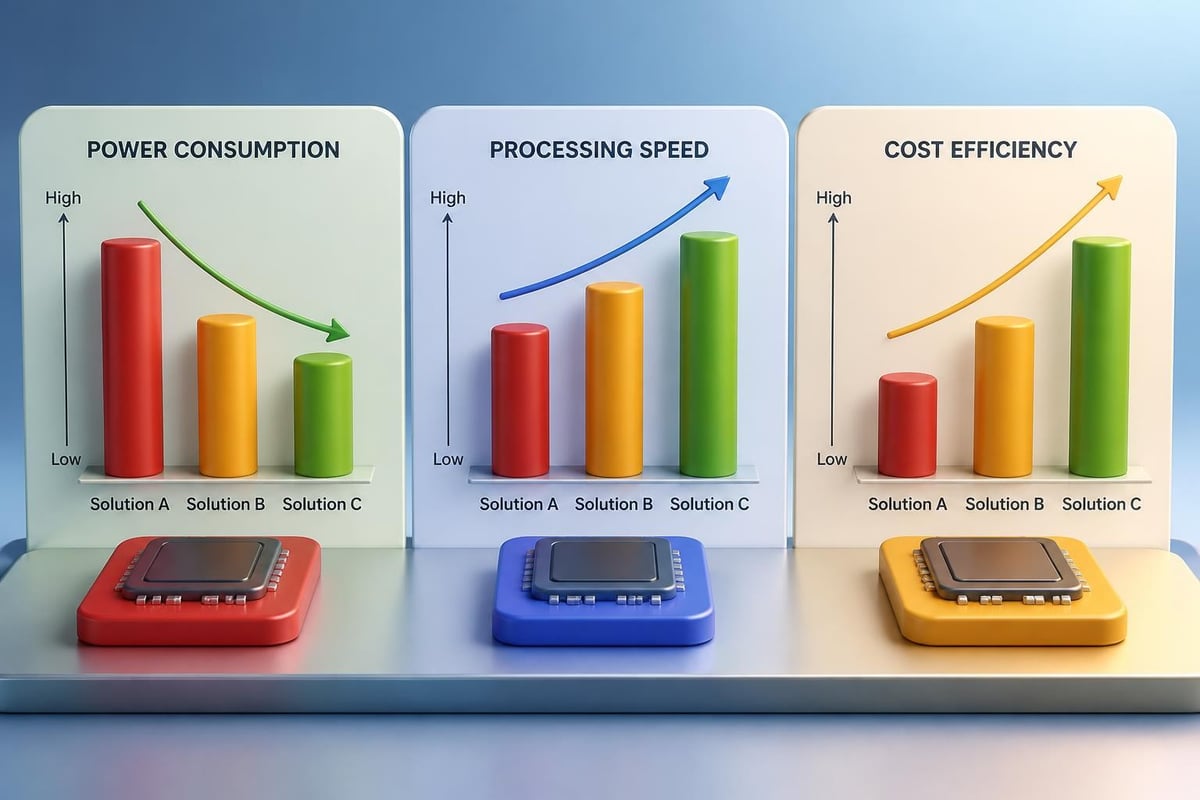
Data visualization comparison

Visual Storytelling for Complex Semiconductor Innovations

Beyond data presentation, semiconductor pitch decks must weave technical elements into a cohesive narrative arc. A semiconductor pitch deck design agency structures your story to build momentum from problem identification through solution validation to market capture strategy. This narrative approach helps investors follow your logic even when individual technical details exceed their expertise.

Building the Narrative Arc

The most effective semiconductor pitches follow a clear progression: establish the market problem or opportunity, introduce your technical innovation as the solution, validate performance through data, demonstrate IP protection and competitive moats, outline the path to commercialization, and present the investment proposition. Each section should build naturally on preceding content while maintaining visual consistency.

Working with professional presentation design services ensures this narrative flow through intentional slide sequencing, visual transitions, and information hierarchy. Unlike template-based approaches, custom design allows each slide to serve its specific role in advancing your overall argument.

Consider how information flows between slides. A market opportunity slide should logically lead into your technology solution. Performance benchmarks should connect to competitive differentiation. Manufacturing strategy should support your financial projections. Professional designers create visual threads linking these elements through consistent use of color, iconography, and layout patterns.

Balancing Technical Depth with Accessibility

One challenge unique to semiconductor pitches involves calibrating technical detail for mixed audiences. Some investors bring deep semiconductor expertise while others evaluate primarily business fundamentals and team capabilities. Your pitch deck must serve both groups without alienating either.

A semiconductor pitch deck design agency addresses this through layered information architecture. Main slides present high-level conclusions and business implications. Supporting appendix slides provide technical specifications, detailed methodologies, and additional validation data. This structure allows presenters to adapt depth during live pitches while ensuring comprehensive information exists for due diligence review.

Audience Segment Primary Focus Areas Design Emphasis
Technical Investors Process innovation, performance metrics, IP strength Detailed diagrams, benchmark data, patent landscapes
Business Investors Market size, competitive positioning, revenue model Market segmentation, go-to-market strategy, financial projections
Strategic Partners Integration potential, supply chain fit, technology roadmap Ecosystem diagrams, partnership models, development timelines
Board Members Risk mitigation, capital efficiency, exit scenarios Milestone tracking, burn rate analysis, comparable transactions

Addressing Industry-Specific Investor Concerns

Semiconductor investors evaluate opportunities through frameworks shaped by industry-specific risks and success factors. Your pitch deck must proactively address concerns around capital intensity, technology risk, market timing, and competitive dynamics. A semiconductor pitch deck design agency familiar with investor due diligence processes structures presentations to build confidence across these dimensions.

Capital Requirements and Use of Funds

Semiconductor ventures typically require substantial funding for product development, manufacturing scale-up, and market entry. Investors scrutinize how capital will be deployed and what milestones each funding increment achieves. Clear visualization of funding rounds, capital allocation, and value creation stages builds confidence in your financial planning.

Create waterfall charts showing how investment translates into product development phases, capacity expansion, and revenue generation. Include sensitivity analyses demonstrating how key assumptions impact capital requirements and timeline to positive cash flow. Professional design makes these financial projections digestible while maintaining necessary detail.

Technology Risk and Validation

Given semiconductor development costs and timelines, investors need evidence that your technology works and can scale. Validation slides should present test results, prototype performance, customer pilots, or foundry partnerships that de-risk technical execution. Visualization choices should emphasize data quality, reproducibility, and relevance to production conditions.

When presenting simulation results, clarify modeling assumptions and validation against physical measurements. For prototype data, distinguish between laboratory demonstrations and real-world operating conditions. Investors appreciate transparency about remaining technical challenges and your mitigation strategies.

Technology validation roadmap

Competitive Differentiation in a Crowded Market

The semiconductor landscape includes established giants with enormous resources alongside innovative startups pursuing disruptive approaches. Your pitch deck must articulate not just what you do differently, but why those differences create sustainable competitive advantages. A semiconductor pitch deck design agency helps visualize positioning that resonates with investors who evaluate hundreds of opportunities annually.

Creating Effective Competitive Matrices

Simple competitive matrices often oversimplify complex technology trade-offs. Instead, consider multi-dimensional visualizations that capture the nuances of semiconductor competition. Show how your approach balances performance, power efficiency, cost, and time-to-market across different application segments. Use radar charts, capability heat maps, or scenario-based comparisons that demonstrate your solution's sweet spot.

Avoid the common mistake of making competitive slides that show you winning on every dimension. Investors recognize real trade-offs exist and appreciate honest positioning that acknowledges where competitors excel while emphasizing your differentiated advantages.

Effective competitive analysis elements:

  • Technology generation comparisons with clear performance metrics
  • Cost structure analysis across different manufacturing approaches
  • Time-to-market advantages from novel design or process innovations
  • IP freedom-to-operate analysis showing your patent position
  • Ecosystem compatibility and integration advantages

Working with a Specialized Design Agency

The decision to engage a semiconductor pitch deck design agency versus using templates or internal resources significantly impacts both presentation quality and fundraising outcomes. Professional agencies bring not just design capabilities but strategic perspective on what resonates with semiconductor investors.

What to Expect from Professional Services

A comprehensive engagement begins with strategic consultation to understand your technology, market position, and fundraising objectives. Designers then develop visual frameworks that support your narrative while ensuring technical accuracy. Iterative refinement incorporates feedback from your team and, when possible, friendly investors who can validate messaging effectiveness.

Professional agencies typically deliver presentation files optimized for both live pitching and asynchronous review. This includes speaker notes, animation sequences for complex builds, and properly formatted appendix sections. Many also provide derivative assets like executive summaries, teaser decks, and data room materials that maintain visual consistency across your fundraising package.

Unlike generic PowerPoint templates, custom semiconductor pitch decks account for your specific technology, competitive landscape, and target investor profile. This customization proves particularly valuable when your innovation doesn't fit standard categories or when market dynamics require nuanced positioning.

Evaluating Agency Expertise

Not all presentation design firms understand semiconductor industry dynamics. When selecting a semiconductor pitch deck design agency, evaluate their portfolio for relevant technical complexity, examine their process for ensuring accuracy, and assess their familiarity with investor expectations in capital-intensive industries.

Ask about their experience with similar technologies or business models. Review case studies that demonstrate successful outcomes. Inquire about their collaboration process and how they incorporate technical review to prevent errors that could undermine credibility. The right agency partner becomes an extension of your team, contributing strategic insights alongside design execution.

Measuring Pitch Deck Effectiveness

A well-designed semiconductor pitch deck should generate measurable results in investor engagement, meeting requests, and advancement through due diligence stages. Track metrics that indicate whether your presentation achieves its objectives and identify opportunities for refinement based on actual investor interactions.

Key Performance Indicators

Monitor how investors respond at different stages of the fundraising process. Initial email open rates and meeting conversion indicate whether your teaser deck generates interest. Follow-up meeting requests suggest your main pitch presentation effectively communicates opportunity. Due diligence progression reflects whether technical and business content withstands detailed scrutiny.

Fundraising Stage Relevant Metrics Success Indicators
Initial Outreach Email open rate, meeting request rate >30% open rate, >10% meeting conversion
First Meeting Presentation completion, Q&A engagement, follow-up requests Full presentation viewed, technical questions, additional materials requested
Due Diligence Reference calls, technical validation, term sheet timing Investor-initiated reference calls, detailed technical review, term sheet within 4-6 weeks
Closing Competitive interest, valuation support, investor value-add Multiple term sheets, valuation at or above expectations, strategic investors engaged

Gather qualitative feedback through post-meeting debriefs with your team. Which slides generated most questions? Where did you lose audience attention? What objections surfaced repeatedly? A semiconductor pitch deck design agency can help refine presentations based on this real-world feedback, continuously improving effectiveness.

Integration with Broader Marketing Strategy

Your pitch deck represents one element within a comprehensive investor communication strategy. Professional agencies ensure visual and narrative consistency across pitch presentations, website content, technical white papers, conference presentations, and media materials. This cohesion reinforces your brand positioning and makes all touchpoints mutually reinforcing.

Consider how your pitch deck visual language can extend into product roadmap presentations for customers, partnership discussions with foundries or IP vendors, and recruiting materials for technical talent. Investing in professional design creates reusable visual frameworks and brand assets that deliver value far beyond a single fundraising round.

When exploring hiring your first graphic designer versus engaging agencies, consider both immediate presentation needs and longer-term visual communication requirements. Agencies offer breadth of expertise and capacity surge for intensive projects, while in-house designers provide ongoing support and deep company knowledge. Many semiconductor companies use hybrid approaches, engaging specialized agencies for high-stakes pitch decks while building internal capabilities for day-to-day materials.


Semiconductor ventures face unique challenges in communicating complex technical innovations to investors who control access to the substantial capital required for success in this industry. A specialized semiconductor pitch deck design agency transforms technical depth into accessible narratives, data-heavy content into clear visualizations, and promising innovations into compelling investment opportunities. Whether you're pursuing Series A funding for a novel chip architecture or preparing strategic partnership discussions around advanced packaging technologies, Prznt Perfect delivers the visual storytelling expertise and technical understanding that helps semiconductor companies secure the resources they need to scale.


News & Updates...

Discover how to find, customize, and leverage free Google Slides templates for professional presentations in financial and tech industries.

Learn how cybersecurity companies build powerful brand identities through visual storytelling, transparent communication, and strategic design.