
7 Must-Have Pitch Deck Elements for 2026 Success
In 2026, more than 100,000 startups will compete for investor dollars, making every pitch deck a crucial gateway to funding. With so many founders vying for attention, standing out demands more than just a good idea.
This article uncovers the seven essential pitch deck elements every founder must master to win over investors and secure funding. Using proven strategies, you will discover how to blend modern storytelling, data-driven persuasion, and visual design for maximum impact.
Get ready to learn what separates a forgettable pitch deck from one that wins.
The Changing Landscape of Pitch Decks in 2026
The world of startup fundraising is transforming rapidly as we move into 2026. The competition for investor attention is fierce, and the expectations for a standout pitch deck have never been higher. Founders can no longer rely on basic, text-heavy slides. Today, the pitch deck must serve as a sophisticated narrative tool, blending storytelling, data, and design to capture both the logic and imagination of investors.

Technology is at the heart of this evolution. Artificial intelligence, automation, and the normalization of remote pitching have set new standards for clarity, engagement, and personalization. Investors expect founders to deliver insights swiftly, supported by real-time data and compelling visuals. The integration of AI tools not only streamlines content creation but also enables dynamic, adaptive presentations that adjust to each audience. To understand how these tools are shaping the future, explore AI's Impact on Pitch Decks, which highlights the transformative role of automation and AI-driven analytics in modern investor presentations.
Investor preferences have shifted significantly. Decision-makers prioritize concise storytelling, clear demonstration of market traction, and strong, defensible differentiation. They want to see not just a great idea, but evidence of real-world demand and a unique advantage. Personalization has become essential. Instead of one-size-fits-all messaging, top founders tailor their pitch deck for each investor persona and industry. This means adapting language, data, and case studies to address specific interests, whether targeting venture capitalists, corporate investors, or strategic partners.
The rise in pitch deck sophistication is visible in the growing number of templates and successful startup examples available on platforms like Slidebean. The classic decks from Airbnb and Uber set the stage for today’s standards, with their sharp focus on problem statements, market sizing, and business model clarity. Modern pitch decks, however, go further. They incorporate interactive visuals, live data feeds, and more granular market analysis, all designed to build trust and reduce perceived risk for investors.
Let’s compare the evolution:
| Era | Classic Decks (2010s) | Modern Decks (2026) |
|---|---|---|
| Structure | Linear, static slides | Dynamic, data-driven narratives |
| Visuals | Basic graphics, text-heavy | Infographics, real-time data, video |
| Delivery | In-person, printed | Remote, interactive, AI-enhanced |
The key insight for founders in 2026 is clear. The pitch deck must blend strategic storytelling with credible evidence and high-impact visuals. It should be adaptable to different audiences, leverage the latest technology, and present a compelling, data-backed case for investment. The seven essential elements outlined in this article directly address these new demands, equipping you to craft a pitch deck that not only stands out, but wins funding in today’s competitive environment.
7 Must-Have Pitch Deck Elements for 2026 Success
Standing out in the crowded 2026 fundraising arena demands more than a generic pitch deck. Investors expect clarity, proof, and vision—delivered in seven distinct elements that work together to tell a compelling story. Mastering these components can transform your pitch deck from an ordinary overview into a powerful tool for winning capital. Let’s break down each element, highlight proven tactics, and reveal what investors want to see at every stage.
1. Compelling Problem Statement
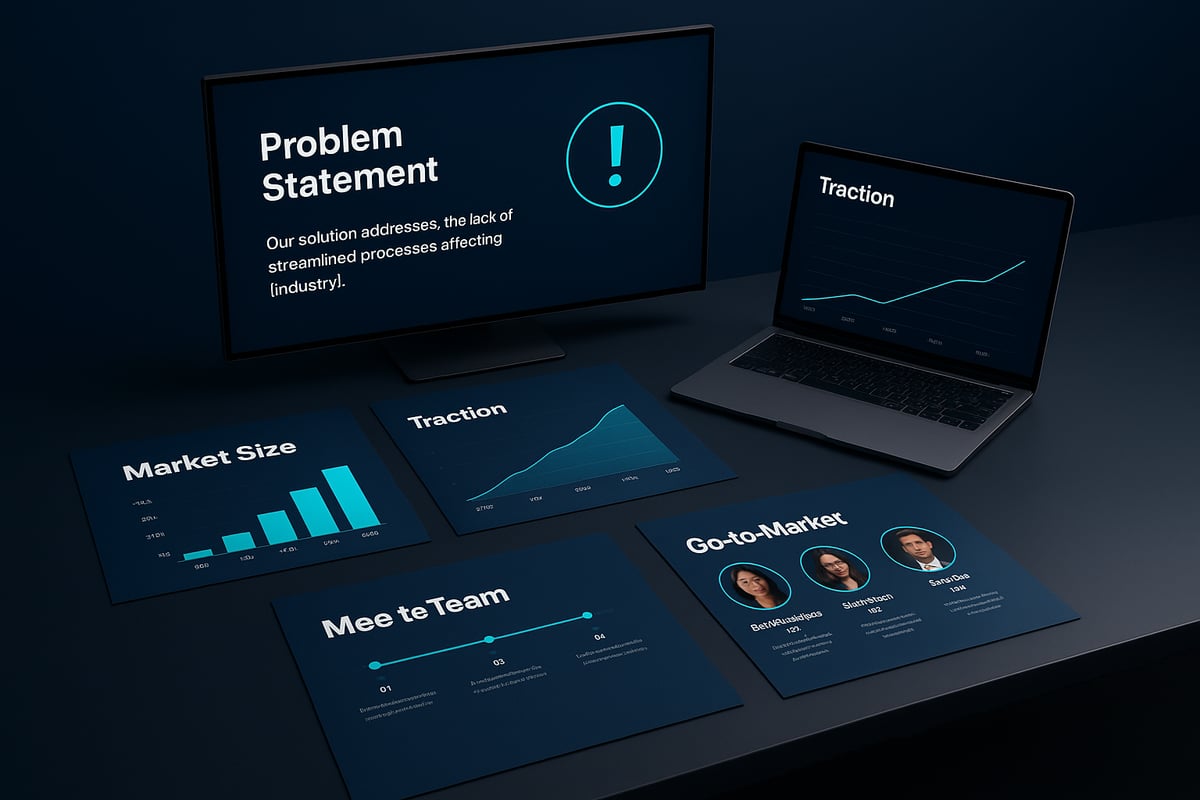
A successful pitch deck always starts with a crystal-clear problem statement. Investors want to know the pain point your solution addresses, and why it matters now. Avoid vague descriptions—focus on specifics that resonate emotionally and intellectually.
For maximum impact, ground your problem in data. Use industry reports, credible surveys, or direct customer feedback to illustrate the scale and urgency. For example, Airbnb’s original pitch deck highlighted the cost and cultural disconnect travelers faced, using relatable anecdotes and market statistics. Slidebean recommends starting with a high-impact, relatable problem that instantly draws attention.
To avoid generic statements, zoom in on the actual experience of your target audience. Is it wasted time, lost revenue, or missed opportunities? Quantify it wherever possible. If you’re solving a $10 billion inefficiency or a daily frustration for millions, make that clear.
Visual storytelling elevates your message. Infographics, customer quotes, or market data snapshots can quickly communicate both the scope and human impact of the issue. A strong problem statement in your pitch deck shows investors you deeply understand the customer’s struggle and are uniquely positioned to solve it.
Tips for a standout problem slide:
- Use a single, powerful data point.
- Add a direct quote from a real customer.
- Visualize the problem’s impact with an infographic.
By starting your pitch deck with an urgent, relatable problem, you lay the foundation for a story investors want to hear.
2. Unique Value Proposition & Differentiation
After establishing the problem, your pitch deck must clearly explain what makes your solution unique. Investors see hundreds of ideas—differentiation is key to capturing attention. Use simple, jargon-free language to describe your unique value proposition.
Draw inspiration from Sequoia Capital’s template: answer “why now” and “why us.” What makes your team the right one to solve this problem at this moment? Is it a breakthrough technology, a unique business model, or a powerful network?
Support your claims with evidence. Patents, proprietary technology, or a novel go-to-market strategy can set you apart. For instance, Uber’s early pitch deck focused on GPS coordination and superior service quality, both of which were defensible differentiators.
Avoid common mistakes like overclaiming or offering vague promises. If you state your product is “the best,” back it up with proof—awards, customer testimonials, or traction data. A comparison table or visual diagram can quickly highlight your advantages over competitors.
Checklist for a strong differentiation slide:
- State your unique value in one sentence.
- Show how you outperform rivals.
- Use a visual (table or graphic) to reinforce your message.
A memorable pitch deck positions your solution as not just another option, but the obvious choice for investors.
3. Data-Driven Market Opportunity
Investors need to understand the scale of the opportunity before committing funds. Your pitch deck should quantify the total addressable market (TAM), segmented addressable market (SAM), and serviceable obtainable market (SOM). Use credible, up-to-date sources and present data in a visual, digestible way.
Pitch’s templates often include dedicated slides for market sizing. Graphs, pie charts, and bar visuals make complex numbers accessible. For example, NextView Ventures’ proposals cite a specific billion-dollar niche, giving investors a clear sense of the upside.
In 2026, market trends may shift fast. Highlight emerging verticals, new geographies, or changing demographics that expand your opportunity. Align your growth projections with these realities to show you’ve done your homework.
Be wary of inflating numbers without context. Overestimating market size is a red flag. Instead, explain your calculation methodology, and tie your projections to real-world adoption rates or competitor benchmarks.
Table: Market Sizing Example
| Metric | Value | Source |
|---|---|---|
| TAM | $15B | Gartner |
| SAM | $3B | Statista |
| SOM | $400M | Company estimate |
A compelling pitch deck demonstrates not only the size, but also the accessibility of your chosen market.
4. Traction & Validation
Nothing builds investor confidence like traction. Your pitch deck should spotlight key metrics: revenue, active users, partnerships, or pilot results. Slidebean’s traction slide emphasizes metrics like month-over-month growth and monthly active users (MAUs).
Visuals are essential. Use line charts to show user growth, milestone timelines to highlight achievements, or logos of well-known clients to boost credibility. Buffer’s pitch deck, for instance, showcased early user numbers and impressive growth rates, making a strong case for product-market fit.
If you’re pre-revenue, focus on pilot feedback, waitlists, or media mentions. Anything that proves demand and reduces perceived risk is valuable. Address any gaps honestly, and explain your plan to accelerate traction.
Checklist for traction slides:
- Show at least one key growth metric.
- Highlight partnerships or pilot results.
- Use visuals for impact and clarity.
Investors want to see that your pitch deck reflects real-world momentum, not just a vision. Solid traction validates your model and signals lower risk.
5. Scalable Business Model
A pitch deck must clearly explain how your company makes money—and how that model scales. Investors are looking for business models that are both profitable and defensible in the long term.
Lay out your pricing strategy, sales channels, and main revenue streams. Use diagrams or flowcharts to illustrate the customer journey and how revenue flows through your system. For example, compare a SaaS subscription model to a marketplace commission approach with a simple table.
Discuss how your business model adapts to market changes. Is it flexible enough to evolve as customer needs shift? Address potential risks and how you’ll maintain profitability at scale.
Business Model Summary Table
| Model Type | Revenue Source | Scalability | Example |
|---|---|---|---|
| SaaS | Subscriptions | High | Salesforce |
| Marketplace | Commissions | Medium | Airbnb |
Investors often ask, “Is this model defensible and sustainable as you grow?” Your pitch deck should answer this with clarity and confidence.
6. Go-to-Market & Growth Strategy
A brilliant product means little if you cannot reach your audience. Your pitch deck should detail your go-to-market and growth strategy, tailored for 2026’s competitive landscape.
Leverage templates from Slidebean and Pitch to structure this slide. Highlight your customer acquisition channels: digital marketing, strategic partnerships, sales funnels, or community building. For early-stage startups, influencer marketing or B2B partnerships can be powerful levers.
Use step-by-step visuals or timelines to outline your launch and growth plans. Be specific—show projected customer acquisition costs, conversion rates, and retention strategies. Explain how your tactics will adapt as your company scales.
Growth Strategy Timeline Example
| Phase | Activity | KPI |
|---|---|---|
| Launch | Influencer campaigns | 10K signups |
| Expansion | B2B partnerships | 5 enterprise deals |
| Scaling | Paid ads, referral loops | 100K users |
Investors want to see a realistic, data-backed path to market dominance. A pitch deck that clearly maps out this journey is far more likely to win attention and funding.
7. Team & Execution Capability
Great ideas require great teams to bring them to life. Your pitch deck should introduce founders and key team members, highlighting relevant expertise and proven execution.
Use photos and brief bios to establish credibility. Showcase notable achievements—previous startups, successful exits, or domain-specific experience. If you have respected advisors or well-known backers, feature them here.
Be honest about skill gaps, and show how you plan to fill them. Investors want to know you recognize your limitations and are proactive in building a world-class team.
Team Slide Checklist:
- Founder photos and titles
- Short, relevant bios
- Key achievements or prior exits
Remember, investors back people as much as ideas. A pitch deck that demonstrates execution capability reassures investors they are betting on a winning team.
For a deeper understanding of how a well-crafted pitch deck can secure investor interest, read How a Proper Pitch Deck Wins Investors.
Visual Storytelling and Design Best Practices for 2026 Pitch Decks
Design is no longer an afterthought—it's a strategic advantage in every pitch deck. In 2026, investors review hundreds of decks each month, and only those with striking visual storytelling break through the noise. A compelling pitch deck not only delivers your message, it also shapes how investors perceive your business before a single word is spoken.

Why Visual Design Matters
First impressions count, and your pitch deck design is your silent ambassador. Investors often decide in seconds if a deck is worth their attention. A visually appealing pitch deck helps crystallize your story, clarify your value, and build instant credibility.
Research from leading presentation platforms shows that decks with strong visual design are 30 percent more likely to be remembered. By integrating modern storytelling with impactful visuals, you ensure your pitch deck stands out in a crowded funding landscape.
Clean, Consistent, and Modern: The New Standard
In 2026, clean layouts and consistent branding are non-negotiable. Investors expect every pitch deck to feature unified color schemes, readable fonts, and well-chosen imagery. Visual clutter or mismatched elements can undermine your message and distract from your value proposition.
According to Presentation Design Trends 2026, founders who embrace minimalist design and clear visual hierarchy see higher engagement rates. A modern pitch deck signals professionalism and helps investors focus on what matters—your story and traction.
Data Visualization: Make Metrics Memorable
Numbers alone rarely persuade. In a pitch deck, data must be transformed into compelling visuals—charts, infographics, and timelines that tell a story. Well-designed graphs make your market opportunity, growth, and projections instantly digestible.
Savvy founders use data visualization to highlight trends, support claims, and create memorable moments. This approach not only clarifies complex information but also demonstrates your command of the numbers and your pitch deck’s credibility.
Accessibility and Hybrid Readiness
With remote and hybrid meetings now the norm, every pitch deck must be built for any device and audience. Use large, sans-serif fonts and high-contrast color palettes for clarity, whether on a phone, tablet, or large screen.
Mobile-friendly decks are expected in 2026, so test your pitch deck across platforms to ensure seamless delivery. Clear visuals and concise text help keep investors engaged, no matter where or how they view your presentation.
Common Pitfalls and ROI of Great Design
Avoid overcrowded slides, inconsistent icons, and pixelated images—these mistakes can torpedo even the best pitch deck. Many founders fall into these traps, but resources like Key Pitch Deck Mistakes to Avoid offer actionable guidance.
Investing in professional pitch deck design pays real dividends: studies show that well-crafted decks can double the likelihood of securing a meeting. Testimonials from funded startups consistently highlight the role of strong visuals in winning investor trust and attention.
Prznt Perfect: Elevate Your Pitch Deck Design
In the race to secure funding, your pitch deck must do more than inform—it needs to persuade, impress, and inspire. Prznt Perfect specializes in transforming ordinary presentations into powerful, investor-ready stories. As a leading presentation design agency for financial and tech innovators, Prznt Perfect blends modern storytelling with data-driven visuals to ensure your pitch deck stands out in any boardroom or virtual meeting.
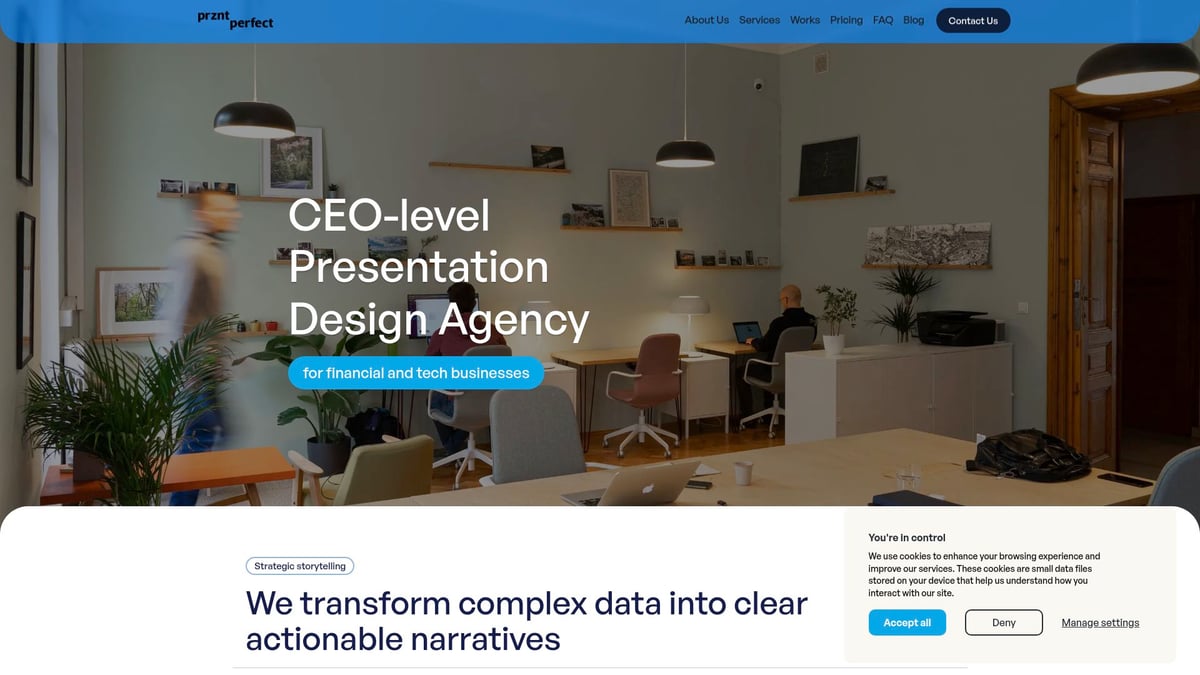
Prznt Perfect’s suite of services is designed to address every facet of effective pitch deck creation:
- Custom pitch deck design tailored to your brand, audience, and industry.
- Creative consulting that sharpens your narrative and messaging.
- Data visualization that transforms complex metrics into compelling graphics.
- Visual storytelling that weaves together strategy, emotion, and evidence.
What sets Prznt Perfect apart is deep industry expertise and executive-level communication. The team has helped clients raise over $2.3 billion, offering end-to-end support with minimal client burden. From initial concept to investor presentation, every pitch deck benefits from a process that ensures consistency, clarity, and impact.
Real-world results matter. Explore Fintech Pitch Deck Examples to see how Prznt Perfect’s approach has driven success for startups in competitive industries. For founders in specialized sectors, resources like How to Design a Cybersecurity Pitch Deck demonstrate the agency’s commitment to personalized, high-performance solutions.
Prznt Perfect is ideal for startup founders, executives, marketing teams, and keynote speakers who need a pitch deck that commands attention. The agency’s track record includes 5-star Clutch ratings and trust from Fortune 500 companies and top startups alike.
Ready to elevate your pitch deck? Discover Prznt Perfect’s portfolio and transparent pricing to prepare for your next high-stakes presentation with confidence.


- This is some text inside of a div block.lay out the facts clearly and compellingly. Use data to establish the ground reality, but remember that facts alone are like the individual strands of a tapestry—necessary but not complete.lay out the facts clearly and compellingly. Use data to establish the ground reality, but remember that facts alone are like the individual strands of a tapestry—necessary but not complete.
- This is some text inside of a div block.lay out the facts clearly and compellingly. Use data to establish the ground reality, but remember that facts alone are like the individual strands of a tapestry—necessary but not complete.

.png)
