
Logo Presentation Template: Build Impact in 2026

A well-crafted logo presentation template serves as the critical bridge between design vision and stakeholder buy-in. For financial and tech businesses launching rebrands or introducing new visual identities, the presentation format determines whether months of strategic work translates into enthusiastic approval or endless revision cycles. Unlike static brand guidelines, a logo presentation template must tell a compelling story that connects strategic rationale to visual execution, making every design decision feel inevitable and essential. This structured approach ensures consistency across client presentations while allowing designers to focus on what matters most: persuasive visual storytelling that resonates with decision-makers who evaluate brands through the lens of market impact and competitive differentiation.
Strategic Foundation Elements Every Template Needs
Every effective logo presentation template begins with context, not imagery. Before revealing any visual work, the template must establish the strategic foundation that justifies design decisions.
Start with brand positioning and market analysis. Financial services and technology companies operate in crowded, competitive landscapes where differentiation drives valuation. Your template should dedicate initial slides to competitive landscape analysis, target audience insights, and the specific market position the new logo must communicate. This framing transforms the presentation from subjective aesthetic evaluation into objective strategic assessment.
Include these strategic components in your opening section:
- Market context slide showing competitive positioning
- Audience insights with demographic and psychographic data
- Brand attributes mapped to visual language
- Success metrics defining what effective brand communication achieves

The strategic foundation, visual identity, and real-world applications framework ensures every subsequent design choice connects back to business objectives. This connection proves particularly valuable when presenting to CFOs, CTOs, and other stakeholders who evaluate creative work through ROI and strategic alignment rather than aesthetic preference.
Design Rationale Documentation
After establishing strategic context, your logo presentation template must document the design rationale that connects strategy to execution. This section explains why specific visual choices serve business objectives.
Create dedicated template slides for:
- Typography selection rationale linked to brand personality
- Color psychology and competitive differentiation
- Symbol or mark meaning tied to company mission
- Stylistic approach explaining modern, classic, or technical visual language
This documentation matters especially in highly regulated industries like financial services, where visual choices may need approval from compliance teams or must align with specific industry standards. The template should provide space for designers to articulate how every element serves strategic purpose, not just aesthetic preference.
Visual Identity System Components
Once strategic foundation and rationale are established, the logo presentation template shifts to comprehensive visual documentation. This section showcases the complete identity system, not just the primary logo.
Primary Logo Variations
Professional logo presentation templates must accommodate multiple logo configurations. According to presentation slides guide for logo makers, establishing master slide setups ensures consistency across all variation presentations.
| Logo Variation | Use Case | Template Slide Requirements |
|---|---|---|
| Horizontal lockup | Primary digital and print applications | Light and dark background examples |
| Vertical lockup | Square social media profiles, app icons | Minimum size specifications |
| Icon or symbol only | Favicon, app launcher, small-scale uses | Isolation and safe space rules |
| Monochrome version | Single-color printing, fax, photocopies | Black and reversed white examples |
Each variation requires its own template slide showing the logo at actual size with clear specifications. This documentation prevents future misuse and establishes authoritative reference for internal teams and external vendors.
Clear Space and Sizing Standards
Brand integrity depends on consistent application. Your logo presentation template must include precise technical specifications that prevent common usage errors.
Major brands like those documented in the G20 Brand Identity Guidelines demonstrate how detailed PowerPoint template layouts establish spacing and sizing rules. These standards should be visually demonstrated, not just described in text.
Minimum size specifications prevent legibility issues. Following examples from Colorado College brand guidelines, show logos at their absolute minimum reproduction size with measurements in both pixels (for digital) and inches (for print). This dual measurement system prevents confusion across different production contexts.
Clear space documentation requires visual demonstration:
- Measurement based on logo element (typically x-height or icon width)
- Examples showing correct clear space on all four sides
- Common violation examples marked as incorrect
- Application across different background types
Real-World Application Mockups
Strategic foundation and technical specifications mean nothing without proof that the logo functions in actual business contexts. The application mockup section transforms abstract brand elements into tangible business assets.
Digital Application Contexts
Technology and financial services companies exist primarily in digital environments. Your logo presentation template should showcase digital applications first, prioritizing the contexts where stakeholders will most frequently encounter the brand.
Website and application interfaces represent primary brand touchpoints. Template slides should show the logo in navigation headers, login screens, and email signatures at actual pixel dimensions. For tech companies, demonstrate how the logo scales responsively across desktop, tablet, and mobile viewports.
Social media applications deserve dedicated template treatment:
- Profile images at actual platform dimensions (Twitter, LinkedIn, Facebook)
- Cover images showing logo placement within platform constraints
- Sponsored content examples demonstrating logo in advertising contexts
- App store listings showing icon alongside competitor apps

These digital mockups prove the logo works in the environments that drive modern business development. For companies working with pitch deck templates, showing how the logo performs in presentation contexts becomes especially critical.
Print and Physical Applications
Despite digital dominance, physical brand applications remain important for corporate events, investor relations, and client-facing materials. Your template should include traditional application mockups that demonstrate professional polish.
Business collateral mockups establish credibility:
- Business cards showing logo with contact information hierarchy
- Letterhead demonstrating proper placement and margins
- Presentation folders with logo placement on covers and interiors
- Event signage showing logo at large scale with legibility maintained
Financial services firms particularly value presentation materials mockups. Show the logo on pitch decks, quarterly reports, investor presentations, and conference materials. These applications prove the brand system supports the formal, authoritative communications that define the industry.
Brand Environments and Experiential
For companies with physical offices or event presences, environmental graphics mockups demonstrate how the logo translates to architectural scale. While not every presentation requires this depth, technology companies planning conference exhibits or financial firms designing office spaces benefit from seeing the brand at human scale.
Include mockups showing:
- Reception area signage and wayfinding
- Conference room graphics and presentation backgrounds
- Trade show booth designs with logo prominence
- Vehicle wraps or building exteriors for companies with field operations
These large-scale applications reveal whether the logo maintains impact and legibility beyond typical digital and print dimensions. Similar to how Atlassian's design system documents logo behavior across contexts, your template should prove the brand system scales appropriately.
Usage Guidelines and Restrictions
Beyond showing correct applications, effective logo presentation templates must explicitly document improper usage. This preventative documentation saves countless hours of future brand governance.
Common Usage Violations
Create template slides showing side-by-side comparisons of correct usage versus common mistakes. Visual examples communicate faster than written rules, especially for non-design stakeholders who will approve vendor work or internal marketing materials.
Document these frequent violations visually:
- Stretching or distorting logo proportions
- Placing logo on busy or low-contrast backgrounds
- Using outdated logo versions after rebrand
- Adding effects like drop shadows, gradients, or outlines
- Recreating or redrawing logo instead of using provided files
- Violating minimum size specifications
- Ignoring clear space requirements
Following the approach outlined in Shopify's brand assets guide, create a dedicated "What Not to Do" section that uses red X marks over violations and green checkmarks over correct usage. This visual language requires no explanation and prevents well-meaning team members from making common mistakes.
File Format and Technical Delivery
The final section of your logo presentation template should clarify technical file delivery and usage protocols. This operational information ensures smooth handoff from design to implementation.
| File Format | Use Case | Color Mode | Resolution |
|---|---|---|---|
| EPS/AI | Print production, professional design | CMYK | Vector (scalable) |
| SVG | Web development, responsive digital | RGB | Vector (scalable) |
| PNG (transparent) | Digital documents, presentations | RGB | 300 DPI minimum |
| JPG | Email signatures, simple web | RGB | 72-150 DPI |
Include template slides explaining when to use each file format, preventing the common mistake of using low-resolution JPGs for print production or CMYK files for web development. This technical guidance protects brand quality across all touchpoints.
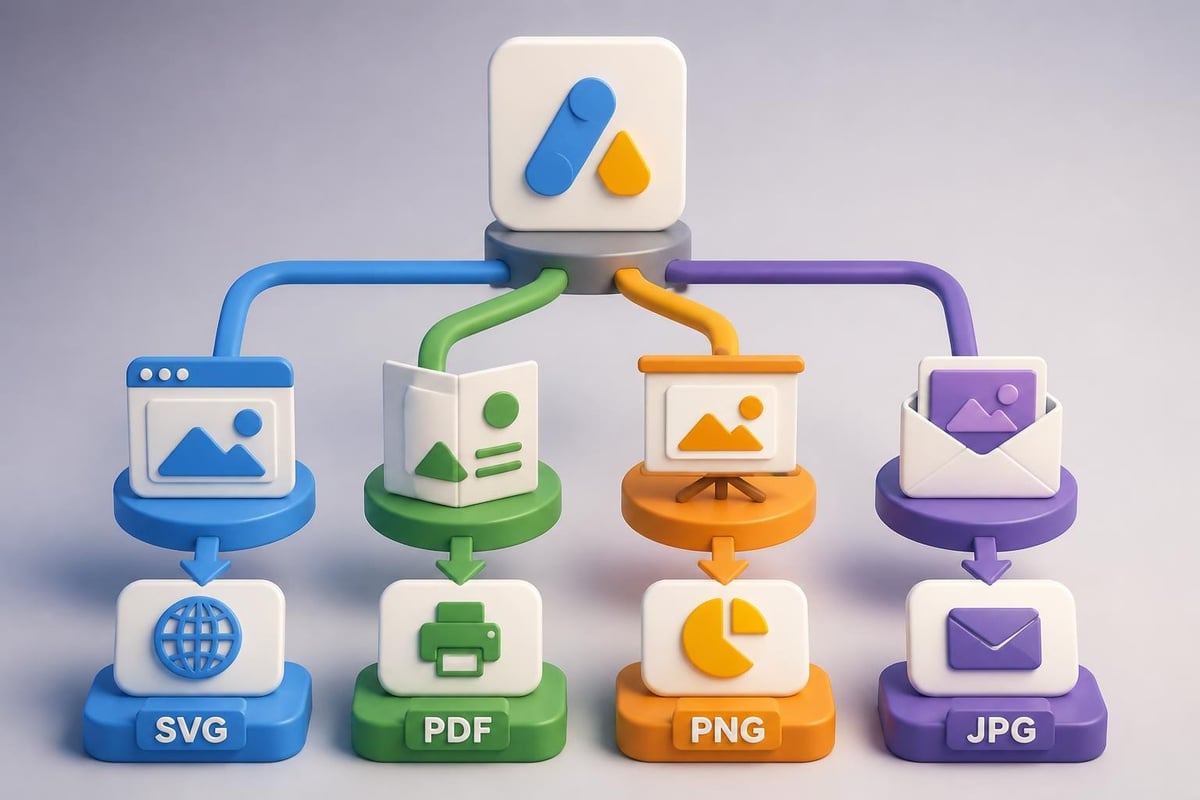
For companies utilizing slide deck templates across their organization, specify which logo files work best in PowerPoint, Keynote, and Google Slides. Different presentation platforms handle transparency and scaling differently, requiring specific file format recommendations.
Template Structure and Organization Best Practices
Beyond content, the structural organization of your logo presentation template determines usability and effectiveness. A well-organized template enables designers to customize presentations for different audiences while maintaining consistent flow.
Master Slide Architecture
Professional presentation design starts with proper master slide setup. Create a master slide structure that enforces consistent typography, spacing, and layout hierarchy throughout the presentation.
Establish these master slide types:
- Title slide with prominent branding
- Section divider slides marking strategic foundation, visual identity, and applications
- Content slides with consistent text hierarchy
- Full-bleed image slides for impactful mockup reveals
- Comparison slides for showing variations side-by-side
- Technical specification slides with measurement overlays
This master slide architecture ensures brand consistency throughout the presentation while enabling efficient customization. Designers can swap content without reconstructing layout, maintaining professional polish regardless of which sections are emphasized for specific audiences.
Narrative Flow and Stakeholder Alignment
Different stakeholders care about different aspects of logo presentations. CFOs prioritize strategic rationale and market differentiation. Marketing teams focus on application versatility and campaign integration. Legal and compliance teams scrutinize usage restrictions and brand protection.
Structure your template to accommodate selective presentation:
- Executive summary deck (8-12 slides) hitting strategic highlights and primary logo only
- Complete presentation (25-40 slides) documenting full identity system
- Technical reference (10-15 slides) focusing on specifications and usage rules
- Application showcase (15-20 slides) emphasizing mockups and real-world examples
This modular approach, similar to strategies used in creative pitch deck design, allows presenters to assemble the right narrative for each audience without creating entirely separate presentations.
Digital Delivery and Interactive Elements
As presentation technology evolves in 2026, logo presentation templates should leverage interactive capabilities that static PDFs cannot match. Digital presentation formats enable richer stakeholder engagement and more comprehensive brand system documentation.
Animation and Transition Strategy
Strategic animation reveals design thinking progressively rather than overwhelming viewers with complete information simultaneously. Your template should include animation presets that enhance comprehension without distracting from content.
Effective animation applications include:
- Building typography and symbol separately to show construction
- Revealing clear space measurement overlays progressively
- Transitioning between logo variations to demonstrate relationship
- Animating mockups to show logo across different contexts sequentially
Avoid gratuitous animation that adds presentation time without adding clarity. Each animated element should serve a pedagogical purpose, helping stakeholders understand logo construction, variation relationships, or application contexts more effectively than static slides could achieve.
Embedded Resources and Documentation
Modern presentation platforms support embedded resources that transform presentations from linear narratives into comprehensive brand reference tools. Include hyperlinked navigation that allows stakeholders to explore sections non-sequentially based on their specific interests.
Embed these resources directly in your template:
- Links to high-resolution logo file downloads
- PDF brand guidelines for detailed reference
- Contact information for brand management team
- Approval workflow documentation
- Usage request forms for external vendors
This embedded documentation approach mirrors how comprehensive brand guidelines combine presentation and reference functions, serving both initial approval and ongoing governance needs.
Measurement and Iteration Frameworks
The most sophisticated logo presentation templates include frameworks for measuring brand performance post-launch. These measurement systems prove ROI and justify brand investment to financial stakeholders.
Brand Recognition Metrics
Include template slides that establish baseline brand awareness metrics and tracking methodologies. For technology companies launching new products or financial services firms entering new markets, quantifying brand recognition validates design effectiveness.
Document these measurement approaches:
- Pre-launch brand awareness surveys establishing baseline
- Post-launch recognition studies measuring improvement
- Competitive brand perception comparisons
- Digital engagement metrics (social media, website traffic, search volume)
- Sales and conversion data correlated with brand launch timing
By incorporating measurement frameworks directly into the presentation template, you position the logo as a business investment with trackable returns rather than a subjective creative exercise. This analytical framing resonates particularly well with data-driven technology and financial services leadership.
Feedback Collection and Iteration
Professional logo presentation templates should include mechanisms for collecting structured stakeholder feedback. Rather than receiving scattered comments via email or meetings, use the template itself to gather organized input.
Create feedback collection slides that prompt specific responses:
- Strategic alignment rating - Does the logo communicate intended brand positioning?
- Competitive differentiation assessment - How effectively does the logo distinguish the brand?
- Application concerns - Which use cases require additional documentation or variation?
- Technical questions - What specification details need clarification?
This structured feedback approach, similar to methodologies used by agencies offering professional presentation services, accelerates approval cycles by preempting common stakeholder concerns and organizing decision-making around specific evaluation criteria.
A comprehensive logo presentation template transforms brand approval from subjective debate into strategic evaluation, connecting every visual decision back to business objectives and market requirements. By documenting strategic foundation, technical specifications, real-world applications, and usage guidelines in a structured presentation format, you create a persuasive narrative that resonates with financial and technology stakeholders who demand both creative excellence and measurable business impact. When you need expert support crafting presentation templates that combine strategic clarity with visual sophistication, Prznt Perfect specializes in translating complex brand systems into compelling visual narratives that drive stakeholder alignment and accelerate approval processes.



- This is some text inside of a div block.lay out the facts clearly and compellingly. Use data to establish the ground reality, but remember that facts alone are like the individual strands of a tapestry—necessary but not complete.lay out the facts clearly and compellingly. Use data to establish the ground reality, but remember that facts alone are like the individual strands of a tapestry—necessary but not complete.
- This is some text inside of a div block.lay out the facts clearly and compellingly. Use data to establish the ground reality, but remember that facts alone are like the individual strands of a tapestry—necessary but not complete.

.png)
