
Fast-Turnaround Pitch Decks: How We Deliver Investor-Ready Slides on Tight Deadlines

Fast timelines don’t mean sloppy execution. They mean tighter communication, sharper judgment, and smarter decision-making from both sides.
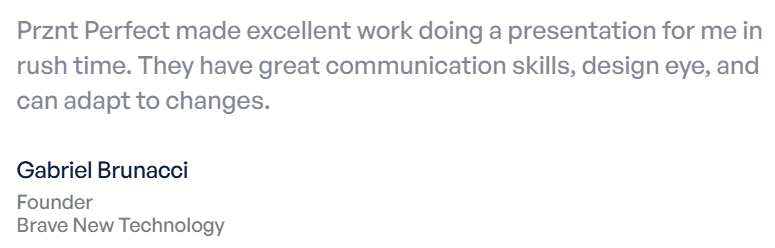
One of our recent projects was with Gabriel Brunacci, founder of Brave New Technology — a startup building in a fast-moving space. Gabriel came to us with a clear challenge: the deck had to be ready in just a few days.
The Power of Staying Adaptable
When timelines shrink, adaptability becomes everything. In this project, that meant:
• Picking the right slide formats fast, without overthinking
• Focusing on clarity over polish in early drafts
• Staying open to change and knowing when not to
Fast-turnaround projects are never about rushing. They are about removing friction.
We shared early layouts in Figma within 24 hours. Gabriel gave quick, actionable feedback. We iterated. And by the time the deadline arrived, we weren’t scrambling. We were shipping.
Great Decks Still Start With Good Questions
Speed doesn’t remove nuance. Even under pressure, we made time to ask:
• What’s the main thing this deck needs to land
• Who’s in the room
• What’s the follow-up conversation we want to spark
This is why the project worked. The right conversation upfront saves hours of second-guessing later.
Working on a short timeline?
We do this often, and we don’t panic.
Keep reading
→ Designing Presentations for Experts
→ Creating a Visual Language That Scales with Your Business
→ Inside Our Process: How We Work With Your Team



- This is some text inside of a div block.lay out the facts clearly and compellingly. Use data to establish the ground reality, but remember that facts alone are like the individual strands of a tapestry—necessary but not complete.lay out the facts clearly and compellingly. Use data to establish the ground reality, but remember that facts alone are like the individual strands of a tapestry—necessary but not complete.
- This is some text inside of a div block.lay out the facts clearly and compellingly. Use data to establish the ground reality, but remember that facts alone are like the individual strands of a tapestry—necessary but not complete.

.png)
