Investor Readiness Kit for Cybersecurity Startup Guide

Building a compelling investor readiness kit for cybersecurity startup fundraising requires more than technical specifications and revenue projections. Investors expect a comprehensive package that demonstrates both market opportunity and operational maturity, especially in a sector where trust, compliance, and credibility determine whether deals close. As the cybersecurity investment landscape becomes more sophisticated in 2026, founders must anticipate deeper due diligence, more rigorous technical validation, and heightened scrutiny around security posture, governance, and scalability. The difference between a term sheet and a pass often comes down to how thoroughly you document your business, how clearly you communicate complex risk, and how professionally you package your story.

Components of a Comprehensive Investor Package

The foundation of any investor readiness kit for cybersecurity startup fundraising includes several critical documents that collectively tell your business story. These materials must work together to address investor concerns around technology, market fit, team capability, and financial viability.

Core documentation includes:

  • Executive summary and one-page teaser
  • Full pitch deck with narrative arc
  • Financial model (three-statement, three-to-five-year projection)
  • Product roadmap and technical architecture
  • Go-to-market strategy and customer acquisition plan
  • Competitive landscape and differentiation analysis
  • Cap table and current ownership structure
  • Data room index and supporting appendices

Beyond these baseline materials, cybersecurity startups must prepare additional documentation that addresses sector-specific concerns. Investors scrutinize your own security posture before they trust you to secure others. This creates a unique paradox where your internal controls become a product demonstration.

Security and Compliance Documentation

When building an investor readiness kit for cybersecurity startup due diligence, expect investors to request evidence of your internal security program. This includes policies, procedures, certifications, and third-party assessments that validate your operational maturity. NIST's quick-start guides for CSF 2.0 provide a practical framework for structuring this documentation in a language investors and their technical advisors recognize.

Security program maturity framework
Document Type Purpose Investor Priority
Security policies Demonstrate governance and intent Medium
SOC 2 Type II report Validate operational controls High
Penetration test results Show proactive vulnerability management High
Incident response plan Prove preparedness for breach scenarios Medium-High
Compliance certifications De-risk customer acquisition and retention High
Third-party risk assessments Anticipate professional diligence findings Medium

Professional diligence firms like Assessed Intelligence routinely deliver deep technical assessments to investors, so anticipating their checklists accelerates your timeline. Building your investor readiness kit for cybersecurity startup diligence around these expectations reduces friction during the evaluation process.

Crafting a Pitch Deck That Communicates Complex Security Value

Cybersecurity products solve complex, technical problems for sophisticated buyers. Translating threat models, compliance frameworks, and security architectures into a compelling investor narrative requires careful visual storytelling and clarity. Investors often lack deep technical expertise in your specific domain, so your cybersecurity pitch deck must balance technical credibility with accessible narrative.

Effective cybersecurity pitch decks typically follow this structure:

  1. Problem statement – Quantify the risk, regulatory pressure, or market gap you address
  2. Solution overview – Explain your approach without diving into protocol-level detail
  3. Product demonstration – Show the interface, workflow, or customer experience
  4. Market opportunity – Size the TAM/SAM/SOM with credible data sources
  5. Business model – Clarify pricing, customer acquisition cost, and lifetime value
  6. Traction and validation – Highlight customers, revenue, partnerships, and growth metrics
  7. Competitive landscape – Position your differentiation honestly and specifically
  8. Team credentials – Emphasize domain expertise, prior exits, and complementary skills
  9. Financial projections – Present realistic growth assumptions with supporting logic
  10. Funding ask and use of funds – Specify the round size, valuation, and deployment plan

The visual design of your deck matters more than many founders realize. Investors review dozens of decks weekly, and clarity, professionalism, and visual hierarchy influence perception. Working with specialists in presentation design for technology companies ensures your complex concepts translate effectively without overwhelming your audience.

Translating Technical Architecture Into Investor Language

One of the most common mistakes in an investor readiness kit for cybersecurity startup fundraising is over-explaining technical architecture. Investors care about outcomes, scalability, and defensibility more than implementation details. Reserve deep technical specifications for appendices and data room materials.

Instead, focus your pitch deck on:

  • What problem the architecture solves for customers
  • Why your approach is faster, cheaper, or more effective than alternatives
  • How the technology creates competitive moats (patents, proprietary data, network effects)
  • Where the product roadmap leads over the next 12 to 24 months

Supporting technical documentation belongs in your data room, where technical diligence teams can review it on demand. This separation keeps your pitch focused and prevents narrative dilution.

Financial Modeling and Unit Economics for Cybersecurity Startups

Investors evaluate cybersecurity startups through the same financial lens they apply to other B2B SaaS businesses, with additional scrutiny around sales cycles, implementation timelines, and customer concentration risk. Your investor readiness kit for cybersecurity startup diligence must include a robust financial model that demonstrates understanding of your unit economics and capital efficiency.

Key metrics investors prioritize:

  • Customer Acquisition Cost (CAC) – Fully loaded cost to close a new customer
  • Lifetime Value (LTV) – Total gross margin a customer generates over their relationship
  • LTV:CAC ratio – Target 3:1 or better to demonstrate sustainable growth
    • Months to recover CAC – Ideal is under 12 months for SaaS businesses
  • Gross margin – Should exceed 70% for software-focused offerings
  • Net revenue retention – Measures expansion revenue and churn; target 110%+ for best-in-class
  • Magic number – Measures sales efficiency (net new ARR / sales and marketing spend)
  • Burn multiple – Net burn divided by net new ARR; lower is better

Your financial model should project monthly or quarterly performance across a three-to-five-year horizon, with clear assumptions documented for revenue growth, headcount expansion, and operating expenses. Investors will stress-test your assumptions, so build in scenario analysis that shows upside, base, and downside cases.

Financial model structure for cybersecurity SaaS

Given recent market dynamics, KPMG's Pulse of Fintech H2 2025 report provides valuable benchmarking data on sector investment trends and valuation multiples that can inform your projections and fundraising narrative.

Demonstrating Market Validation and Customer Traction

For cybersecurity startups, customer traction carries disproportionate weight in investor evaluation. Security products face long sales cycles, rigorous procurement processes, and high switching costs. Demonstrating that customers actually buy, deploy, and renew your solution de-risks the investment significantly.

Your investor readiness kit for cybersecurity startup diligence should showcase:

  • Signed contracts and revenue – Actual customers paying actual money
  • Customer testimonials and case studies – Quantified outcomes and ROI validation
  • Logos and verticals – Diversity across industries and company sizes
  • Pipeline metrics – Qualified opportunities, conversion rates, and average deal size
  • Product-market fit signals – Low churn, high NPS, organic referrals, and expansion revenue

When presenting traction, specificity matters. Instead of claiming "strong customer interest," quantify it: "47 qualified opportunities representing $2.3M in ARR, 12 in active trials, 8 in contract negotiation." This level of detail builds credibility and allows investors to model forward momentum.

Building a Repeatable Go-to-Market Motion

Investors want to see evidence that your early traction can scale through a repeatable, predictable sales process. Your investor readiness kit for cybersecurity startup materials should document your customer acquisition playbook, including lead generation channels, sales process stages, typical decision-maker personas, and average sales cycle length.

Startups often struggle to articulate their go-to-market strategy beyond "outbound sales and content marketing." More sophisticated approaches segment by customer size, vertical, or use case and deploy tailored messaging and sales motions for each segment. Demonstrating this level of strategic thinking differentiates your fundraising narrative.

Team Composition and Advisory Board Credibility

Cybersecurity investors invest in teams as much as technologies. The sector demands deep technical expertise, domain credibility, and the ability to navigate complex enterprise sales. Your investor readiness kit for cybersecurity startup fundraising must highlight why your team is uniquely positioned to execute.

Investors evaluate:

  • Founder backgrounds – Prior exits, domain expertise, complementary skill sets
  • Technical leadership – Engineering talent with relevant security credentials
  • Sales and GTM experience – Track record closing enterprise security deals
  • Advisory board – Industry leaders who open doors and validate your approach
  • Culture and retention – Low employee turnover and strong Glassdoor reviews

If your team lacks enterprise sales experience or security domain credibility, acknowledge it and explain how you're addressing the gap through advisors, board members, or key hires. Investors appreciate self-awareness and proactive risk mitigation more than pretending gaps don't exist.

Building relationships with recognized advisors in cybersecurity, compliance, or your target verticals adds significant credibility. Advisory board members should actively contribute through introductions, strategic guidance, or technical validation rather than serving as resume decoration.

Preparing Your Data Room for Technical Due Diligence

Once you generate serious investor interest, expect requests for deeper documentation through a formal data room. Your investor readiness kit for cybersecurity startup diligence should anticipate these requests and organize materials for efficient review.

A well-structured data room includes:

  • Corporate and legal documents – Certificate of incorporation, bylaws, board minutes, cap table
  • Contracts and agreements – Customer contracts, partner agreements, vendor relationships
  • Financial records – Historical financials, tax returns, detailed financial model
  • Product and technical documentation – Architecture diagrams, security policies, roadmap
  • Intellectual property – Patents, trademarks, code repositories, licensing agreements
  • HR and employment – Org chart, key employee agreements, equity grants, employment policies
  • Customer and sales data – CRM exports, pipeline reports, customer references
  • Security and compliance – SOC 2 reports, penetration test results, incident response plans

The Oxford Infosec tech due-diligence checklist provides a comprehensive view of what investors and their technical advisors typically request during deep diligence, allowing you to prepare documentation proactively.

Organizing your data room with clear folder structures, indexed documents, and summary overviews demonstrates professionalism and accelerates the diligence process. Investors often evaluate dozens of opportunities simultaneously, so reducing friction improves your competitive position.

Aligning Security Posture With Investor Expectations

The most unique aspect of an investor readiness kit for cybersecurity startup due diligence is that your internal security program becomes part of your product validation. Investors expect you to practice what you preach. If you sell threat detection but haven't implemented basic logging and monitoring internally, it raises red flags.

At minimum, investors expect to see:

  • Documented security policies covering access control, data handling, incident response
  • Implemented technical controls aligned to industry frameworks like NIST or CIS
  • Regular security testing including vulnerability scans and penetration tests
  • Incident response plan with defined roles, escalation paths, and communication protocols
  • Compliance certifications relevant to your target market (SOC 2, ISO 27001, FedRAMP)
  • Employee security training demonstrating organizational security culture

SANS' startup security program guide offers practical frameworks for building investor-ready security programs without enterprise-scale resources. For startups with limited budgets, CISA resources for small and medium businesses provide no-cost tools and playbooks that demonstrate operational maturity.

Building and documenting an incident response capability is particularly important. SANS guidance on building incident-response playbooks helps you move beyond policy statements to operational readiness, which investors and their technical advisors scrutinize during diligence.

Storytelling and Narrative Flow Across Your Materials

While technical documentation and financial models provide the substance of your investor readiness kit for cybersecurity startup fundraising, narrative flow determines whether investors engage emotionally with your vision. Every component of your materials should reinforce a consistent story about the problem you solve, why now is the right time, and why your team is uniquely positioned to win.

Effective narrative elements include:

  • A clear enemy or antagonist – Regulatory pressure, threat actors, legacy solutions
  • Quantified pain points – Specific costs, risks, or inefficiencies your solution addresses
  • Proof points that build momentum – Customer wins, product milestones, market validation
  • A defensible moat – Technology, data, partnerships, or network effects that sustain advantage
  • An ambitious but credible vision – Where the company goes beyond the current product

Too many cybersecurity pitches focus exclusively on technical superiority without connecting features to customer outcomes or market dynamics. Working with professionals who specialize in visual storytelling for financial and tech businesses helps translate complex security concepts into narratives that resonate with investors who may lack deep technical backgrounds.

The narrative should remain consistent across your pitch deck, executive summary, data room materials, and in-person presentations. Inconsistencies raise questions about strategic clarity and execution capability.

Adapting Your Materials for Different Investor Types

Not all investors evaluate cybersecurity startups through the same lens. Your investor readiness kit for cybersecurity startup fundraising should flex based on whether you're pitching venture capital firms, strategic corporate investors, or angel syndicates.

Investor Type Primary Focus Customization Strategy
Venture capital Scalability, market size, team Emphasize TAM, growth metrics, and venture outcomes
Corporate strategic Product fit, partnership potential Highlight integration opportunities and customer overlap
Angel investors Team, vision, early validation Focus on founder story and initial traction
Growth equity Unit economics, profitability path Detail CAC recovery, retention, and margin expansion

Strategic investors from large enterprises may prioritize how your technology complements their existing offerings or addresses their customer pain points. Venture firms focus on market size, defensibility, and exit potential. Tailoring your emphasis without changing core materials ensures consistency while addressing specific investor priorities.

Participating in industry events like the TEAMZ Summit, where Web3 and AI innovators connect with global investors, can provide valuable networking opportunities and insight into what different investor segments prioritize in early-stage technology companies.

Governance and Investor Communication Infrastructure

Beyond the initial fundraising materials, investors evaluate whether you have the infrastructure to govern effectively and communicate transparently post-investment. Your investor readiness kit for cybersecurity startup diligence should demonstrate that you've thought through board governance, reporting cadence, and stakeholder communication.

Key governance elements include:

  • Board meeting cadence and structure – Typically monthly or quarterly with clear agendas
  • Investor reporting templates – Standardized metrics, narrative updates, and asks
  • Communication tools and access – Investor portals, cap table management, document sharing
  • Decision-making frameworks – How major strategic decisions get made and approved
  • Transparency and escalation protocols – How you communicate challenges and course corrections

Demonstrating governance maturity early signals that you understand investor expectations and can operate professionally as fiduciary responsibilities increase. This becomes particularly important for cybersecurity startups handling sensitive customer data or operating in regulated environments.

Resources like the GOV.UK investor readiness essentials provide concise guidance on investor-pack structure and governance expectations applicable across startup stages and geographies.

Measuring and Improving Your Pitch Performance

Building an investor readiness kit for cybersecurity startup fundraising is not a one-time exercise. Successful founders treat fundraising as a continuous learning process, tracking which materials resonate, what questions arise repeatedly, and where investors disengage.

After each investor meeting, document:

  • Questions asked – Patterns reveal gaps in your materials or narrative
  • Objections raised – Common concerns need proactive addressing in your deck
  • Sections that generated excitement – Double down on what works
  • Requested follow-up materials – Pre-prepare frequently requested documents
  • Decision timeline and next steps – Track investor velocity and conversion rates

This feedback loop allows you to refine your pitch deck, strengthen your financial model, and improve your delivery over successive meetings. Top-performing founders often go through 10 to 15 iterations of their pitch deck based on real investor feedback before achieving consistent conversion.

Leveraging services from firms like Accountability Now, which specializes in executive coaching and accountability for business owners, can help founders maintain discipline and execution momentum throughout the fundraising process.

Investor pitch iteration cycle

Market Positioning and Competitive Differentiation

Investors consistently ask how your cybersecurity solution differs from existing alternatives and why customers will choose you over incumbents or competitive startups. Your investor readiness kit for cybersecurity startup materials must address competitive positioning with honesty and specificity.

Avoid common positioning mistakes:

  • Claiming "no competitors" (signals naivety or narrow market research)
  • Only comparing to legacy solutions (ignores emerging startup threats)
  • Overemphasizing features without connecting to customer outcomes
  • Using vague differentiation like "better technology" or "superior UX"

Instead, position your solution through the lens of customer decision criteria. If customers choose based on deployment speed, prove you're fastest. If compliance coverage matters most, detail your certification roadmap. If total cost of ownership drives decisions, quantify your cost advantage with customer data.

Effective competitive analysis acknowledges where incumbents or competitors excel and explicitly explains why your approach wins despite those strengths. This demonstrates strategic thinking and realistic market understanding.

Preparing for Live Pitch Presentations and Q&A

While your written materials form the foundation of your investor readiness kit for cybersecurity startup fundraising, live presentations and Q&A sessions often determine whether investors move forward. Preparation, practice, and polish separate funded startups from those that stall.

Live pitch best practices:

  • Rehearse extensively – Practice until delivery feels natural and timing is internalized
  • Anticipate questions – Prepare crisp, confident answers to common investor questions
  • Bring domain experts – Include your CTO or technical lead for architecture questions
  • Tell stories – Weave customer anecdotes and use cases into your presentation
  • Watch the clock – Respect time limits and leave room for dialogue
  • Read the room – Adapt pacing and detail based on investor engagement and questions

Remember that investors evaluate team dynamics and communication skills during live presentations. How you handle tough questions, acknowledge gaps, or pivot when challenged reveals as much as your slides. Coaching from platforms like Noomii, which offers executive and leadership development services, can help founders refine their presentation skills and communication under pressure.

For financial advisors and professionals looking to improve client communication and education, platforms like WebPrez offer structured frameworks for turning complex concepts into clear, repeatable conversations-a skill equally valuable in investor presentations.

Regulatory Awareness and Compliance Roadmap

Cybersecurity startups often operate in regulated environments or sell to customers facing strict compliance requirements. Investors evaluate whether you understand the regulatory landscape and have a credible plan to achieve necessary certifications without derailing product development.

Your investor readiness kit for cybersecurity startup diligence should address:

  • Current compliance status – Certifications achieved, audits completed, frameworks adopted
  • Regulatory requirements – Industry-specific mandates affecting your target customers
  • Certification roadmap – Timeline and budget for SOC 2, ISO 27001, FedRAMP, or industry-specific standards
  • Data privacy and handling – GDPR, CCPA, and international data transfer mechanisms
  • Insurance coverage – Cyber liability, E&O, and other risk transfer mechanisms

Demonstrating regulatory awareness and proactive compliance planning de-risks your investment thesis and accelerates customer acquisition in regulated verticals. The NIST small-business quick-start guide provides actionable mapping of cybersecurity activities tailored to resource-constrained startups.

Current Market Context and Investment Trends

Understanding where cybersecurity investment stands in 2026 helps frame your fundraising narrative and set realistic expectations. Baker Tilly's 2025 cybersecurity investment trends summary highlights what investors currently prioritize, which segments attract capital, and how valuation multiples have evolved.

Recent trends shaping investor appetite include:

  • AI-powered security solutions attracting significant attention and capital
  • Consolidation pressure as enterprises reduce vendor count and seek platform solutions
  • Increased focus on measurable ROI and rapid time-to-value
  • Regulatory tailwinds from evolving compliance mandates and data privacy laws
  • Higher bars for profitability as growth-at-all-costs strategies fade

Positioning your startup within these macro trends strengthens your narrative and demonstrates market awareness. If you're building in a hot category, explain how you'll compete for talent and customers in a crowded space. If you're addressing an emerging need, articulate why timing favors your solution now.


Building a comprehensive investor readiness kit for cybersecurity startup fundraising requires balancing technical depth with accessible storytelling, financial rigor with ambitious vision, and operational maturity with startup agility. Successful founders anticipate investor questions, organize materials for efficient diligence, and continuously refine their narrative based on real feedback. When your complex security concepts need translation into compelling visual narratives that resonate with investors, Prznt Perfect specializes in transforming technical complexity into clear, actionable presentations that help cybersecurity and fintech startups close funding rounds and communicate value effectively.

We offer free 30-min consultation on the presentation design audit
and hiring the right visual 
comms professional, let’s talk!
Shedule a call
Shedule a call
"I understand" goes a step further into the cognitive dance of persuasion. It's where the audience begins to see the connections between the facts, to grasp the nuances of the problem and the elegance of the solution.
  • This is some text inside of a div block.
    lay out the facts clearly and compellingly. Use data to establish the ground reality, but remember that facts alone are like the individual strands of a tapestry—necessary but not complete.
    lay out the facts clearly and compellingly. Use data to establish the ground reality, but remember that facts alone are like the individual strands of a tapestry—necessary but not complete.
  • This is some text inside of a div block.
    lay out the facts clearly and compellingly. Use data to establish the ground reality, but remember that facts alone are like the individual strands of a tapestry—necessary but not complete.

We offer free 30-min consultation on the presentation design audit

and hiring the right visual 
comms professional, let’s talk!

Shedule a call

"I understand" goes a step further into the cognitive dance of persuasion. It's where the audience begins to see the connections between the facts, to grasp the nuances of the problem and the elegance of the solution.

  • - 1 -
    Consistency at Scale:

    Biotech Market Trends 2024: Tailoring Your Pitch Deck to Current Industry Dynamics.

  • - 2 -
    Efficiency and Speed:

    The traditional process of manually updating presentations is not only slow but also prone to bottlenecks, especially when dealing with large volumes of slides. Automation dramatically accelerates this process, enabling designers to apply changes across hundreds of slides in the time it would take to manually update a single one. This efficiency is a game-changer for agencies working under tight deadlines or managing multiple projects simultaneously.

  • - 3 -
    Enhanced Creativity:

    With the burden of manual updates lifted, designers can allocate more time and energy to the creative aspects of presentation design. This freedom allows for deeper exploration of innovative design concepts, experimentation with new visual storytelling techniques, and the development of more engaging and interactive presentations. Automation doesn't stifle creativity; it amplifies it, enabling designers to push the boundaries of what's possible in corporate presentation design.

  • - 4 -
    Error Reduction:

    Manual updates are inherently prone to inconsistencies and mistakes, from misaligned logos to incorrect font sizes. These errors can detract from the professionalism of a presentation and, by extension, the corporate image. Automation minimizes these risks by ensuring that updates are applied uniformly and accurately across all slides, enhancing the overall quality and integrity of the presentation.

  • - 5 -
    Cost-Effectiveness:

    The time savings afforded by automation directly translate to cost savings for both the design agency and its clients. By reducing the hours spent on manual updates, agencies can optimize their workflows and resources, allowing them to take on more projects without compromising on quality. This efficiency can also make high-quality presentation design services more affordable and accessible to a broader range of businesses.

Investor Readiness Kit for Cybersecurity Startup Guide

Build a winning investor readiness kit for cybersecurity startup fundraising. Learn what to include, how to package it, and how to stand out.

Building a compelling investor readiness kit for cybersecurity startup fundraising requires more than technical specifications and revenue projections. Investors expect a comprehensive package that demonstrates both market opportunity and operational maturity, especially in a sector where trust, compliance, and credibility determine whether deals close. As the cybersecurity investment landscape becomes more sophisticated in 2026, founders must anticipate deeper due diligence, more rigorous technical validation, and heightened scrutiny around security posture, governance, and scalability. The difference between a term sheet and a pass often comes down to how thoroughly you document your business, how clearly you communicate complex risk, and how professionally you package your story.

Components of a Comprehensive Investor Package

The foundation of any investor readiness kit for cybersecurity startup fundraising includes several critical documents that collectively tell your business story. These materials must work together to address investor concerns around technology, market fit, team capability, and financial viability.

Core documentation includes:

  • Executive summary and one-page teaser
  • Full pitch deck with narrative arc
  • Financial model (three-statement, three-to-five-year projection)
  • Product roadmap and technical architecture
  • Go-to-market strategy and customer acquisition plan
  • Competitive landscape and differentiation analysis
  • Cap table and current ownership structure
  • Data room index and supporting appendices

Beyond these baseline materials, cybersecurity startups must prepare additional documentation that addresses sector-specific concerns. Investors scrutinize your own security posture before they trust you to secure others. This creates a unique paradox where your internal controls become a product demonstration.

Security and Compliance Documentation

When building an investor readiness kit for cybersecurity startup due diligence, expect investors to request evidence of your internal security program. This includes policies, procedures, certifications, and third-party assessments that validate your operational maturity. NIST's quick-start guides for CSF 2.0 provide a practical framework for structuring this documentation in a language investors and their technical advisors recognize.

Security program maturity framework
Document Type Purpose Investor Priority
Security policies Demonstrate governance and intent Medium
SOC 2 Type II report Validate operational controls High
Penetration test results Show proactive vulnerability management High
Incident response plan Prove preparedness for breach scenarios Medium-High
Compliance certifications De-risk customer acquisition and retention High
Third-party risk assessments Anticipate professional diligence findings Medium

Professional diligence firms like Assessed Intelligence routinely deliver deep technical assessments to investors, so anticipating their checklists accelerates your timeline. Building your investor readiness kit for cybersecurity startup diligence around these expectations reduces friction during the evaluation process.

Crafting a Pitch Deck That Communicates Complex Security Value

Cybersecurity products solve complex, technical problems for sophisticated buyers. Translating threat models, compliance frameworks, and security architectures into a compelling investor narrative requires careful visual storytelling and clarity. Investors often lack deep technical expertise in your specific domain, so your cybersecurity pitch deck must balance technical credibility with accessible narrative.

Effective cybersecurity pitch decks typically follow this structure:

  1. Problem statement – Quantify the risk, regulatory pressure, or market gap you address
  2. Solution overview – Explain your approach without diving into protocol-level detail
  3. Product demonstration – Show the interface, workflow, or customer experience
  4. Market opportunity – Size the TAM/SAM/SOM with credible data sources
  5. Business model – Clarify pricing, customer acquisition cost, and lifetime value
  6. Traction and validation – Highlight customers, revenue, partnerships, and growth metrics
  7. Competitive landscape – Position your differentiation honestly and specifically
  8. Team credentials – Emphasize domain expertise, prior exits, and complementary skills
  9. Financial projections – Present realistic growth assumptions with supporting logic
  10. Funding ask and use of funds – Specify the round size, valuation, and deployment plan

The visual design of your deck matters more than many founders realize. Investors review dozens of decks weekly, and clarity, professionalism, and visual hierarchy influence perception. Working with specialists in presentation design for technology companies ensures your complex concepts translate effectively without overwhelming your audience.

Translating Technical Architecture Into Investor Language

One of the most common mistakes in an investor readiness kit for cybersecurity startup fundraising is over-explaining technical architecture. Investors care about outcomes, scalability, and defensibility more than implementation details. Reserve deep technical specifications for appendices and data room materials.

Instead, focus your pitch deck on:

  • What problem the architecture solves for customers
  • Why your approach is faster, cheaper, or more effective than alternatives
  • How the technology creates competitive moats (patents, proprietary data, network effects)
  • Where the product roadmap leads over the next 12 to 24 months

Supporting technical documentation belongs in your data room, where technical diligence teams can review it on demand. This separation keeps your pitch focused and prevents narrative dilution.

Financial Modeling and Unit Economics for Cybersecurity Startups

Investors evaluate cybersecurity startups through the same financial lens they apply to other B2B SaaS businesses, with additional scrutiny around sales cycles, implementation timelines, and customer concentration risk. Your investor readiness kit for cybersecurity startup diligence must include a robust financial model that demonstrates understanding of your unit economics and capital efficiency.

Key metrics investors prioritize:

  • Customer Acquisition Cost (CAC) – Fully loaded cost to close a new customer
  • Lifetime Value (LTV) – Total gross margin a customer generates over their relationship
  • LTV:CAC ratio – Target 3:1 or better to demonstrate sustainable growth
    • Months to recover CAC – Ideal is under 12 months for SaaS businesses
  • Gross margin – Should exceed 70% for software-focused offerings
  • Net revenue retention – Measures expansion revenue and churn; target 110%+ for best-in-class
  • Magic number – Measures sales efficiency (net new ARR / sales and marketing spend)
  • Burn multiple – Net burn divided by net new ARR; lower is better

Your financial model should project monthly or quarterly performance across a three-to-five-year horizon, with clear assumptions documented for revenue growth, headcount expansion, and operating expenses. Investors will stress-test your assumptions, so build in scenario analysis that shows upside, base, and downside cases.
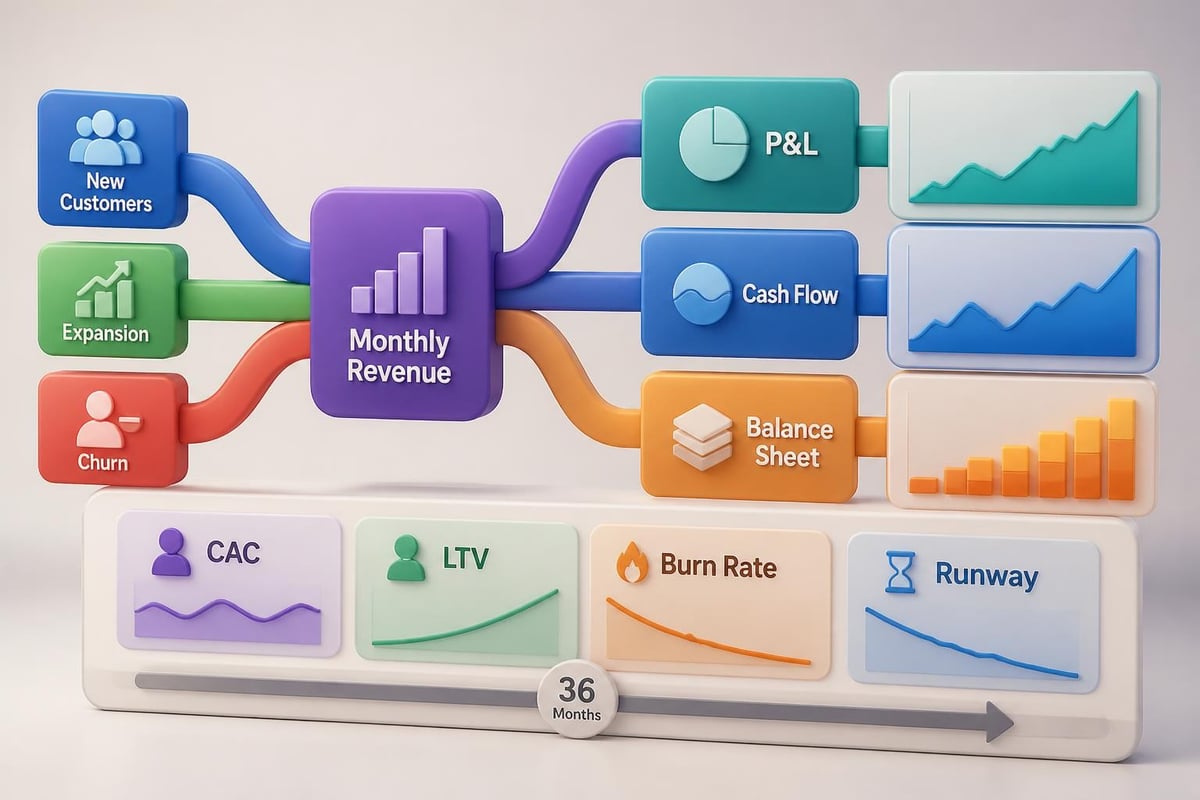
Financial model structure for cybersecurity SaaS

Given recent market dynamics, KPMG's Pulse of Fintech H2 2025 report provides valuable benchmarking data on sector investment trends and valuation multiples that can inform your projections and fundraising narrative.

Demonstrating Market Validation and Customer Traction

For cybersecurity startups, customer traction carries disproportionate weight in investor evaluation. Security products face long sales cycles, rigorous procurement processes, and high switching costs. Demonstrating that customers actually buy, deploy, and renew your solution de-risks the investment significantly.

Your investor readiness kit for cybersecurity startup diligence should showcase:

  • Signed contracts and revenue – Actual customers paying actual money
  • Customer testimonials and case studies – Quantified outcomes and ROI validation
  • Logos and verticals – Diversity across industries and company sizes
  • Pipeline metrics – Qualified opportunities, conversion rates, and average deal size
  • Product-market fit signals – Low churn, high NPS, organic referrals, and expansion revenue

When presenting traction, specificity matters. Instead of claiming "strong customer interest," quantify it: "47 qualified opportunities representing $2.3M in ARR, 12 in active trials, 8 in contract negotiation." This level of detail builds credibility and allows investors to model forward momentum.

Building a Repeatable Go-to-Market Motion

Investors want to see evidence that your early traction can scale through a repeatable, predictable sales process. Your investor readiness kit for cybersecurity startup materials should document your customer acquisition playbook, including lead generation channels, sales process stages, typical decision-maker personas, and average sales cycle length.

Startups often struggle to articulate their go-to-market strategy beyond "outbound sales and content marketing." More sophisticated approaches segment by customer size, vertical, or use case and deploy tailored messaging and sales motions for each segment. Demonstrating this level of strategic thinking differentiates your fundraising narrative.

Team Composition and Advisory Board Credibility

Cybersecurity investors invest in teams as much as technologies. The sector demands deep technical expertise, domain credibility, and the ability to navigate complex enterprise sales. Your investor readiness kit for cybersecurity startup fundraising must highlight why your team is uniquely positioned to execute.

Investors evaluate:

  • Founder backgrounds – Prior exits, domain expertise, complementary skill sets
  • Technical leadership – Engineering talent with relevant security credentials
  • Sales and GTM experience – Track record closing enterprise security deals
  • Advisory board – Industry leaders who open doors and validate your approach
  • Culture and retention – Low employee turnover and strong Glassdoor reviews

If your team lacks enterprise sales experience or security domain credibility, acknowledge it and explain how you're addressing the gap through advisors, board members, or key hires. Investors appreciate self-awareness and proactive risk mitigation more than pretending gaps don't exist.

Building relationships with recognized advisors in cybersecurity, compliance, or your target verticals adds significant credibility. Advisory board members should actively contribute through introductions, strategic guidance, or technical validation rather than serving as resume decoration.

Preparing Your Data Room for Technical Due Diligence

Once you generate serious investor interest, expect requests for deeper documentation through a formal data room. Your investor readiness kit for cybersecurity startup diligence should anticipate these requests and organize materials for efficient review.

A well-structured data room includes:

  • Corporate and legal documents – Certificate of incorporation, bylaws, board minutes, cap table
  • Contracts and agreements – Customer contracts, partner agreements, vendor relationships
  • Financial records – Historical financials, tax returns, detailed financial model
  • Product and technical documentation – Architecture diagrams, security policies, roadmap
  • Intellectual property – Patents, trademarks, code repositories, licensing agreements
  • HR and employment – Org chart, key employee agreements, equity grants, employment policies
  • Customer and sales data – CRM exports, pipeline reports, customer references
  • Security and compliance – SOC 2 reports, penetration test results, incident response plans

The Oxford Infosec tech due-diligence checklist provides a comprehensive view of what investors and their technical advisors typically request during deep diligence, allowing you to prepare documentation proactively.

Organizing your data room with clear folder structures, indexed documents, and summary overviews demonstrates professionalism and accelerates the diligence process. Investors often evaluate dozens of opportunities simultaneously, so reducing friction improves your competitive position.

Aligning Security Posture With Investor Expectations

The most unique aspect of an investor readiness kit for cybersecurity startup due diligence is that your internal security program becomes part of your product validation. Investors expect you to practice what you preach. If you sell threat detection but haven't implemented basic logging and monitoring internally, it raises red flags.

At minimum, investors expect to see:

  • Documented security policies covering access control, data handling, incident response
  • Implemented technical controls aligned to industry frameworks like NIST or CIS
  • Regular security testing including vulnerability scans and penetration tests
  • Incident response plan with defined roles, escalation paths, and communication protocols
  • Compliance certifications relevant to your target market (SOC 2, ISO 27001, FedRAMP)
  • Employee security training demonstrating organizational security culture

SANS' startup security program guide offers practical frameworks for building investor-ready security programs without enterprise-scale resources. For startups with limited budgets, CISA resources for small and medium businesses provide no-cost tools and playbooks that demonstrate operational maturity.

Building and documenting an incident response capability is particularly important. SANS guidance on building incident-response playbooks helps you move beyond policy statements to operational readiness, which investors and their technical advisors scrutinize during diligence.

Storytelling and Narrative Flow Across Your Materials

While technical documentation and financial models provide the substance of your investor readiness kit for cybersecurity startup fundraising, narrative flow determines whether investors engage emotionally with your vision. Every component of your materials should reinforce a consistent story about the problem you solve, why now is the right time, and why your team is uniquely positioned to win.

Effective narrative elements include:

  • A clear enemy or antagonist – Regulatory pressure, threat actors, legacy solutions
  • Quantified pain points – Specific costs, risks, or inefficiencies your solution addresses
  • Proof points that build momentum – Customer wins, product milestones, market validation
  • A defensible moat – Technology, data, partnerships, or network effects that sustain advantage
  • An ambitious but credible vision – Where the company goes beyond the current product

Too many cybersecurity pitches focus exclusively on technical superiority without connecting features to customer outcomes or market dynamics. Working with professionals who specialize in visual storytelling for financial and tech businesses helps translate complex security concepts into narratives that resonate with investors who may lack deep technical backgrounds.

The narrative should remain consistent across your pitch deck, executive summary, data room materials, and in-person presentations. Inconsistencies raise questions about strategic clarity and execution capability.

Adapting Your Materials for Different Investor Types

Not all investors evaluate cybersecurity startups through the same lens. Your investor readiness kit for cybersecurity startup fundraising should flex based on whether you're pitching venture capital firms, strategic corporate investors, or angel syndicates.

Investor Type Primary Focus Customization Strategy
Venture capital Scalability, market size, team Emphasize TAM, growth metrics, and venture outcomes
Corporate strategic Product fit, partnership potential Highlight integration opportunities and customer overlap
Angel investors Team, vision, early validation Focus on founder story and initial traction
Growth equity Unit economics, profitability path Detail CAC recovery, retention, and margin expansion

Strategic investors from large enterprises may prioritize how your technology complements their existing offerings or addresses their customer pain points. Venture firms focus on market size, defensibility, and exit potential. Tailoring your emphasis without changing core materials ensures consistency while addressing specific investor priorities.

Participating in industry events like the TEAMZ Summit, where Web3 and AI innovators connect with global investors, can provide valuable networking opportunities and insight into what different investor segments prioritize in early-stage technology companies.

Governance and Investor Communication Infrastructure

Beyond the initial fundraising materials, investors evaluate whether you have the infrastructure to govern effectively and communicate transparently post-investment. Your investor readiness kit for cybersecurity startup diligence should demonstrate that you've thought through board governance, reporting cadence, and stakeholder communication.

Key governance elements include:

  • Board meeting cadence and structure – Typically monthly or quarterly with clear agendas
  • Investor reporting templates – Standardized metrics, narrative updates, and asks
  • Communication tools and access – Investor portals, cap table management, document sharing
  • Decision-making frameworks – How major strategic decisions get made and approved
  • Transparency and escalation protocols – How you communicate challenges and course corrections

Demonstrating governance maturity early signals that you understand investor expectations and can operate professionally as fiduciary responsibilities increase. This becomes particularly important for cybersecurity startups handling sensitive customer data or operating in regulated environments.

Resources like the GOV.UK investor readiness essentials provide concise guidance on investor-pack structure and governance expectations applicable across startup stages and geographies.

Measuring and Improving Your Pitch Performance

Building an investor readiness kit for cybersecurity startup fundraising is not a one-time exercise. Successful founders treat fundraising as a continuous learning process, tracking which materials resonate, what questions arise repeatedly, and where investors disengage.

After each investor meeting, document:

  • Questions asked – Patterns reveal gaps in your materials or narrative
  • Objections raised – Common concerns need proactive addressing in your deck
  • Sections that generated excitement – Double down on what works
  • Requested follow-up materials – Pre-prepare frequently requested documents
  • Decision timeline and next steps – Track investor velocity and conversion rates

This feedback loop allows you to refine your pitch deck, strengthen your financial model, and improve your delivery over successive meetings. Top-performing founders often go through 10 to 15 iterations of their pitch deck based on real investor feedback before achieving consistent conversion.

Leveraging services from firms like Accountability Now, which specializes in executive coaching and accountability for business owners, can help founders maintain discipline and execution momentum throughout the fundraising process.

Investor pitch iteration cycle

Market Positioning and Competitive Differentiation

Investors consistently ask how your cybersecurity solution differs from existing alternatives and why customers will choose you over incumbents or competitive startups. Your investor readiness kit for cybersecurity startup materials must address competitive positioning with honesty and specificity.

Avoid common positioning mistakes:

  • Claiming "no competitors" (signals naivety or narrow market research)
  • Only comparing to legacy solutions (ignores emerging startup threats)
  • Overemphasizing features without connecting to customer outcomes
  • Using vague differentiation like "better technology" or "superior UX"

Instead, position your solution through the lens of customer decision criteria. If customers choose based on deployment speed, prove you're fastest. If compliance coverage matters most, detail your certification roadmap. If total cost of ownership drives decisions, quantify your cost advantage with customer data.

Effective competitive analysis acknowledges where incumbents or competitors excel and explicitly explains why your approach wins despite those strengths. This demonstrates strategic thinking and realistic market understanding.

Preparing for Live Pitch Presentations and Q&A

While your written materials form the foundation of your investor readiness kit for cybersecurity startup fundraising, live presentations and Q&A sessions often determine whether investors move forward. Preparation, practice, and polish separate funded startups from those that stall.

Live pitch best practices:

  • Rehearse extensively – Practice until delivery feels natural and timing is internalized
  • Anticipate questions – Prepare crisp, confident answers to common investor questions
  • Bring domain experts – Include your CTO or technical lead for architecture questions
  • Tell stories – Weave customer anecdotes and use cases into your presentation
  • Watch the clock – Respect time limits and leave room for dialogue
  • Read the room – Adapt pacing and detail based on investor engagement and questions

Remember that investors evaluate team dynamics and communication skills during live presentations. How you handle tough questions, acknowledge gaps, or pivot when challenged reveals as much as your slides. Coaching from platforms like Noomii, which offers executive and leadership development services, can help founders refine their presentation skills and communication under pressure.

For financial advisors and professionals looking to improve client communication and education, platforms like WebPrez offer structured frameworks for turning complex concepts into clear, repeatable conversations-a skill equally valuable in investor presentations.

Regulatory Awareness and Compliance Roadmap

Cybersecurity startups often operate in regulated environments or sell to customers facing strict compliance requirements. Investors evaluate whether you understand the regulatory landscape and have a credible plan to achieve necessary certifications without derailing product development.

Your investor readiness kit for cybersecurity startup diligence should address:

  • Current compliance status – Certifications achieved, audits completed, frameworks adopted
  • Regulatory requirements – Industry-specific mandates affecting your target customers
  • Certification roadmap – Timeline and budget for SOC 2, ISO 27001, FedRAMP, or industry-specific standards
  • Data privacy and handling – GDPR, CCPA, and international data transfer mechanisms
  • Insurance coverage – Cyber liability, E&O, and other risk transfer mechanisms

Demonstrating regulatory awareness and proactive compliance planning de-risks your investment thesis and accelerates customer acquisition in regulated verticals. The NIST small-business quick-start guide provides actionable mapping of cybersecurity activities tailored to resource-constrained startups.

Current Market Context and Investment Trends

Understanding where cybersecurity investment stands in 2026 helps frame your fundraising narrative and set realistic expectations. Baker Tilly's 2025 cybersecurity investment trends summary highlights what investors currently prioritize, which segments attract capital, and how valuation multiples have evolved.

Recent trends shaping investor appetite include:

  • AI-powered security solutions attracting significant attention and capital
  • Consolidation pressure as enterprises reduce vendor count and seek platform solutions
  • Increased focus on measurable ROI and rapid time-to-value
  • Regulatory tailwinds from evolving compliance mandates and data privacy laws
  • Higher bars for profitability as growth-at-all-costs strategies fade

Positioning your startup within these macro trends strengthens your narrative and demonstrates market awareness. If you're building in a hot category, explain how you'll compete for talent and customers in a crowded space. If you're addressing an emerging need, articulate why timing favors your solution now.


Building a comprehensive investor readiness kit for cybersecurity startup fundraising requires balancing technical depth with accessible storytelling, financial rigor with ambitious vision, and operational maturity with startup agility. Successful founders anticipate investor questions, organize materials for efficient diligence, and continuously refine their narrative based on real feedback. When your complex security concepts need translation into compelling visual narratives that resonate with investors, Prznt Perfect specializes in transforming technical complexity into clear, actionable presentations that help cybersecurity and fintech startups close funding rounds and communicate value effectively.


News & Updates...

Learn how zero trust product one-pager design services transform complex cybersecurity concepts into compelling visual assets for stakeholders.

Master presentation design for security companies. Learn to transform complex cybersecurity data into compelling visual narratives.