Fractional CMO for Hire: Strategic Marketing Leadership

The marketing landscape for financial and tech businesses has fundamentally shifted. Companies need sophisticated marketing strategies to differentiate themselves in crowded markets, yet many organizations cannot justify the expense of a full-time chief marketing officer. This is where the concept of a fractional CMO for hire emerges as a transformative solution, providing executive-level marketing expertise on a flexible, part-time basis. For businesses focused on complex services like presentation design, strategic marketing leadership becomes essential to communicate value propositions effectively and capture high-value clients in competitive sectors.

Understanding the Fractional CMO Model

A fractional CMO for hire operates as a senior marketing executive who works with your organization on a part-time or project basis, delivering the same strategic expertise as a full-time CMO but at a fraction of the cost. This arrangement allows businesses to access C-suite marketing talent without the financial commitment of a six-figure salary, benefits package, and long-term employment contract.

The fractional CMO model has gained significant traction among growing companies, particularly in specialized sectors where marketing sophistication directly impacts revenue. These executives typically manage multiple clients simultaneously, bringing cross-industry insights and proven frameworks to each engagement.

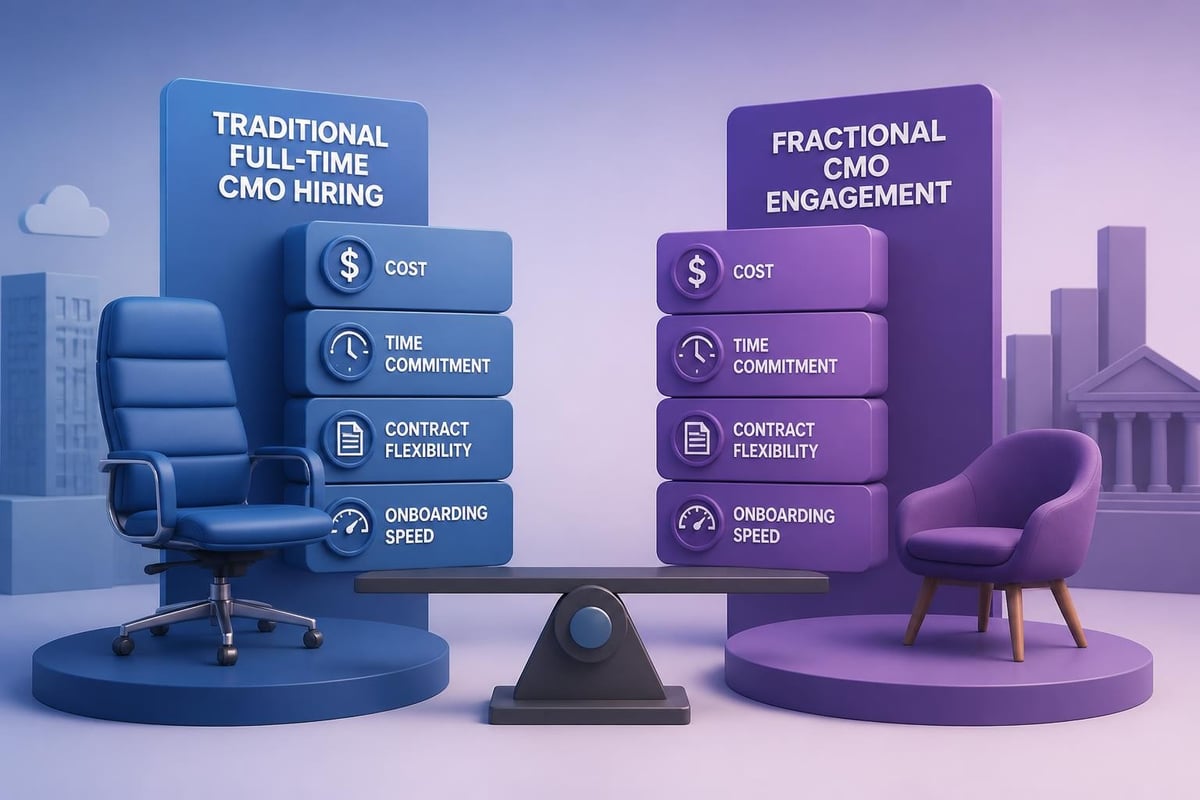
How Fractional Engagement Differs from Traditional Hiring

Traditional CMO positions require substantial investment beyond salary. Companies must consider equity compensation, benefits, office resources, and the risk of a poor cultural fit. A fractional CMO for hire eliminates many of these concerns through flexible engagement structures.

Key differences include:

  • Engagement duration: Contracts typically range from 3-18 months versus indefinite employment
  • Time commitment: 10-30 hours per week compared to full-time presence
  • Cost structure: Monthly retainer or project fees instead of annual salary packages
  • Onboarding speed: Experienced fractional executives can deliver value within weeks
  • Risk mitigation: Easier to adjust or terminate arrangements based on performance
Fractional CMO engagement model comparison

Strategic Advantages for Specialized Businesses

For companies operating in niche markets like presentation design for financial and tech sectors, a fractional CMO for hire brings particular advantages. These executives understand how to position specialized services, identify ideal customer profiles, and create messaging that resonates with sophisticated buyers.

Industry-Specific Marketing Expertise

When your business serves clients who themselves require expert positioning-such as tech startups preparing pitch deck presentations or financial firms developing investor communications-your marketing must demonstrate exceptional strategic thinking. A fractional CMO with experience in B2B professional services can craft narratives that speak directly to these audiences.

This expertise extends to understanding buyer psychology in high-consideration purchases. Decision-makers selecting presentation design partners evaluate not just portfolio quality but strategic alignment, communication capabilities, and industry knowledge. Marketing leadership that comprehends these evaluation criteria can significantly improve conversion rates.

Marketing Challenge Fractional CMO Solution Business Impact
Undefined target audience Buyer persona development and segmentation 35-50% improvement in lead quality
Inconsistent brand messaging Strategic narrative framework and voice guidelines Enhanced brand recognition and recall
Limited content strategy Editorial calendar aligned with buyer journey 2-3x increase in qualified inbound leads
Disconnected marketing activities Integrated campaign planning and execution 25-40% improvement in marketing ROI

Building Marketing Infrastructure

Many specialized agencies operate with strong delivery capabilities but weak marketing foundations. A fractional CMO for hire establishes the systems, processes, and frameworks necessary for sustainable growth. This includes implementing marketing technology stacks, creating content workflows, and developing measurement frameworks.

For presentation design businesses, this might involve:

  • Developing case study templates that showcase transformation from initial concepts to final deliverables
  • Creating content series that demonstrate expertise in visual storytelling and data visualization
  • Implementing CRM systems that track prospects through extended sales cycles
  • Establishing thought leadership platforms that position the firm as industry authorities

These foundational elements continue delivering value long after the fractional engagement concludes, representing infrastructure investment rather than operating expense.

Identifying When Your Business Needs Fractional Leadership

The decision to bring a fractional CMO for hire into your organization should align with specific business conditions and growth objectives. Not every company at every stage requires this level of marketing expertise, but certain indicators suggest strong potential value.

Growth Inflection Points

Companies experiencing rapid growth often outpace their marketing capabilities. When your sales pipeline depends increasingly on sophisticated positioning or when you're expanding into new market segments, executive marketing guidance becomes critical. Similarly, businesses preparing for funding rounds, acquisitions, or major partnership announcements benefit from strategic communication planning.

For agencies serving financial and tech clients, growth often coincides with increasing competition. As markets mature, differentiation becomes more nuanced, requiring sophisticated messaging that extends beyond portfolio showcases. Understanding how to position complex services in crowded markets demands strategic marketing leadership.

Resource Constraints and Scaling Challenges

Mid-sized businesses frequently encounter a peculiar challenge: they've grown beyond founder-led marketing but haven't reached the scale justifying a full-time CMO. Revenue might range from $2-20 million, with marketing handled by a small team lacking senior strategic direction.

In these scenarios, a fractional CMO for hire provides the missing leadership layer. They can:

  1. Assess current marketing effectiveness and identify optimization opportunities
  2. Develop comprehensive marketing strategies aligned with business objectives
  3. Mentor existing team members and build their strategic capabilities
  4. Make or oversee hiring decisions for specialized marketing roles
  5. Establish accountability structures and performance measurement systems

This guidance transforms marketing from a cost center into a strategic growth engine, often delivering measurable improvements within the first quarter of engagement.

Marketing leadership gap analysis

Cost Considerations and ROI Analysis

Understanding the financial implications of hiring a fractional CMO for hire requires examining both direct costs and potential returns. While pricing varies based on experience, industry specialization, and engagement scope, the economics generally favor fractional arrangements for companies below certain revenue thresholds.

Investment Structure

According to recent industry data, fractional CMO engagements typically cost between $5,000 and $15,000 monthly, depending on scope and seniority. This represents 60-80% savings compared to full-time CMO compensation, which averages $200,000-$350,000 annually before benefits and equity.

For specialized agencies, this cost structure aligns well with project-based revenue models. Monthly retainer costs can often be recovered through a single additional client engagement, making the ROI calculation straightforward. The key lies in selecting a fractional executive with demonstrated experience driving measurable business outcomes.

Measuring Marketing Leadership Impact

Effective fractional CMOs establish clear success metrics from engagement inception. For presentation design businesses, relevant KPIs might include:

  • Pipeline velocity: Time from initial contact to signed contract
  • Deal size: Average project value and upsell percentage
  • Lead quality: Percentage of inbound leads matching ideal client profile
  • Content performance: Engagement rates on thought leadership content
  • Market positioning: Share of voice in target segments
  • Client acquisition cost: Total marketing spend divided by new clients

Beyond quantitative metrics, qualitative improvements in brand perception, team confidence, and strategic clarity contribute significantly to long-term value. Many businesses report that the frameworks and processes established during fractional engagements continue generating returns for years.

Selecting the Right Fractional Marketing Executive

The effectiveness of a fractional CMO for hire depends heavily on finding the right strategic fit. This extends beyond credentials and experience to include communication style, industry knowledge, and alignment with company culture and values.

Essential Qualifications and Experience

When evaluating candidates, prioritize those with demonstrated success in similar business contexts. For companies serving financial and tech sectors, look for fractional CMOs who understand:

  • Complex B2B sales cycles: Experience with high-consideration, relationship-driven sales
  • Technical product marketing: Ability to translate sophisticated offerings into compelling value propositions
  • Account-based marketing: Strategies for targeting specific high-value prospects
  • Content-driven growth: Building authority through thought leadership and educational content

Request specific case studies showing how candidates have driven growth for comparable businesses. The benefits of hiring a fractional CMO multiply significantly when their background aligns closely with your market challenges.

Vetting Process and Trial Engagements

Many successful fractional relationships begin with limited-scope pilot projects. This approach allows both parties to assess compatibility before committing to longer-term arrangements. Consider structuring initial engagements around specific deliverables:

  1. Marketing audit: Comprehensive assessment of current activities, channels, and effectiveness
  2. Strategic roadmap: 12-18 month marketing plan with prioritized initiatives and resource requirements
  3. Campaign execution: End-to-end management of a specific marketing program
  4. Team development: Skills assessment and training for existing marketing personnel

These focused projects provide concrete evidence of the executive's working style, strategic thinking, and ability to drive results within your specific context. They also allow your team to adapt to external leadership without disrupting ongoing operations.

Digital marketing expertise has become increasingly important for fractional CMOs, particularly in understanding how integrated campaigns across social media, search, and content platforms drive business results. Partnerships with specialized agencies like Social Zense can extend the fractional CMO's capabilities in areas like paid social and search advertising, creating comprehensive digital strategies without requiring full-time specialists on your internal team.

Fractional CMO evaluation framework

Integration with Existing Teams and Operations

Successfully incorporating a fractional CMO for hire requires thoughtful integration with existing operations. Unlike full-time executives who can rely on daily presence to build relationships and influence culture, fractional leaders must establish credibility and effectiveness within limited time allocations.

Establishing Authority and Communication Rhythms

Clear reporting structures and communication protocols prevent confusion about decision-making authority. Most effective arrangements position the fractional CMO with direct access to the CEO or ownership team, creating the executive-level perspective necessary for strategic alignment.

Regular touchpoints maintain momentum between in-person or video sessions:

  • Weekly status updates: Brief written reports on progress, decisions needed, and upcoming priorities
  • Bi-weekly strategy sessions: Deeper discussions about campaign performance, market changes, and strategic adjustments
  • Monthly executive reviews: Formal presentations to leadership on marketing performance and future recommendations
  • Quarterly planning meetings: Comprehensive strategy refinement based on results and evolving business objectives

For businesses managing complex projects like presentation design engagements, this communication cadence ensures marketing activities support delivery teams without creating bottlenecks or misalignment.

Leveraging External Networks and Resources

Experienced fractional CMOs bring extensive professional networks that can accelerate specific initiatives. This might include connections to:

  • Specialized agencies for capabilities like SEO, paid advertising, or creative production
  • Technology vendors offering favorable pricing or implementation support
  • Industry influencers and media contacts for thought leadership placement
  • Freelance specialists for short-term project needs

These relationships often deliver value exceeding the direct cost of fractional services. Rather than your team researching vendors, negotiating contracts, and managing onboarding, the fractional CMO leverages pre-existing relationships to deploy resources quickly and effectively.

Fractional Leadership Across Different Growth Stages

The role and focus of a fractional CMO for hire evolves based on organizational maturity. Understanding how fractional marketing leadership adapts to different growth phases helps set appropriate expectations and structure engagements effectively.

Early-Stage Companies and Market Entry

For newer businesses or those entering new markets, fractional CMOs focus heavily on foundational strategy. This includes defining target audiences, establishing brand positioning, and creating initial go-to-market frameworks. The emphasis is less on campaign optimization and more on strategic direction setting.

Companies at this stage often lack the internal resources to execute sophisticated marketing programs. The fractional CMO might spend significant time on vendor selection, agency management, and building basic marketing infrastructure. For presentation design firms expanding from one sector to another-such as adding financial services to an existing tech client base-this strategic guidance proves invaluable.

Scaling Organizations and Team Building

As companies grow, the fractional CMO's role shifts toward team development and organizational capability building. This includes hiring and mentoring marketing personnel, establishing departmental processes, and creating scalable systems that reduce dependency on any single individual.

At this stage, the fractional executive often serves as interim leadership while the company prepares for a full-time CMO hire. They can define the role requirements, participate in candidate evaluation, and facilitate knowledge transfer to ensure continuity when transitioning to permanent leadership.

Established Businesses and Transformation Initiatives

Mature companies sometimes engage fractional CMOs for specific transformation projects: rebranding, digital transformation, market repositioning, or entering new segments. These engagements demand deep strategic expertise and change management capabilities.

For established presentation design agencies, this might involve repositioning from a production service to a strategic consulting partner, requiring fundamental shifts in messaging, pricing, and client engagement models. The fractional CMO drives this transformation while maintaining business continuity.

Global Perspectives and Cross-Border Considerations

For businesses serving international clients or considering geographic expansion, a fractional CMO for hire with global experience offers distinct advantages. Marketing strategies that succeed domestically often require significant adaptation for international markets, particularly in regulated industries like financial services.

Navigating Cultural and Regulatory Differences

Tech and financial sectors operate under varying regulations across jurisdictions, affecting everything from data privacy to advertising claims. A fractional CMO experienced in global markets helps navigate these complexities while maintaining brand consistency.

This expertise proves particularly valuable when creating presentations for international audiences, where visual conventions, color symbolism, and communication styles vary significantly. Understanding these nuances ensures marketing materials and sales collateral resonate appropriately across cultures.

Companies expanding internationally also face operational complexities around team management, payroll, and compliance. While marketing leadership focuses primarily on commercial strategy, integrating with partners like Agile for global employment solutions ensures marketing expansion plans align with practical operational capabilities across different countries.

Tax and Financial Planning for Marketing Investments

Marketing budgets represent significant financial commitments, and optimizing these investments requires coordination with financial planning. For U.S.-based businesses, understanding how marketing expenses affect tax liability and cash flow management becomes increasingly important as budgets scale.

Working with specialized tax planning services helps businesses structure marketing investments for optimal financial outcomes, ensuring that aggressive growth initiatives align with overall financial health and tax efficiency strategies.

Technology and Tools in Modern Marketing Leadership

Contemporary fractional CMOs for hire leverage sophisticated marketing technology to deliver insights and execution that would have required large teams historically. Understanding the technology landscape and how to deploy tools strategically represents a core competency for effective marketing leadership.

Marketing Technology Stack Development

The average marketing department now uses 15-20 different software platforms for various functions. A fractional CMO evaluates your specific needs and builds an appropriate technology stack without over-investing in unnecessary tools.

Essential categories include:

Technology Category Primary Function Typical Investment
CRM Platform Contact management and sales pipeline tracking $1,200-$3,600 annually
Marketing Automation Email campaigns, lead nurturing, and scoring $2,400-$12,000 annually
Analytics Suite Website traffic, conversion tracking, and attribution $0-$4,800 annually
Content Management Website hosting, blog publishing, and page optimization $600-$3,600 annually
Design Tools Graphics, presentations, and visual content creation $600-$2,400 annually

For presentation design businesses, the technology stack might emphasize tools supporting visual content creation, portfolio showcase capabilities, and project collaboration platforms that demonstrate working processes to potential clients.

Data-Driven Decision Making

Effective fractional CMOs distinguish themselves through rigorous analytics and measurement. Rather than relying on intuition or industry conventions, they establish data collection frameworks that inform strategic decisions and demonstrate marketing ROI to stakeholders.

This analytical approach proves particularly valuable when optimizing high-value B2B sales processes. By tracking detailed metrics around content engagement, proposal success rates, and customer acquisition costs by channel, fractional marketing leadership identifies the specific activities driving business outcomes.

Content Strategy for Thought Leadership

For specialized professional services like presentation design, content marketing serves dual purposes: attracting prospects and demonstrating expertise. A fractional CMO for hire develops content strategies that accomplish both objectives while supporting sales conversations and client education.

Creating Strategic Content Frameworks

Effective content strategies begin with understanding buyer questions throughout their decision journey. For businesses selling to financial and tech companies, this might include:

  • Awareness stage: Educational content about visual communication effectiveness, data storytelling principles, and presentation design trends
  • Consideration stage: Case studies, methodology explanations, and comparison frameworks for evaluating design partners
  • Decision stage: Process documentation, client testimonials, and specific capability demonstrations

By mapping content to buyer stages and creating editorial calendars that consistently address key topics, fractional CMOs ensure marketing activities support sales objectives rather than existing as disconnected initiatives.

Guidance on topics like PowerPoint layout design or slide deck organization positions the business as an authority while providing genuine value to potential clients researching best practices.

Distribution and Amplification Strategies

Creating excellent content represents only half the challenge. Distribution determines whether that content reaches target audiences and influences buying decisions. Fractional CMOs develop multi-channel distribution plans that maximize content ROI.

Effective distribution strategies might include:

  1. Email nurture sequences: Automated series delivering relevant content based on prospect characteristics and behaviors
  2. Social media scheduling: Platform-specific content adaptation and consistent posting calendars
  3. Industry publication outreach: Guest posting and contributed articles in relevant trade publications
  4. Search optimization: Technical and content optimization to capture high-intent search traffic
  5. Partnership distribution: Co-marketing arrangements with complementary service providers

These approaches work synergistically, with owned channels (email, blog) supporting earned placements (guest posts, media coverage) and paid distribution (sponsored content, advertising) filling gaps in organic reach.


Engaging a fractional CMO for hire provides specialized businesses access to executive-level marketing expertise without the financial commitment of full-time employment, delivering strategic guidance during critical growth phases while building sustainable marketing capabilities. Whether you're refining your positioning in competitive markets, expanding into new segments, or establishing foundational marketing infrastructure, fractional leadership offers flexibility and expertise aligned with business objectives. When your marketing needs to demonstrate the same level of strategic thinking and visual excellence that your Prznt Perfect presentations deliver to clients, expert guidance transforms your market presence from operational necessity to competitive advantage.

We offer free 30-min consultation on the presentation design audit
and hiring the right visual 
comms professional, let’s talk!
Shedule a call
Shedule a call
"I understand" goes a step further into the cognitive dance of persuasion. It's where the audience begins to see the connections between the facts, to grasp the nuances of the problem and the elegance of the solution.
  • This is some text inside of a div block.
    lay out the facts clearly and compellingly. Use data to establish the ground reality, but remember that facts alone are like the individual strands of a tapestry—necessary but not complete.
    lay out the facts clearly and compellingly. Use data to establish the ground reality, but remember that facts alone are like the individual strands of a tapestry—necessary but not complete.
  • This is some text inside of a div block.
    lay out the facts clearly and compellingly. Use data to establish the ground reality, but remember that facts alone are like the individual strands of a tapestry—necessary but not complete.

We offer free 30-min consultation on the presentation design audit

and hiring the right visual 
comms professional, let’s talk!

Shedule a call

"I understand" goes a step further into the cognitive dance of persuasion. It's where the audience begins to see the connections between the facts, to grasp the nuances of the problem and the elegance of the solution.

  • - 1 -
    Consistency at Scale:

    Biotech Market Trends 2024: Tailoring Your Pitch Deck to Current Industry Dynamics.

  • - 2 -
    Efficiency and Speed:

    The traditional process of manually updating presentations is not only slow but also prone to bottlenecks, especially when dealing with large volumes of slides. Automation dramatically accelerates this process, enabling designers to apply changes across hundreds of slides in the time it would take to manually update a single one. This efficiency is a game-changer for agencies working under tight deadlines or managing multiple projects simultaneously.

  • - 3 -
    Enhanced Creativity:

    With the burden of manual updates lifted, designers can allocate more time and energy to the creative aspects of presentation design. This freedom allows for deeper exploration of innovative design concepts, experimentation with new visual storytelling techniques, and the development of more engaging and interactive presentations. Automation doesn't stifle creativity; it amplifies it, enabling designers to push the boundaries of what's possible in corporate presentation design.

  • - 4 -
    Error Reduction:

    Manual updates are inherently prone to inconsistencies and mistakes, from misaligned logos to incorrect font sizes. These errors can detract from the professionalism of a presentation and, by extension, the corporate image. Automation minimizes these risks by ensuring that updates are applied uniformly and accurately across all slides, enhancing the overall quality and integrity of the presentation.

  • - 5 -
    Cost-Effectiveness:

    The time savings afforded by automation directly translate to cost savings for both the design agency and its clients. By reducing the hours spent on manual updates, agencies can optimize their workflows and resources, allowing them to take on more projects without compromising on quality. This efficiency can also make high-quality presentation design services more affordable and accessible to a broader range of businesses.

Fractional CMO for Hire: Strategic Marketing Leadership

Discover how hiring a fractional CMO provides expert marketing leadership for your business without full-time costs. Strategic guidance when you need it.

The marketing landscape for financial and tech businesses has fundamentally shifted. Companies need sophisticated marketing strategies to differentiate themselves in crowded markets, yet many organizations cannot justify the expense of a full-time chief marketing officer. This is where the concept of a fractional CMO for hire emerges as a transformative solution, providing executive-level marketing expertise on a flexible, part-time basis. For businesses focused on complex services like presentation design, strategic marketing leadership becomes essential to communicate value propositions effectively and capture high-value clients in competitive sectors.

Understanding the Fractional CMO Model

A fractional CMO for hire operates as a senior marketing executive who works with your organization on a part-time or project basis, delivering the same strategic expertise as a full-time CMO but at a fraction of the cost. This arrangement allows businesses to access C-suite marketing talent without the financial commitment of a six-figure salary, benefits package, and long-term employment contract.

The fractional CMO model has gained significant traction among growing companies, particularly in specialized sectors where marketing sophistication directly impacts revenue. These executives typically manage multiple clients simultaneously, bringing cross-industry insights and proven frameworks to each engagement.

How Fractional Engagement Differs from Traditional Hiring

Traditional CMO positions require substantial investment beyond salary. Companies must consider equity compensation, benefits, office resources, and the risk of a poor cultural fit. A fractional CMO for hire eliminates many of these concerns through flexible engagement structures.

Key differences include:

  • Engagement duration: Contracts typically range from 3-18 months versus indefinite employment
  • Time commitment: 10-30 hours per week compared to full-time presence
  • Cost structure: Monthly retainer or project fees instead of annual salary packages
  • Onboarding speed: Experienced fractional executives can deliver value within weeks
  • Risk mitigation: Easier to adjust or terminate arrangements based on performance
Fractional CMO engagement model comparison

Strategic Advantages for Specialized Businesses

For companies operating in niche markets like presentation design for financial and tech sectors, a fractional CMO for hire brings particular advantages. These executives understand how to position specialized services, identify ideal customer profiles, and create messaging that resonates with sophisticated buyers.

Industry-Specific Marketing Expertise

When your business serves clients who themselves require expert positioning-such as tech startups preparing pitch deck presentations or financial firms developing investor communications-your marketing must demonstrate exceptional strategic thinking. A fractional CMO with experience in B2B professional services can craft narratives that speak directly to these audiences.

This expertise extends to understanding buyer psychology in high-consideration purchases. Decision-makers selecting presentation design partners evaluate not just portfolio quality but strategic alignment, communication capabilities, and industry knowledge. Marketing leadership that comprehends these evaluation criteria can significantly improve conversion rates.

Marketing Challenge Fractional CMO Solution Business Impact
Undefined target audience Buyer persona development and segmentation 35-50% improvement in lead quality
Inconsistent brand messaging Strategic narrative framework and voice guidelines Enhanced brand recognition and recall
Limited content strategy Editorial calendar aligned with buyer journey 2-3x increase in qualified inbound leads
Disconnected marketing activities Integrated campaign planning and execution 25-40% improvement in marketing ROI

Building Marketing Infrastructure

Many specialized agencies operate with strong delivery capabilities but weak marketing foundations. A fractional CMO for hire establishes the systems, processes, and frameworks necessary for sustainable growth. This includes implementing marketing technology stacks, creating content workflows, and developing measurement frameworks.

For presentation design businesses, this might involve:

  • Developing case study templates that showcase transformation from initial concepts to final deliverables
  • Creating content series that demonstrate expertise in visual storytelling and data visualization
  • Implementing CRM systems that track prospects through extended sales cycles
  • Establishing thought leadership platforms that position the firm as industry authorities

These foundational elements continue delivering value long after the fractional engagement concludes, representing infrastructure investment rather than operating expense.

Identifying When Your Business Needs Fractional Leadership

The decision to bring a fractional CMO for hire into your organization should align with specific business conditions and growth objectives. Not every company at every stage requires this level of marketing expertise, but certain indicators suggest strong potential value.

Growth Inflection Points

Companies experiencing rapid growth often outpace their marketing capabilities. When your sales pipeline depends increasingly on sophisticated positioning or when you're expanding into new market segments, executive marketing guidance becomes critical. Similarly, businesses preparing for funding rounds, acquisitions, or major partnership announcements benefit from strategic communication planning.

For agencies serving financial and tech clients, growth often coincides with increasing competition. As markets mature, differentiation becomes more nuanced, requiring sophisticated messaging that extends beyond portfolio showcases. Understanding how to position complex services in crowded markets demands strategic marketing leadership.

Resource Constraints and Scaling Challenges

Mid-sized businesses frequently encounter a peculiar challenge: they've grown beyond founder-led marketing but haven't reached the scale justifying a full-time CMO. Revenue might range from $2-20 million, with marketing handled by a small team lacking senior strategic direction.

In these scenarios, a fractional CMO for hire provides the missing leadership layer. They can:

  1. Assess current marketing effectiveness and identify optimization opportunities
  2. Develop comprehensive marketing strategies aligned with business objectives
  3. Mentor existing team members and build their strategic capabilities
  4. Make or oversee hiring decisions for specialized marketing roles
  5. Establish accountability structures and performance measurement systems

This guidance transforms marketing from a cost center into a strategic growth engine, often delivering measurable improvements within the first quarter of engagement.

Marketing leadership gap analysis

Cost Considerations and ROI Analysis

Understanding the financial implications of hiring a fractional CMO for hire requires examining both direct costs and potential returns. While pricing varies based on experience, industry specialization, and engagement scope, the economics generally favor fractional arrangements for companies below certain revenue thresholds.

Investment Structure

According to recent industry data, fractional CMO engagements typically cost between $5,000 and $15,000 monthly, depending on scope and seniority. This represents 60-80% savings compared to full-time CMO compensation, which averages $200,000-$350,000 annually before benefits and equity.

For specialized agencies, this cost structure aligns well with project-based revenue models. Monthly retainer costs can often be recovered through a single additional client engagement, making the ROI calculation straightforward. The key lies in selecting a fractional executive with demonstrated experience driving measurable business outcomes.

Measuring Marketing Leadership Impact

Effective fractional CMOs establish clear success metrics from engagement inception. For presentation design businesses, relevant KPIs might include:

  • Pipeline velocity: Time from initial contact to signed contract
  • Deal size: Average project value and upsell percentage
  • Lead quality: Percentage of inbound leads matching ideal client profile
  • Content performance: Engagement rates on thought leadership content
  • Market positioning: Share of voice in target segments
  • Client acquisition cost: Total marketing spend divided by new clients

Beyond quantitative metrics, qualitative improvements in brand perception, team confidence, and strategic clarity contribute significantly to long-term value. Many businesses report that the frameworks and processes established during fractional engagements continue generating returns for years.

Selecting the Right Fractional Marketing Executive

The effectiveness of a fractional CMO for hire depends heavily on finding the right strategic fit. This extends beyond credentials and experience to include communication style, industry knowledge, and alignment with company culture and values.

Essential Qualifications and Experience

When evaluating candidates, prioritize those with demonstrated success in similar business contexts. For companies serving financial and tech sectors, look for fractional CMOs who understand:

  • Complex B2B sales cycles: Experience with high-consideration, relationship-driven sales
  • Technical product marketing: Ability to translate sophisticated offerings into compelling value propositions
  • Account-based marketing: Strategies for targeting specific high-value prospects
  • Content-driven growth: Building authority through thought leadership and educational content

Request specific case studies showing how candidates have driven growth for comparable businesses. The benefits of hiring a fractional CMO multiply significantly when their background aligns closely with your market challenges.

Vetting Process and Trial Engagements

Many successful fractional relationships begin with limited-scope pilot projects. This approach allows both parties to assess compatibility before committing to longer-term arrangements. Consider structuring initial engagements around specific deliverables:

  1. Marketing audit: Comprehensive assessment of current activities, channels, and effectiveness
  2. Strategic roadmap: 12-18 month marketing plan with prioritized initiatives and resource requirements
  3. Campaign execution: End-to-end management of a specific marketing program
  4. Team development: Skills assessment and training for existing marketing personnel

These focused projects provide concrete evidence of the executive's working style, strategic thinking, and ability to drive results within your specific context. They also allow your team to adapt to external leadership without disrupting ongoing operations.

Digital marketing expertise has become increasingly important for fractional CMOs, particularly in understanding how integrated campaigns across social media, search, and content platforms drive business results. Partnerships with specialized agencies like Social Zense can extend the fractional CMO's capabilities in areas like paid social and search advertising, creating comprehensive digital strategies without requiring full-time specialists on your internal team.

Fractional CMO evaluation framework

Integration with Existing Teams and Operations

Successfully incorporating a fractional CMO for hire requires thoughtful integration with existing operations. Unlike full-time executives who can rely on daily presence to build relationships and influence culture, fractional leaders must establish credibility and effectiveness within limited time allocations.

Establishing Authority and Communication Rhythms

Clear reporting structures and communication protocols prevent confusion about decision-making authority. Most effective arrangements position the fractional CMO with direct access to the CEO or ownership team, creating the executive-level perspective necessary for strategic alignment.

Regular touchpoints maintain momentum between in-person or video sessions:

  • Weekly status updates: Brief written reports on progress, decisions needed, and upcoming priorities
  • Bi-weekly strategy sessions: Deeper discussions about campaign performance, market changes, and strategic adjustments
  • Monthly executive reviews: Formal presentations to leadership on marketing performance and future recommendations
  • Quarterly planning meetings: Comprehensive strategy refinement based on results and evolving business objectives

For businesses managing complex projects like presentation design engagements, this communication cadence ensures marketing activities support delivery teams without creating bottlenecks or misalignment.

Leveraging External Networks and Resources

Experienced fractional CMOs bring extensive professional networks that can accelerate specific initiatives. This might include connections to:

  • Specialized agencies for capabilities like SEO, paid advertising, or creative production
  • Technology vendors offering favorable pricing or implementation support
  • Industry influencers and media contacts for thought leadership placement
  • Freelance specialists for short-term project needs

These relationships often deliver value exceeding the direct cost of fractional services. Rather than your team researching vendors, negotiating contracts, and managing onboarding, the fractional CMO leverages pre-existing relationships to deploy resources quickly and effectively.

Fractional Leadership Across Different Growth Stages

The role and focus of a fractional CMO for hire evolves based on organizational maturity. Understanding how fractional marketing leadership adapts to different growth phases helps set appropriate expectations and structure engagements effectively.

Early-Stage Companies and Market Entry

For newer businesses or those entering new markets, fractional CMOs focus heavily on foundational strategy. This includes defining target audiences, establishing brand positioning, and creating initial go-to-market frameworks. The emphasis is less on campaign optimization and more on strategic direction setting.

Companies at this stage often lack the internal resources to execute sophisticated marketing programs. The fractional CMO might spend significant time on vendor selection, agency management, and building basic marketing infrastructure. For presentation design firms expanding from one sector to another-such as adding financial services to an existing tech client base-this strategic guidance proves invaluable.

Scaling Organizations and Team Building

As companies grow, the fractional CMO's role shifts toward team development and organizational capability building. This includes hiring and mentoring marketing personnel, establishing departmental processes, and creating scalable systems that reduce dependency on any single individual.

At this stage, the fractional executive often serves as interim leadership while the company prepares for a full-time CMO hire. They can define the role requirements, participate in candidate evaluation, and facilitate knowledge transfer to ensure continuity when transitioning to permanent leadership.

Established Businesses and Transformation Initiatives

Mature companies sometimes engage fractional CMOs for specific transformation projects: rebranding, digital transformation, market repositioning, or entering new segments. These engagements demand deep strategic expertise and change management capabilities.

For established presentation design agencies, this might involve repositioning from a production service to a strategic consulting partner, requiring fundamental shifts in messaging, pricing, and client engagement models. The fractional CMO drives this transformation while maintaining business continuity.

Global Perspectives and Cross-Border Considerations

For businesses serving international clients or considering geographic expansion, a fractional CMO for hire with global experience offers distinct advantages. Marketing strategies that succeed domestically often require significant adaptation for international markets, particularly in regulated industries like financial services.

Navigating Cultural and Regulatory Differences

Tech and financial sectors operate under varying regulations across jurisdictions, affecting everything from data privacy to advertising claims. A fractional CMO experienced in global markets helps navigate these complexities while maintaining brand consistency.

This expertise proves particularly valuable when creating presentations for international audiences, where visual conventions, color symbolism, and communication styles vary significantly. Understanding these nuances ensures marketing materials and sales collateral resonate appropriately across cultures.

Companies expanding internationally also face operational complexities around team management, payroll, and compliance. While marketing leadership focuses primarily on commercial strategy, integrating with partners like Agile for global employment solutions ensures marketing expansion plans align with practical operational capabilities across different countries.

Tax and Financial Planning for Marketing Investments

Marketing budgets represent significant financial commitments, and optimizing these investments requires coordination with financial planning. For U.S.-based businesses, understanding how marketing expenses affect tax liability and cash flow management becomes increasingly important as budgets scale.

Working with specialized tax planning services helps businesses structure marketing investments for optimal financial outcomes, ensuring that aggressive growth initiatives align with overall financial health and tax efficiency strategies.

Technology and Tools in Modern Marketing Leadership

Contemporary fractional CMOs for hire leverage sophisticated marketing technology to deliver insights and execution that would have required large teams historically. Understanding the technology landscape and how to deploy tools strategically represents a core competency for effective marketing leadership.

Marketing Technology Stack Development

The average marketing department now uses 15-20 different software platforms for various functions. A fractional CMO evaluates your specific needs and builds an appropriate technology stack without over-investing in unnecessary tools.

Essential categories include:

Technology Category Primary Function Typical Investment
CRM Platform Contact management and sales pipeline tracking $1,200-$3,600 annually
Marketing Automation Email campaigns, lead nurturing, and scoring $2,400-$12,000 annually
Analytics Suite Website traffic, conversion tracking, and attribution $0-$4,800 annually
Content Management Website hosting, blog publishing, and page optimization $600-$3,600 annually
Design Tools Graphics, presentations, and visual content creation $600-$2,400 annually

For presentation design businesses, the technology stack might emphasize tools supporting visual content creation, portfolio showcase capabilities, and project collaboration platforms that demonstrate working processes to potential clients.

Data-Driven Decision Making

Effective fractional CMOs distinguish themselves through rigorous analytics and measurement. Rather than relying on intuition or industry conventions, they establish data collection frameworks that inform strategic decisions and demonstrate marketing ROI to stakeholders.

This analytical approach proves particularly valuable when optimizing high-value B2B sales processes. By tracking detailed metrics around content engagement, proposal success rates, and customer acquisition costs by channel, fractional marketing leadership identifies the specific activities driving business outcomes.

Content Strategy for Thought Leadership

For specialized professional services like presentation design, content marketing serves dual purposes: attracting prospects and demonstrating expertise. A fractional CMO for hire develops content strategies that accomplish both objectives while supporting sales conversations and client education.

Creating Strategic Content Frameworks

Effective content strategies begin with understanding buyer questions throughout their decision journey. For businesses selling to financial and tech companies, this might include:

  • Awareness stage: Educational content about visual communication effectiveness, data storytelling principles, and presentation design trends
  • Consideration stage: Case studies, methodology explanations, and comparison frameworks for evaluating design partners
  • Decision stage: Process documentation, client testimonials, and specific capability demonstrations

By mapping content to buyer stages and creating editorial calendars that consistently address key topics, fractional CMOs ensure marketing activities support sales objectives rather than existing as disconnected initiatives.

Guidance on topics like PowerPoint layout design or slide deck organization positions the business as an authority while providing genuine value to potential clients researching best practices.

Distribution and Amplification Strategies

Creating excellent content represents only half the challenge. Distribution determines whether that content reaches target audiences and influences buying decisions. Fractional CMOs develop multi-channel distribution plans that maximize content ROI.

Effective distribution strategies might include:

  1. Email nurture sequences: Automated series delivering relevant content based on prospect characteristics and behaviors
  2. Social media scheduling: Platform-specific content adaptation and consistent posting calendars
  3. Industry publication outreach: Guest posting and contributed articles in relevant trade publications
  4. Search optimization: Technical and content optimization to capture high-intent search traffic
  5. Partnership distribution: Co-marketing arrangements with complementary service providers

These approaches work synergistically, with owned channels (email, blog) supporting earned placements (guest posts, media coverage) and paid distribution (sponsored content, advertising) filling gaps in organic reach.


Engaging a fractional CMO for hire provides specialized businesses access to executive-level marketing expertise without the financial commitment of full-time employment, delivering strategic guidance during critical growth phases while building sustainable marketing capabilities. Whether you're refining your positioning in competitive markets, expanding into new segments, or establishing foundational marketing infrastructure, fractional leadership offers flexibility and expertise aligned with business objectives. When your marketing needs to demonstrate the same level of strategic thinking and visual excellence that your Prznt Perfect presentations deliver to clients, expert guidance transforms your market presence from operational necessity to competitive advantage.


News & Updates...

Discover how hiring a fractional CMO delivers expert marketing leadership without full-time costs. Essential guide for financial and tech businesses.

Discover winning biotech pitch deck examples from successful startups. Learn structure, design, and storytelling strategies that secure funding.