Deep Tech Presentation: Design for Complex Innovation

Presenting deep tech innovations requires a fundamentally different approach than traditional technology pitches. Unlike software applications or consumer products, deep tech ventures build on scientific breakthroughs, advanced engineering, and years of research development. When you're explaining quantum computing applications, biotechnology platforms, or advanced materials science to potential investors, clarity becomes your most valuable currency. The challenge lies not just in communicating what your technology does, but in translating scientific complexity into compelling narratives that drive investment decisions and strategic partnerships.

Understanding the Deep Tech Communication Challenge

Deep tech companies operate at the intersection of scientific research and commercial application. These ventures typically require significant capital investment, extended development timelines, and specialized technical expertise. The concept of deep tech encompasses technologies that solve fundamental problems through scientific innovation rather than incremental improvements to existing solutions.

The presentation challenge becomes immediately apparent when founders attempt to condense years of research into accessible formats. Scientific accuracy must coexist with narrative simplicity. Technical precision cannot sacrifice audience engagement. This balance defines successful deep tech presentation design.

The Investor Perspective Gap

Investors evaluating deep tech opportunities bring diverse backgrounds and expertise levels. Some possess deep technical knowledge in specific domains, while others focus primarily on market dynamics and financial metrics. Your deep tech presentation must serve both audiences simultaneously without alienating either group.

Consider these critical audience considerations:

  • Technical validators who scrutinize scientific claims and intellectual property strength
  • Business strategists focused on market size, competitive moats, and revenue models
  • Financial analysts evaluating capital requirements, runway, and return potential
  • Industry experts assessing regulatory pathways and commercialization timelines

Each stakeholder group processes information differently and prioritizes distinct elements of your story. A well-crafted professional PowerPoint addresses these varied needs through layered communication strategies.

Deep tech stakeholder analysis

Structuring Your Deep Tech Presentation for Maximum Impact

The architecture of a deep tech presentation differs significantly from standard startup pitch decks. While traditional pitches might emphasize rapid user growth or viral adoption, your narrative must establish scientific credibility while demonstrating commercial viability.

Opening with the Problem Statement

Begin by framing the fundamental problem your technology addresses. This isn't about market pain points or customer frustrations. Deep tech presentations must articulate scientific or engineering challenges that have resisted previous solution attempts.

Your problem statement should answer:

  1. What fundamental limitation exists in current approaches?
  2. Why have previous attempts failed to solve this problem?
  3. What makes this problem significant enough to warrant deep tech innovation?
  4. How does solving this unlock new possibilities or markets?

The biotech pitch deck insights we've developed demonstrate how effective problem framing sets the stage for technical explanation without overwhelming audiences immediately.

Translating Technical Innovation

The centerpiece of any deep tech presentation is the technology explanation. This section requires exceptional visual design and communication precision. Complex scientific concepts demand clear visual metaphors, progressive disclosure techniques, and careful information hierarchy.

Communication Strategy Application Benefit
Visual Analogies Compare novel processes to familiar systems Accelerates comprehension without sacrificing accuracy
Progressive Complexity Layer technical details across multiple slides Maintains engagement while building understanding
Data Visualization Transform research results into clear graphics Demonstrates proof points credibly
Process Diagrams Map technical workflows step-by-step Shows feasibility and implementation logic

Understanding how to build a clear deep tech pitch deck requires recognizing that visual design isn't decorative but fundamental to communication success. Every visual element should reduce cognitive load while maintaining scientific integrity.

Design Principles for Deep Tech Presentations

Visual design in deep tech presentations serves strategic communication objectives. The aesthetic choices you make either clarify or obscure your message. Given the inherent complexity of the subject matter, design becomes a critical tool for managing audience attention and facilitating understanding.

Hierarchy and Information Flow

Complex technical information requires deliberate visual hierarchy. Your PPT layout design should guide viewers through information in logical sequences, preventing cognitive overload while building toward key insights.

Effective hierarchy strategies include:

  • Sizing and positioning to establish relative importance of elements
  • Color coding to differentiate data types, process stages, or comparison categories
  • White space utilization to create breathing room around complex diagrams
  • Typography variation to signal transitions between concept levels

The goal is never to simplify inappropriately but to sequence complexity so audiences can absorb it progressively. Each slide should represent one complete thought or concept, even when that concept requires sophisticated explanation.

Data Visualization Standards

Deep tech ventures generate substantial research data, experimental results, and performance metrics. How you present this data dramatically impacts credibility and persuasiveness. Poor data visualization raises questions about scientific rigor and attention to detail.

Consider these visualization guidelines:

  1. Choose appropriate chart types for your data relationships (correlation, distribution, comparison, composition)
  2. Eliminate chart junk that doesn't serve analytical understanding
  3. Provide clear context through labels, legends, and explanatory text
  4. Highlight key findings using color, annotation, or callout techniques
  5. Maintain consistent scales when comparing across multiple visualizations
Data visualization comparison

The Technical Moat and Competitive Positioning

Deep tech presentations must establish defensible competitive advantages rooted in scientific achievement. Unlike software companies where network effects or brand might create moats, deep tech ventures rely on intellectual property, technical complexity, and research barriers to entry.

Communicating Intellectual Property Strength

Your presentation should clearly articulate IP position without drowning in patent details. Investors need to understand what you've protected, what remains defensible through trade secrets, and where potential challenges might emerge.

Present IP strategically through:

  • Portfolio overview showing granted patents, pending applications, and protected territories
  • Freedom to operate analysis demonstrating you can commercialize without infringement
  • Competitive IP landscape mapping where your protection sits relative to competitors
  • Trade secret strategy for elements that provide advantage without disclosure

The deep tech pitch deck framework emphasizes aligning technical complexity with investor expectations, ensuring your IP discussion matches audience sophistication levels.

Demonstrating Technical Feasibility

Proof of concept becomes critical in deep tech presentations. Unlike software demos, you're often presenting laboratory results, prototype performance data, or pilot program outcomes. This evidence must be presented clearly and honestly while building confidence in scalability.

Evidence Type Presentation Approach Credibility Factors
Laboratory Results Show methodology, controls, reproducibility Peer review status, publication record
Prototype Performance Compare to theoretical predictions and benchmarks Testing conditions, independent validation
Pilot Programs Demonstrate real-world application success Customer testimonials, partnership letters
Computational Models Explain validation methods and assumptions Model accuracy, comparative analysis

Market Opportunity and Commercialization Path

Even the most brilliant scientific innovation requires viable paths to market. Your deep tech presentation must bridge the gap between laboratory success and commercial deployment. This section often determines whether investors see your venture as research project or investment opportunity.

Addressable Market Analysis

Market sizing for deep tech differs from consumer applications. You're often creating new markets or disrupting established industries through technological substitution. Your analysis needs depth that reflects these dynamics.

Address market opportunity through:

  • Total Addressable Market (TAM) based on fundamental problem scope
  • Serviceable Addressable Market (SAM) filtered by practical application constraints
  • Serviceable Obtainable Market (SOM) representing realistic capture given resources and timeline
  • Market evolution scenarios showing how adoption might accelerate or face resistance

Avoid the trap of presenting enormous TAM figures without credible paths to capture meaningful share. Investors value realistic assessment over optimistic projections when evaluating why some deep tech pitches fail.

Regulatory and Adoption Pathways

Many deep tech innovations face regulatory scrutiny, certification requirements, or industry standard compliance. Your presentation must acknowledge these challenges while demonstrating clear strategies for navigation.

Commercialization timeline

Map your commercialization strategy by addressing:

  1. Regulatory requirements specific to your industry and geography
  2. Timeline assumptions for approval processes based on comparable precedents
  3. Partnership strategies with established players who can accelerate adoption
  4. Pilot customer programs that validate value proposition and inform iteration
  5. Scaling considerations including manufacturing, supply chain, or deployment challenges

The presentation outsourcing services approach recognizes that communicating these complex pathways requires specialized design expertise to maintain clarity without oversimplification.

Team Credentials and Execution Capability

Deep tech ventures succeed or fail based on team capability to execute against ambitious technical and commercial objectives. Your presentation must establish credibility through relevant expertise, track records, and advisory relationships.

Scientific and Technical Leadership

Highlight the depth of scientific expertise on your team. Investors need confidence that you can navigate technical challenges and maintain scientific rigor throughout development.

Showcase team strength through:

  • Academic credentials relevant to core technology domains
  • Publication records demonstrating thought leadership and peer recognition
  • Prior commercialization experience bridging research and business
  • Technical advisory board providing guidance and validation
  • Institutional relationships with research organizations or academic partners

Balance scientific credentials with business acumen. Pure research teams may struggle with commercialization, while purely business-focused leadership might lack technical credibility. The ideal composition demonstrates both scientific excellence and commercial execution capability.

Financial Requirements and Use of Funds

Deep tech ventures typically require substantial capital to reach commercial milestones. Your presentation must justify the investment size while demonstrating efficient capital deployment against measurable objectives.

Capital Strategy and Milestones

Present your funding requirements in the context of value creation milestones. Investors evaluate whether capital efficiency matches industry norms and whether proposed milestones genuinely reduce risk.

Structure your financial ask around:

  • Current stage completion showing what existing capital has achieved
  • Next milestone targets with specific technical and commercial objectives
  • Capital allocation across research, development, regulatory, and market preparation
  • Timeline to next inflection point when subsequent funding might be available at higher valuations
  • Risk reduction strategy showing how each milestone addresses specific uncertainty

The essential slides for deep tech startup pitch decks typically include detailed financial projections that account for extended development timelines and capital intensity characteristic of the sector.

Funding Stage Typical Objectives Capital Efficiency Metrics
Seed Proof of concept, initial IP Cost per patent, prototype development cost
Series A Product validation, regulatory progress Pilot customer acquisition cost, regulatory milestone achievement
Series B Market entry, scaling preparation Customer acquisition cost, unit economics improvement
Growth Market expansion, production scaling Revenue per employee, gross margin improvement

Presentation Delivery and Stakeholder Engagement

Creating an exceptional deep tech presentation is only half the challenge. Delivery technique, stakeholder engagement, and follow-up strategy determine whether your message drives desired outcomes.

Adapting to Different Forums

Your deep tech presentation will serve multiple contexts: investor meetings, conference presentations, partnership discussions, and grant applications. Each context requires adaptation while maintaining core message consistency.

Customize presentation approach for:

  • One-on-one investor meetings allowing deeper technical discussion and dynamic pacing
  • Pitch competitions requiring tight timing and maximum impact delivery
  • Conference presentations balancing technical depth with broad audience appeal
  • Board meetings focusing on progress against milestones and strategic decisions
  • Partnership discussions emphasizing mutual value creation and integration opportunities

Understanding how company presentations adapt across contexts helps ensure your message remains effective regardless of delivery environment.

Handling Technical Questions

Deep tech presentations inevitably generate detailed technical questions. Your response strategy demonstrates both expertise and communication skill. Prepare for challenging inquiries by anticipating skepticism areas and developing clear, confident responses.

Effective question handling requires:

  1. Acknowledging complexity without defensive posturing
  2. Providing layered answers that satisfy questioner without losing broader audience
  3. Using backup slides with technical depth available but not in main flow
  4. Admitting uncertainties honestly while explaining mitigation approaches
  5. Redirecting to expertise when questions exceed your direct knowledge

Design Resources and Professional Support

Creating effective deep tech presentations demands specialized skills combining scientific communication, visual design, and strategic storytelling. Many technical founders underestimate the expertise required to translate complex innovations into compelling visual narratives.

When to Seek Professional Design Support

While early-stage ventures often create initial presentations internally, there are clear inflection points where professional design becomes critical. Recognize these signals:

  • Approaching significant funding rounds where presentation quality impacts valuation
  • Entering competitive processes where visual differentiation matters
  • Receiving feedback that technical content overwhelms audiences
  • Lacking internal design resources with scientific communication expertise
  • Needing rapid turnaround for high-stakes opportunities

Professional presentation design services bring specialized expertise in visual communication, information architecture, and stakeholder psychology that complements your technical knowledge. The investment in professional design typically generates returns through improved funding outcomes, partnership success, and stakeholder engagement.

Maintaining Brand Consistency

As your deep tech venture matures, presentation materials become part of broader brand ecosystem. Consistent visual language across presentations, white papers, conference materials, and digital properties reinforces professionalism and attention to detail.

Establish brand guidelines covering:

  • Color palette reflecting both scientific precision and commercial accessibility
  • Typography system balancing readability with technical credibility
  • Visual style for diagrams, charts, and technical illustrations
  • Photography approach for team, facility, and product imagery
  • Tone and voice in written content across materials

Consistent branding signals organizational maturity and creates cumulative recognition as stakeholders encounter your materials across contexts.


Mastering the deep tech presentation requires balancing scientific accuracy with narrative clarity, technical depth with accessibility, and research credibility with commercial viability. By applying these principles to your visual communication strategy, you transform complex innovations into compelling stories that drive investment, partnerships, and market success. Whether you're preparing for your first investor meeting or refining materials for growth stage funding, expert presentation design makes the difference between technical achievement and commercial breakthrough. Prznt Perfect specializes in translating complex deep tech innovations into visually stunning presentations that resonate with investors and stakeholders, combining scientific communication expertise with strategic design to help your breakthrough technology achieve the recognition and funding it deserves.

We offer free 30-min consultation on the presentation design audit
and hiring the right visual 
comms professional, let’s talk!
Shedule a call
Shedule a call
"I understand" goes a step further into the cognitive dance of persuasion. It's where the audience begins to see the connections between the facts, to grasp the nuances of the problem and the elegance of the solution.
  • This is some text inside of a div block.
    lay out the facts clearly and compellingly. Use data to establish the ground reality, but remember that facts alone are like the individual strands of a tapestry—necessary but not complete.
    lay out the facts clearly and compellingly. Use data to establish the ground reality, but remember that facts alone are like the individual strands of a tapestry—necessary but not complete.
  • This is some text inside of a div block.
    lay out the facts clearly and compellingly. Use data to establish the ground reality, but remember that facts alone are like the individual strands of a tapestry—necessary but not complete.

We offer free 30-min consultation on the presentation design audit

and hiring the right visual 
comms professional, let’s talk!

Shedule a call

"I understand" goes a step further into the cognitive dance of persuasion. It's where the audience begins to see the connections between the facts, to grasp the nuances of the problem and the elegance of the solution.

  • - 1 -
    Consistency at Scale:

    Biotech Market Trends 2024: Tailoring Your Pitch Deck to Current Industry Dynamics.

  • - 2 -
    Efficiency and Speed:

    The traditional process of manually updating presentations is not only slow but also prone to bottlenecks, especially when dealing with large volumes of slides. Automation dramatically accelerates this process, enabling designers to apply changes across hundreds of slides in the time it would take to manually update a single one. This efficiency is a game-changer for agencies working under tight deadlines or managing multiple projects simultaneously.

  • - 3 -
    Enhanced Creativity:

    With the burden of manual updates lifted, designers can allocate more time and energy to the creative aspects of presentation design. This freedom allows for deeper exploration of innovative design concepts, experimentation with new visual storytelling techniques, and the development of more engaging and interactive presentations. Automation doesn't stifle creativity; it amplifies it, enabling designers to push the boundaries of what's possible in corporate presentation design.

  • - 4 -
    Error Reduction:

    Manual updates are inherently prone to inconsistencies and mistakes, from misaligned logos to incorrect font sizes. These errors can detract from the professionalism of a presentation and, by extension, the corporate image. Automation minimizes these risks by ensuring that updates are applied uniformly and accurately across all slides, enhancing the overall quality and integrity of the presentation.

  • - 5 -
    Cost-Effectiveness:

    The time savings afforded by automation directly translate to cost savings for both the design agency and its clients. By reducing the hours spent on manual updates, agencies can optimize their workflows and resources, allowing them to take on more projects without compromising on quality. This efficiency can also make high-quality presentation design services more affordable and accessible to a broader range of businesses.

Deep Tech Presentation: Design for Complex Innovation
Master deep tech presentation design with proven strategies for communicating complex innovations. Expert tips for pitch decks that resonate with investors.

Presenting deep tech innovations requires a fundamentally different approach than traditional technology pitches. Unlike software applications or consumer products, deep tech ventures build on scientific breakthroughs, advanced engineering, and years of research development. When you're explaining quantum computing applications, biotechnology platforms, or advanced materials science to potential investors, clarity becomes your most valuable currency. The challenge lies not just in communicating what your technology does, but in translating scientific complexity into compelling narratives that drive investment decisions and strategic partnerships.

Understanding the Deep Tech Communication Challenge

Deep tech companies operate at the intersection of scientific research and commercial application. These ventures typically require significant capital investment, extended development timelines, and specialized technical expertise. The concept of deep tech encompasses technologies that solve fundamental problems through scientific innovation rather than incremental improvements to existing solutions.

The presentation challenge becomes immediately apparent when founders attempt to condense years of research into accessible formats. Scientific accuracy must coexist with narrative simplicity. Technical precision cannot sacrifice audience engagement. This balance defines successful deep tech presentation design.

The Investor Perspective Gap

Investors evaluating deep tech opportunities bring diverse backgrounds and expertise levels. Some possess deep technical knowledge in specific domains, while others focus primarily on market dynamics and financial metrics. Your deep tech presentation must serve both audiences simultaneously without alienating either group.

Consider these critical audience considerations:

  • Technical validators who scrutinize scientific claims and intellectual property strength
  • Business strategists focused on market size, competitive moats, and revenue models
  • Financial analysts evaluating capital requirements, runway, and return potential
  • Industry experts assessing regulatory pathways and commercialization timelines

Each stakeholder group processes information differently and prioritizes distinct elements of your story. A well-crafted professional PowerPoint addresses these varied needs through layered communication strategies.

Deep tech stakeholder analysis

Structuring Your Deep Tech Presentation for Maximum Impact

The architecture of a deep tech presentation differs significantly from standard startup pitch decks. While traditional pitches might emphasize rapid user growth or viral adoption, your narrative must establish scientific credibility while demonstrating commercial viability.

Opening with the Problem Statement

Begin by framing the fundamental problem your technology addresses. This isn't about market pain points or customer frustrations. Deep tech presentations must articulate scientific or engineering challenges that have resisted previous solution attempts.

Your problem statement should answer:

  1. What fundamental limitation exists in current approaches?
  2. Why have previous attempts failed to solve this problem?
  3. What makes this problem significant enough to warrant deep tech innovation?
  4. How does solving this unlock new possibilities or markets?

The biotech pitch deck insights we've developed demonstrate how effective problem framing sets the stage for technical explanation without overwhelming audiences immediately.

Translating Technical Innovation

The centerpiece of any deep tech presentation is the technology explanation. This section requires exceptional visual design and communication precision. Complex scientific concepts demand clear visual metaphors, progressive disclosure techniques, and careful information hierarchy.

Communication Strategy Application Benefit
Visual Analogies Compare novel processes to familiar systems Accelerates comprehension without sacrificing accuracy
Progressive Complexity Layer technical details across multiple slides Maintains engagement while building understanding
Data Visualization Transform research results into clear graphics Demonstrates proof points credibly
Process Diagrams Map technical workflows step-by-step Shows feasibility and implementation logic

Understanding how to build a clear deep tech pitch deck requires recognizing that visual design isn't decorative but fundamental to communication success. Every visual element should reduce cognitive load while maintaining scientific integrity.

Design Principles for Deep Tech Presentations

Visual design in deep tech presentations serves strategic communication objectives. The aesthetic choices you make either clarify or obscure your message. Given the inherent complexity of the subject matter, design becomes a critical tool for managing audience attention and facilitating understanding.

Hierarchy and Information Flow

Complex technical information requires deliberate visual hierarchy. Your PPT layout design should guide viewers through information in logical sequences, preventing cognitive overload while building toward key insights.

Effective hierarchy strategies include:

  • Sizing and positioning to establish relative importance of elements
  • Color coding to differentiate data types, process stages, or comparison categories
  • White space utilization to create breathing room around complex diagrams
  • Typography variation to signal transitions between concept levels

The goal is never to simplify inappropriately but to sequence complexity so audiences can absorb it progressively. Each slide should represent one complete thought or concept, even when that concept requires sophisticated explanation.

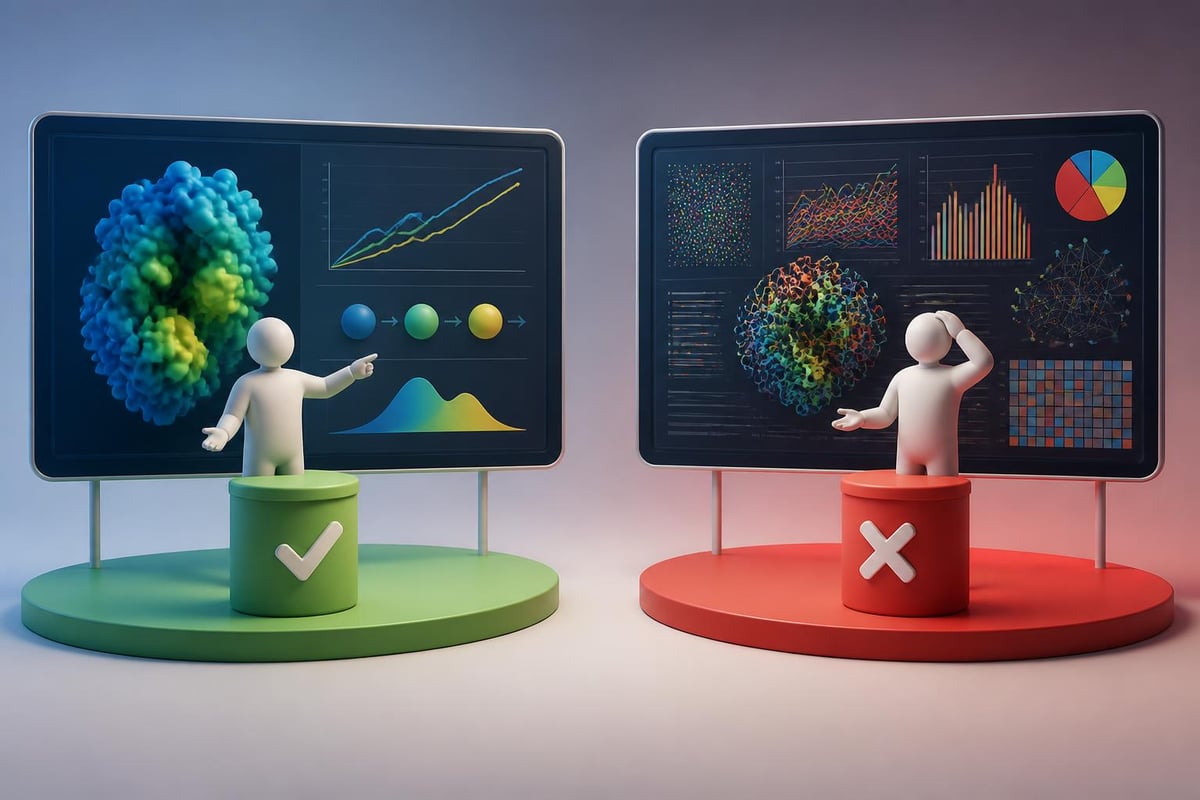
Data Visualization Standards

Deep tech ventures generate substantial research data, experimental results, and performance metrics. How you present this data dramatically impacts credibility and persuasiveness. Poor data visualization raises questions about scientific rigor and attention to detail.

Consider these visualization guidelines:

  1. Choose appropriate chart types for your data relationships (correlation, distribution, comparison, composition)
  2. Eliminate chart junk that doesn't serve analytical understanding
  3. Provide clear context through labels, legends, and explanatory text
  4. Highlight key findings using color, annotation, or callout techniques
  5. Maintain consistent scales when comparing across multiple visualizations
Data visualization comparison

The Technical Moat and Competitive Positioning

Deep tech presentations must establish defensible competitive advantages rooted in scientific achievement. Unlike software companies where network effects or brand might create moats, deep tech ventures rely on intellectual property, technical complexity, and research barriers to entry.

Communicating Intellectual Property Strength

Your presentation should clearly articulate IP position without drowning in patent details. Investors need to understand what you've protected, what remains defensible through trade secrets, and where potential challenges might emerge.

Present IP strategically through:

  • Portfolio overview showing granted patents, pending applications, and protected territories
  • Freedom to operate analysis demonstrating you can commercialize without infringement
  • Competitive IP landscape mapping where your protection sits relative to competitors
  • Trade secret strategy for elements that provide advantage without disclosure

The deep tech pitch deck framework emphasizes aligning technical complexity with investor expectations, ensuring your IP discussion matches audience sophistication levels.

Demonstrating Technical Feasibility

Proof of concept becomes critical in deep tech presentations. Unlike software demos, you're often presenting laboratory results, prototype performance data, or pilot program outcomes. This evidence must be presented clearly and honestly while building confidence in scalability.

Evidence Type Presentation Approach Credibility Factors
Laboratory Results Show methodology, controls, reproducibility Peer review status, publication record
Prototype Performance Compare to theoretical predictions and benchmarks Testing conditions, independent validation
Pilot Programs Demonstrate real-world application success Customer testimonials, partnership letters
Computational Models Explain validation methods and assumptions Model accuracy, comparative analysis

Market Opportunity and Commercialization Path

Even the most brilliant scientific innovation requires viable paths to market. Your deep tech presentation must bridge the gap between laboratory success and commercial deployment. This section often determines whether investors see your venture as research project or investment opportunity.

Addressable Market Analysis

Market sizing for deep tech differs from consumer applications. You're often creating new markets or disrupting established industries through technological substitution. Your analysis needs depth that reflects these dynamics.

Address market opportunity through:

  • Total Addressable Market (TAM) based on fundamental problem scope
  • Serviceable Addressable Market (SAM) filtered by practical application constraints
  • Serviceable Obtainable Market (SOM) representing realistic capture given resources and timeline
  • Market evolution scenarios showing how adoption might accelerate or face resistance

Avoid the trap of presenting enormous TAM figures without credible paths to capture meaningful share. Investors value realistic assessment over optimistic projections when evaluating why some deep tech pitches fail.

Regulatory and Adoption Pathways

Many deep tech innovations face regulatory scrutiny, certification requirements, or industry standard compliance. Your presentation must acknowledge these challenges while demonstrating clear strategies for navigation.

Commercialization timeline

Map your commercialization strategy by addressing:

  1. Regulatory requirements specific to your industry and geography
  2. Timeline assumptions for approval processes based on comparable precedents
  3. Partnership strategies with established players who can accelerate adoption
  4. Pilot customer programs that validate value proposition and inform iteration
  5. Scaling considerations including manufacturing, supply chain, or deployment challenges

The presentation outsourcing services approach recognizes that communicating these complex pathways requires specialized design expertise to maintain clarity without oversimplification.

Team Credentials and Execution Capability

Deep tech ventures succeed or fail based on team capability to execute against ambitious technical and commercial objectives. Your presentation must establish credibility through relevant expertise, track records, and advisory relationships.

Scientific and Technical Leadership

Highlight the depth of scientific expertise on your team. Investors need confidence that you can navigate technical challenges and maintain scientific rigor throughout development.

Showcase team strength through:

  • Academic credentials relevant to core technology domains
  • Publication records demonstrating thought leadership and peer recognition
  • Prior commercialization experience bridging research and business
  • Technical advisory board providing guidance and validation
  • Institutional relationships with research organizations or academic partners

Balance scientific credentials with business acumen. Pure research teams may struggle with commercialization, while purely business-focused leadership might lack technical credibility. The ideal composition demonstrates both scientific excellence and commercial execution capability.

Financial Requirements and Use of Funds

Deep tech ventures typically require substantial capital to reach commercial milestones. Your presentation must justify the investment size while demonstrating efficient capital deployment against measurable objectives.

Capital Strategy and Milestones

Present your funding requirements in the context of value creation milestones. Investors evaluate whether capital efficiency matches industry norms and whether proposed milestones genuinely reduce risk.

Structure your financial ask around:

  • Current stage completion showing what existing capital has achieved
  • Next milestone targets with specific technical and commercial objectives
  • Capital allocation across research, development, regulatory, and market preparation
  • Timeline to next inflection point when subsequent funding might be available at higher valuations
  • Risk reduction strategy showing how each milestone addresses specific uncertainty

The essential slides for deep tech startup pitch decks typically include detailed financial projections that account for extended development timelines and capital intensity characteristic of the sector.

Funding Stage Typical Objectives Capital Efficiency Metrics
Seed Proof of concept, initial IP Cost per patent, prototype development cost
Series A Product validation, regulatory progress Pilot customer acquisition cost, regulatory milestone achievement
Series B Market entry, scaling preparation Customer acquisition cost, unit economics improvement
Growth Market expansion, production scaling Revenue per employee, gross margin improvement

Presentation Delivery and Stakeholder Engagement

Creating an exceptional deep tech presentation is only half the challenge. Delivery technique, stakeholder engagement, and follow-up strategy determine whether your message drives desired outcomes.

Adapting to Different Forums

Your deep tech presentation will serve multiple contexts: investor meetings, conference presentations, partnership discussions, and grant applications. Each context requires adaptation while maintaining core message consistency.

Customize presentation approach for:

  • One-on-one investor meetings allowing deeper technical discussion and dynamic pacing
  • Pitch competitions requiring tight timing and maximum impact delivery
  • Conference presentations balancing technical depth with broad audience appeal
  • Board meetings focusing on progress against milestones and strategic decisions
  • Partnership discussions emphasizing mutual value creation and integration opportunities

Understanding how company presentations adapt across contexts helps ensure your message remains effective regardless of delivery environment.

Handling Technical Questions

Deep tech presentations inevitably generate detailed technical questions. Your response strategy demonstrates both expertise and communication skill. Prepare for challenging inquiries by anticipating skepticism areas and developing clear, confident responses.

Effective question handling requires:

  1. Acknowledging complexity without defensive posturing
  2. Providing layered answers that satisfy questioner without losing broader audience
  3. Using backup slides with technical depth available but not in main flow
  4. Admitting uncertainties honestly while explaining mitigation approaches
  5. Redirecting to expertise when questions exceed your direct knowledge

Design Resources and Professional Support

Creating effective deep tech presentations demands specialized skills combining scientific communication, visual design, and strategic storytelling. Many technical founders underestimate the expertise required to translate complex innovations into compelling visual narratives.

When to Seek Professional Design Support

While early-stage ventures often create initial presentations internally, there are clear inflection points where professional design becomes critical. Recognize these signals:

  • Approaching significant funding rounds where presentation quality impacts valuation
  • Entering competitive processes where visual differentiation matters
  • Receiving feedback that technical content overwhelms audiences
  • Lacking internal design resources with scientific communication expertise
  • Needing rapid turnaround for high-stakes opportunities

Professional presentation design services bring specialized expertise in visual communication, information architecture, and stakeholder psychology that complements your technical knowledge. The investment in professional design typically generates returns through improved funding outcomes, partnership success, and stakeholder engagement.

Maintaining Brand Consistency

As your deep tech venture matures, presentation materials become part of broader brand ecosystem. Consistent visual language across presentations, white papers, conference materials, and digital properties reinforces professionalism and attention to detail.

Establish brand guidelines covering:

  • Color palette reflecting both scientific precision and commercial accessibility
  • Typography system balancing readability with technical credibility
  • Visual style for diagrams, charts, and technical illustrations
  • Photography approach for team, facility, and product imagery
  • Tone and voice in written content across materials

Consistent branding signals organizational maturity and creates cumulative recognition as stakeholders encounter your materials across contexts.


Mastering the deep tech presentation requires balancing scientific accuracy with narrative clarity, technical depth with accessibility, and research credibility with commercial viability. By applying these principles to your visual communication strategy, you transform complex innovations into compelling stories that drive investment, partnerships, and market success. Whether you're preparing for your first investor meeting or refining materials for growth stage funding, expert presentation design makes the difference between technical achievement and commercial breakthrough. Prznt Perfect specializes in translating complex deep tech innovations into visually stunning presentations that resonate with investors and stakeholders, combining scientific communication expertise with strategic design to help your breakthrough technology achieve the recognition and funding it deserves.


News & Updates...

Master technical storytelling to transform complex data into compelling narratives. Learn frameworks, techniques, and best practices for 2026.

Master investment memo design with strategic frameworks, visual hierarchy, and data-driven storytelling that transforms complex analyses into actionable insights.