
Business Plan Slide: Essential Elements for Success

Creating an effective business plan slide requires balancing strategic thinking with visual clarity. Whether you're pitching to investors, seeking bank financing, or presenting to stakeholders, your business plan slides must communicate complex ideas quickly while building confidence in your vision. In financial and tech sectors particularly, where competition for attention and capital is fierce, the quality of your presentation often determines whether your business plan receives serious consideration or gets dismissed within the first few minutes.
Understanding the Purpose of Business Plan Slides
A business plan slide serves as a visual gateway to your company's strategy and potential. Unlike a comprehensive written business plan that may span dozens of pages, presentation slides must distill essential information into digestible, memorable formats.
Defining Your Presentation Objectives
Every successful business plan slide begins with clarity about what you need to accomplish. Are you seeking seed funding, presenting a Series A pitch, or communicating strategic direction to your board? The answer shapes everything from your content selection to your visual hierarchy.
Primary objectives typically include:
- Demonstrating market opportunity and competitive advantage
- Establishing credibility through team credentials and traction
- Presenting clear financial projections and capital requirements
- Articulating your unique value proposition
- Building investor confidence in execution capability
The financial services and technology sectors demand particular attention to data credibility. Investors in these spaces expect rigorous analysis supported by verifiable metrics, making your data visualization presentation approach critical to success.

Essential Slides Every Business Plan Needs
The structure of a business plan presentation follows a proven sequence that guides investors through your narrative logically. While customization matters, certain core slides appear in virtually every successful pitch.
Executive Summary and Problem Statement
Your opening business plan slide sets the tone for everything that follows. This isn't merely an introduction-it's your opportunity to hook attention immediately with a compelling problem statement that resonates with your audience's experience or knowledge.
Strong problem statements quantify the issue with specific metrics. Instead of saying "small businesses struggle with accounting," demonstrate that "47% of small businesses fail due to cash flow mismanagement, representing a $2.3B annual loss." This specificity establishes credibility while creating urgency.
Market Analysis and Opportunity
Investors need confidence that substantial market opportunity exists. Your market analysis business plan slide should present both top-down and bottom-up perspectives, demonstrating you understand total addressable market (TAM), serviceable addressable market (SAM), and serviceable obtainable market (SOM).
| Market Metric | Definition | Purpose |
|---|---|---|
| TAM | Total market demand for a product/service | Shows maximum potential |
| SAM | Portion of TAM targeted by your products | Demonstrates focus |
| SOM | Portion of SAM you can realistically capture | Proves achievable goals |
Tech companies particularly benefit from showing market growth trajectories with compound annual growth rates (CAGR) that illustrate expanding opportunity. Financial services firms should emphasize regulatory changes or demographic shifts creating new market conditions.
Solution and Value Proposition
After establishing the problem and market, your solution business plan slide must clearly articulate how your offering addresses the identified pain points. This slide often determines whether investors lean forward with interest or mentally check out.
Effective solution slides accomplish three goals:
- Demonstrate clear differentiation from existing alternatives
- Explain your approach with sufficient detail to establish feasibility
- Connect features directly to customer benefits and business outcomes
For technical products, balance depth with accessibility. Your audience may include both technical and non-technical decision-makers, so layer information thoughtfully. Consider how professional PowerPoint presentations use progressive disclosure to manage complexity.
Business Model and Revenue Strategy
Understanding how to create a winning business model slide transforms abstract concepts into concrete financial reality. This business plan slide should answer: How do you make money, from whom, and at what margins?
Revenue model clarity matters immensely in financial and tech presentations. Subscription models, transaction fees, licensing arrangements, and hybrid approaches each carry different investor implications regarding scalability, customer lifetime value, and capital efficiency.
Be explicit about:
- Pricing strategy: How you determined pricing and how it compares to alternatives
- Unit economics: Customer acquisition cost (CAC) versus lifetime value (LTV)
- Revenue streams: Primary and secondary income sources
- Monetization timeline: When different revenue streams activate
Design Principles for Effective Business Plan Slides
Creating visually compelling slides requires understanding both aesthetic principles and cognitive psychology. Your business plan slide design either amplifies your message or creates friction that undermines even the strongest content.
Visual Hierarchy and Information Architecture
Professional presentation design establishes clear visual hierarchies that guide viewer attention deliberately. Primary information should dominate through size, position, and contrast, while supporting details provide context without creating clutter.
Consider how fintech and banking presentations must balance regulatory compliance with visual appeal. The fintech presentation design approach often incorporates trust signals like security certifications and regulatory acknowledgments while maintaining modern aesthetics.
Core design principles include:
- Consistent typography with maximum three font weights
- Strategic color use that reinforces brand while maintaining readability
- Generous white space that prevents cognitive overload
- Alignment and proximity that create logical groupings
- Contrast that emphasizes key takeaways
Data Visualization Best Practices
Numbers tell your business story, but raw data rarely persuades. Each business plan slide containing financial projections, market statistics, or operational metrics requires thoughtful visualization that makes trends and relationships immediately apparent.
Charts and graphs should simplify, not complicate. Bar charts excel at comparisons, line graphs show trends over time, and pie charts (used sparingly) can illustrate composition. Avoid 3D effects, excessive colors, or decorative elements that obscure rather than clarify.
For complex financial models, consider progressive reveal techniques. Start with high-level summary metrics, then provide supporting detail on subsequent slides. This approach respects different audience knowledge levels while preventing information overload.

Competitive Analysis and Market Positioning
Your competitive landscape business plan slide demonstrates strategic awareness and realistic market understanding. Investors immediately distrust presentations that claim "no competition"-every solution competes with alternatives, even if that alternative is doing nothing.
Creating Effective Competitive Matrices
Competitive positioning matrices compare your solution against key competitors across dimensions that matter to customers. Select 3-4 differentiating factors that genuinely influence buying decisions, not arbitrary features where you happen to excel.
| Competitor | Feature A | Feature B | Pricing | Market Share |
|---|---|---|---|---|
| Your Company | High | High | Mid | Emerging |
| Competitor 1 | Mid | Low | Low | 23% |
| Competitor 2 | High | Mid | High | 41% |
| Competitor 3 | Low | High | Mid | 18% |
This framework works particularly well for tech companies where feature sets drive differentiation. Financial services firms might instead emphasize regulatory compliance, customer service quality, or risk-adjusted returns.
Articulating Sustainable Competitive Advantages
Beyond current positioning, investors want confidence in sustainable competitive advantages-moats that protect market position as the company scales. Your business plan slide addressing competitive advantages should identify specific barriers to entry or imitation.
Common sustainable advantages include:
- Proprietary technology or intellectual property
- Network effects that increase value with user adoption
- Switching costs that create customer lock-in
- Regulatory licenses or approvals
- Exclusive partnerships or distribution agreements
- Brand equity built through customer trust
Tech startups often overestimate patent protection while underestimating execution speed as a competitive advantage. Financial firms correctly emphasize regulatory compliance and customer trust, which require years to establish.
Financial Projections and Capital Requirements
The financial section of your business plan slide deck carries enormous weight. Numbers must be ambitious enough to demonstrate venture-scale opportunity while remaining credible based on demonstrated traction and realistic assumptions.
Building Credible Financial Models
Your financial projection business plan slide should present three to five year forecasts covering revenue, expenses, profitability, and cash flow. The essential slides for a business plan presentation typically include summary financials with detailed assumptions available in appendix slides.
Start with clearly stated assumptions driving your model. How many customers do you expect to acquire monthly? What's your conversion rate? What does customer acquisition cost? These foundational assumptions allow investors to stress-test your projections against their own market knowledge.
Key financial metrics to present:
- Revenue growth trajectory with drivers clearly identified
- Gross margin trends showing path to profitability
- Operating expense breakdown by major category
- Burn rate and runway calculations
- Key performance indicators specific to your business model
For SaaS companies, monthly recurring revenue (MRR) growth, churn rates, and expansion revenue matter enormously. E-commerce businesses emphasize average order value, customer lifetime value, and inventory turns. Tailor metrics to your specific business model.
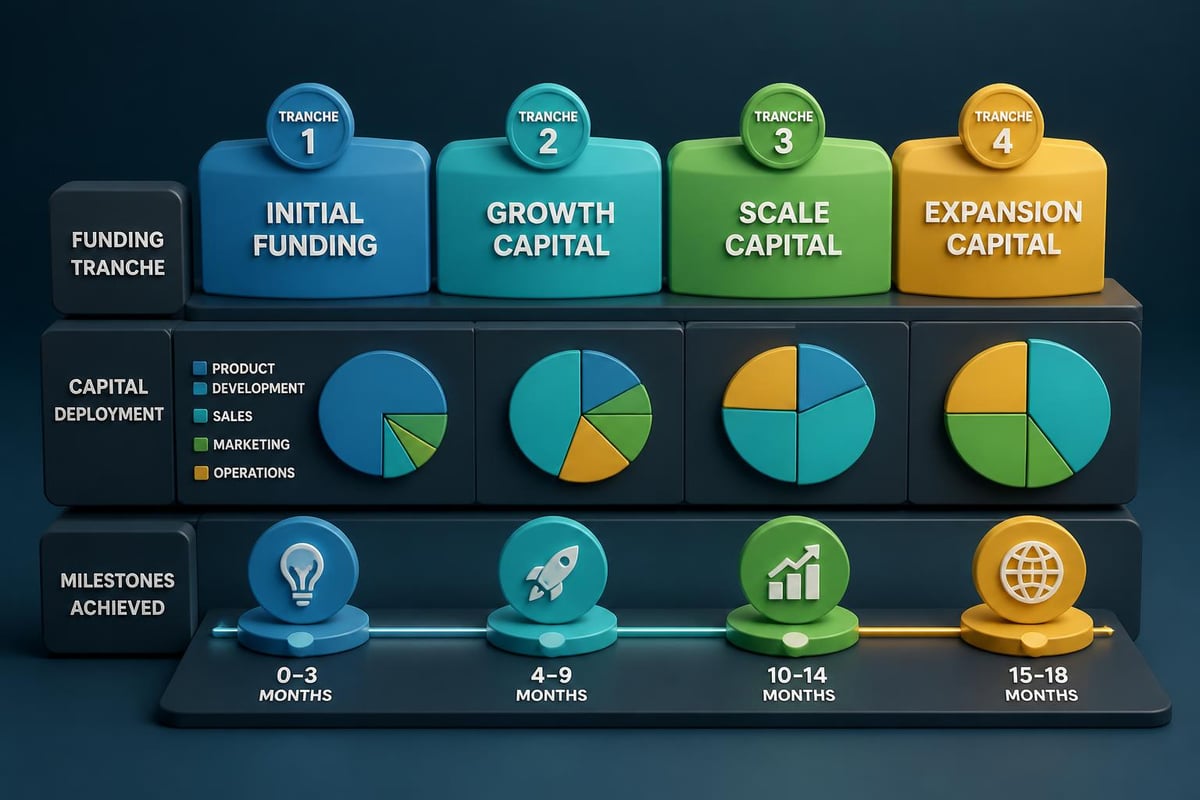
Capital Requirements and Use of Funds
Investors need transparency about how much capital you're raising and precisely how you'll deploy it. Your use of funds business plan slide should break down the raise into major categories with specific allocation percentages.
Typical categories include:
- Product development: Engineering, design, and technical infrastructure (30-40%)
- Sales and marketing: Customer acquisition and brand building (30-40%)
- Operations: General and administrative expenses (15-20%)
- Working capital: Cash reserves for operational flexibility (10-15%)
Be prepared to justify these allocations based on your current stage and growth priorities. Early-stage companies typically allocate more toward product development, while growth-stage firms emphasize sales and marketing to capture market share.
Team and Execution Capability
The team business plan slide often determines investment decisions more than any other single factor. Investors back people as much as ideas, particularly in early stages where pivots are common and execution determines success.
Highlighting Relevant Experience
Present key team members with emphasis on directly relevant experience. If your founding team includes former executives from industry leaders, highlight that credibility. If team members have previous exits or relevant domain expertise, make those accomplishments prominent.
Avoid generic titles and responsibilities. Instead of "CEO with 15 years experience," specify "CEO who scaled previous SaaS company from $0 to $50M ARR, achieving successful acquisition by [acquirer]." Concrete achievements trump vague experience claims.
Addressing Team Gaps Honestly
Most early-stage teams have capability gaps. Acknowledging these gaps while demonstrating plans to address them builds credibility. If you lack a CFO for example, explain your plans to recruit one at a specific fundraising or revenue milestone.
Advisory boards can help fill knowledge gaps, but be honest about advisor engagement levels. Listing impressive names who rarely engage damages credibility more than acknowledging you're building advisory relationships.
Customization for Different Audiences
A single business plan slide deck rarely works for all audiences. Angel investors, venture capitalists, strategic partners, and bank lenders each prioritize different information and bring different evaluation frameworks.
Tailoring Content for Investor Types
Angel investors often emphasize founding team quality and vision more than detailed financial models. They're comfortable with earlier-stage risk and may invest based on founder potential and market timing.
Venture capitalists demand rigorous market analysis, competitive positioning, and financial projections showing path to venture-scale returns. They evaluate dozens of opportunities weekly, so clarity and conciseness matter enormously.
Strategic partners care most about alignment with their business objectives. How does partnership with your company strengthen their market position or capabilities? Frame your business plan slide content around mutual benefit.
Traditional lenders prioritize collateral, cash flow stability, and risk mitigation. Business plan slides for debt financing should emphasize stable revenue streams, asset base, and conservative growth projections rather than aggressive scaling scenarios.
Common Mistakes to Avoid
Even experienced entrepreneurs make preventable errors when creating business plan slides. Understanding these pitfalls helps you avoid them in your own presentations.
Information Overload and Slide Density
The most common error is cramming too much information onto individual slides. If your audience needs to squint to read text or struggles to identify the main point, you've included too much. As a rule, limit each business plan slide to one core concept with 3-5 supporting points maximum.
Signs of information overload include:
- Font sizes below 18pt for body text
- More than six bullet points per slide
- Multiple detailed charts on a single slide
- Paragraphs of text rather than concise phrases
- No white space or visual breathing room
Professional presentation services like those offered by Prznt Perfect excel at distilling complex information into clean, focused slides that communicate clearly without oversimplification.
Unrealistic Projections and Assumptions
Another critical error is presenting financial projections that strain credibility. Hockey stick growth curves without demonstrated traction, market share assumptions that exceed reasonable penetration rates, or cost structures that ignore industry realities all undermine investor confidence.
Ground your projections in comparable company data. If you're projecting 15% monthly user growth, reference similar companies that achieved comparable rates and explain why your metrics will match or exceed those benchmarks. If you're assuming 60% gross margins in a typically 40% margin business, justify that assumption with specific operational advantages.
Neglecting Visual Consistency
Inconsistent fonts, colors, layouts, and graphic treatments create amateur impressions that undermine even strong content. Your business plan slide deck represents your company's attention to detail and professionalism, particularly important when targeting financial and tech investors who expect polish.
Establish and maintain strict design systems including:
- Color palette: Primary, secondary, and accent colors used consistently
- Typography: Specific fonts for headlines, body text, and emphasis
- Layout grids: Consistent alignment and spacing systems
- Icon styles: Unified visual language for graphics and diagrams
- Chart formatting: Standardized colors, labels, and axis treatments
Many founders benefit from professional PowerPoint presentation services that ensure visual consistency while they focus on content and strategy. Digital product studios like CollectDev can help integrate your business plan presentation with broader brand identity and digital presence for cohesive market positioning.
Testing and Iteration
Your first business plan slide draft should never be your final version. Effective presentations emerge through iterative refinement based on feedback and real-world testing.
Gathering Constructive Feedback
Present your business plan slides to trusted advisors, mentors, or colleagues before high-stakes investor meetings. Ask specific questions about clarity, persuasiveness, and gaps in logic or information.
Useful feedback questions include:
- Which slides felt unclear or confusing?
- Where did you lose interest or attention?
- What questions arose that the presentation didn't answer?
- Which claims seemed unsupported or questionable?
- How compelling did you find the overall narrative?
Record practice presentations and review them critically. Notice where you struggle to explain slides clearly or spend excessive time on single points. These friction points indicate slides needing revision.
Tracking Performance Metrics
If possible, track which slides generate questions, where presentations typically stall, and which points resonate most strongly with different investor types. This data-driven approach to iteration helps optimize your business plan slide deck over time.
Successful entrepreneurs often maintain multiple presentation versions optimized for different contexts: 10-slide elevator pitch version, 20-slide comprehensive deck, and detailed appendix slides addressing anticipated technical or financial questions. This flexibility lets you adapt to varying time constraints and audience sophistication levels.
Leveraging Professional Design Resources
Creating exceptional business plan slides requires skills many entrepreneurs lack: graphic design, data visualization, storytelling, and presentation psychology. Recognizing when to engage professional help often separates funded companies from those that struggle to gain traction.
Benefits of Professional Presentation Design
Professional presentation design agencies bring specialized expertise in visual communication, ensuring your business plan slides communicate with maximum impact. They understand how to transform dense financial models into clear visualizations, structure complex technical concepts for non-technical audiences, and create visual hierarchies that guide attention deliberately.
For financial and tech companies where stakes are particularly high, professional design represents strategic investment rather than cosmetic enhancement. The difference between securing funding and facing rejection often comes down to presentation quality as much as business fundamentals.
Agencies specializing in tech and financial presentations understand sector-specific expectations, from the metrics VCs expect in biotech pitch decks to the compliance considerations in financial services presentations. This domain expertise ensures your business plan slides meet industry standards while standing out visually.
Selecting Templates Versus Custom Design
Template-based approaches offer speed and cost advantages for straightforward business plan presentations. Resources like simple business plan slide templates provide solid starting points for companies with limited budgets or time constraints.
However, templates carry limitations. Multiple companies may use identical designs, diluting differentiation. Templates often lack flexibility for unique content requirements or brand integration. For high-stakes presentations where millions of dollars hang in the balance, custom design typically delivers better returns.
Custom presentation design allows complete alignment with brand identity, optimal information architecture for your specific story, and visual differentiation that makes your business plan slide deck memorable in a sea of similar pitches.
Mastering the business plan slide requires balancing strategic content with visual communication excellence, tailoring your approach to specific audiences while maintaining consistency and credibility. Whether you're presenting to angel investors, venture capitalists, strategic partners, or traditional lenders, the quality of your slides often determines whether your business receives the capital and support it needs to succeed. Prznt Perfect specializes in transforming complex business strategies into compelling visual narratives that resonate with financial and tech audiences, helping companies secure funding and communicate vision with clarity and impact.



- This is some text inside of a div block.lay out the facts clearly and compellingly. Use data to establish the ground reality, but remember that facts alone are like the individual strands of a tapestry—necessary but not complete.lay out the facts clearly and compellingly. Use data to establish the ground reality, but remember that facts alone are like the individual strands of a tapestry—necessary but not complete.
- This is some text inside of a div block.lay out the facts clearly and compellingly. Use data to establish the ground reality, but remember that facts alone are like the individual strands of a tapestry—necessary but not complete.

.png)
